

# How Does Slow Internet Affect Carbon Footprint
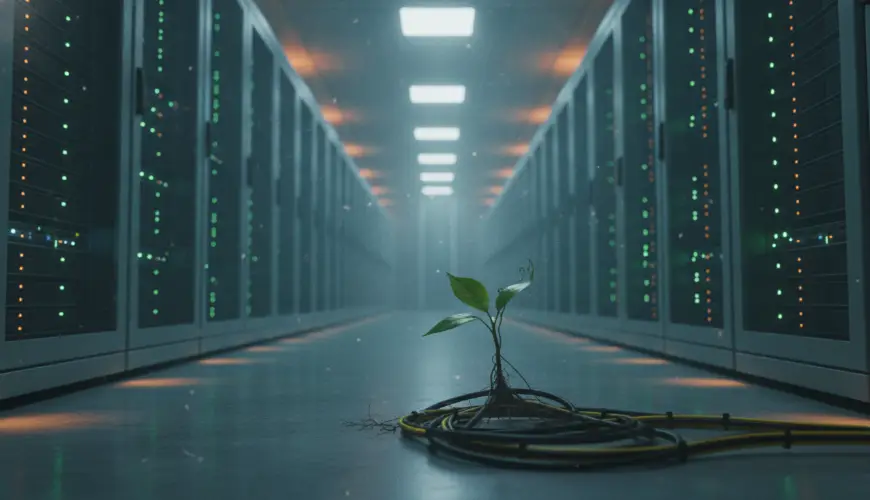
Few people think about what happens the moment they click on a video, open an email attachment, or stream their favourite series. The internet feels intangible – as if it existed only in the ether, without any physical substance and without any environmental consequences. The reality, however, is surprisingly different. Behind every byte of data travelling through the network stands a physical infrastructure that consumes electricity, produces heat, and leaves a measurable carbon footprint. And the speed of the connection – whether we are browsing on slow or fast internet – plays a far greater role in this story than might appear at first glance.
The digital world is no castle in the air. It is made up of data centres full of servers, submarine cables stretching thousands of kilometres along the ocean floor, mobile network base stations, and billions of devices connected to the global network. According to estimates by the International Energy Agency, data centres and transmission networks together consume approximately 1–1.5% of global electricity consumption – and this share grows every year as data volumes increase. When we consider that electricity generation is still largely dependent on fossil fuels, it becomes clear why the topic of data traffic and carbon footprint is so relevant.
Try our natural products






What does internet speed have to do with CO₂ emissions?
At first glance, it might seem that faster internet means more data consumed, and therefore a greater burden on the environment. Yet the reality is paradoxically more complex. Slow connectivity does not automatically mean lower emissions – and in many cases, the opposite may be true.
Let us take a concrete real-life example: Jana lives in a village and has a slow DSL connection with a speed of around 5 Mbit/s. Every evening she watches series on a streaming platform. Because her connection cannot handle smooth playback in high definition, the video constantly buffers, the player repeatedly sends requests to the server, loading drags on, and the entire process requires far more communication between her device and the remote server than would be necessary with a stable, fast connection. The result? Data transmission takes longer, servers are under load for longer, and the overall energy demands of one evening watching a series are paradoxically higher than they would be if Jana had a fast fibre connection that could handle the entire transfer efficiently and without unnecessary repetition.
This phenomenon is not the exception but the rule. Inefficient data transfer – caused by poor connectivity, congested networks, or outdated protocols – generates so-called data waste: unnecessarily repeated requests, failed transfers, and extended response times that place a needless burden on infrastructure. Every failed data transfer means that the energy expended on carrying it was wasted – and the entire process must start again.
Researchers at The Shift Project, a French think tank focused on decarbonising the economy, noted in their reports that the digital sector as a whole produces approximately 3–4% of global greenhouse gas emissions – roughly as much as the aviation industry. Video streaming alone accounts for more than 60% of all internet traffic. The way in which this data is transmitted is therefore far from irrelevant.
The world finds itself at an interesting crossroads. On one hand, there is growing pressure to deploy 5G networks and expand fibre infrastructure, promising higher speeds and more efficient transmission. On the other hand, the volume of streamed content in ever-higher resolutions – 4K, 8K, HDR – immediately absorbs these capacities. The question therefore is not simply whether slow internet is better for the planet, but rather how we make use of the capacity we have available.
An interesting perspective is offered by comparing different types of connections in terms of energy efficiency. Optical fibres are significantly more energy-efficient in the long term than older technologies such as ADSL or mobile data transmitted over 3G networks. Mobile data transmitted over older networks can consume up to twenty times more energy to transfer the same volume of data compared to transmission over a fixed fibre network. This is why the transition to more modern infrastructure is not merely a matter of user comfort, but also of environmental responsibility.
How every user can reduce their digital carbon footprint
Recognising that the internet is not free in terms of emissions opens up space for behavioural change – without needing to abandon the digital world entirely. This is not about dramatic gestures, but about a series of small decisions that together make a measurable difference.
One of the simplest changes is being mindful about the quality of streamed content. Automatic playback of videos at the highest available resolution is today the standard on most platforms, but few people actually need to watch YouTube on their phone in 4K resolution. Reducing the resolution to 1080p or 720p when watching on a smaller screen makes a negligible difference to the visual experience, but significantly reduces the volume of data transferred – and with it the energy demands of the transmission. Platforms such as Netflix or YouTube offer this option in their settings, and making use of it is a matter of a few clicks.
A similar logic applies to how we handle email. The average email with an attachment has a carbon footprint of approximately 50 grams of CO₂ – this seems like a negligible figure, but with tens of billions of emails sent daily around the world, the total quickly becomes astronomical. The habit of sending unnecessary emails along the lines of "thank you" or forwarding large attachments where a link would suffice contributes to data traffic that has no added value.
Another less well-known factor is cloud data storage. Backups, photos, documents – all of this resides on servers that run continuously and consume energy even when no one is accessing them. Regularly deleting unnecessary files from the cloud is therefore not only organisationally beneficial, but also environmentally meaningful. Similarly, streaming music rather than downloading it generates unnecessary data traffic with repeated listening to favourite tracks – a downloaded track played a hundred times burdens the network only once, while a streamed track does so a hundred times.
As Tim Berners-Lee, the inventor of the World Wide Web, aptly put it: "The internet is a reflection of our society and that mirror is going to reflect what we see." And what we are seeing today is, among other things, that we are beginning to realise that the digital world has physical consequences – and that we bear responsibility for them.
There are also more systemic approaches. For example, choosing services and products from companies that have committed to running their data centres on renewable energy is a way of voting with your wallet for a more sustainable internet. Major players such as Google or Microsoft publish regular reports on their progress towards carbon neutrality, and some of their servers do indeed run on wind or solar power. Smaller and medium-sized companies are still catching up in this regard, but consumer pressure is a powerful motivator for change.
Last but not least, the topic of outdated devices is worth mentioning. An old computer or smartphone that operates slowly and inefficiently does not process data as economically as modern hardware designed with energy efficiency in mind. Extending the lifespan of devices by repairing rather than discarding them is environmentally beneficial – but if a device has truly reached the end of its life, replacing it with a more energy-efficient model may reduce overall energy consumption in the long term. This is a delicate balance that needs to be weighed on an individual basis.
The entire topic of digital carbon footprint is still a relatively young area of research and public debate. Organisations such as the Green Web Foundation are working on tools that allow users and companies to find out whether the websites and services they use are powered by green energy. Such tools help translate abstract figures into a concrete, comprehensible form – and enable informed decisions where indifference might otherwise prevail.
Slow internet is therefore not synonymous with ecological internet – and fast internet need not necessarily be an enemy of the climate. The key is efficiency: how data is transmitted, how it is processed, and how it is stored. Every user, company, and service provider has a role to play in this chain. And while changes in individual behaviour may seem like a drop in the ocean, the digital habits of billions of people together shape the nature of the internet – and with it its impact on the planet we share.