

# Slow Cooker Recipes for Women Who Are Always Busy
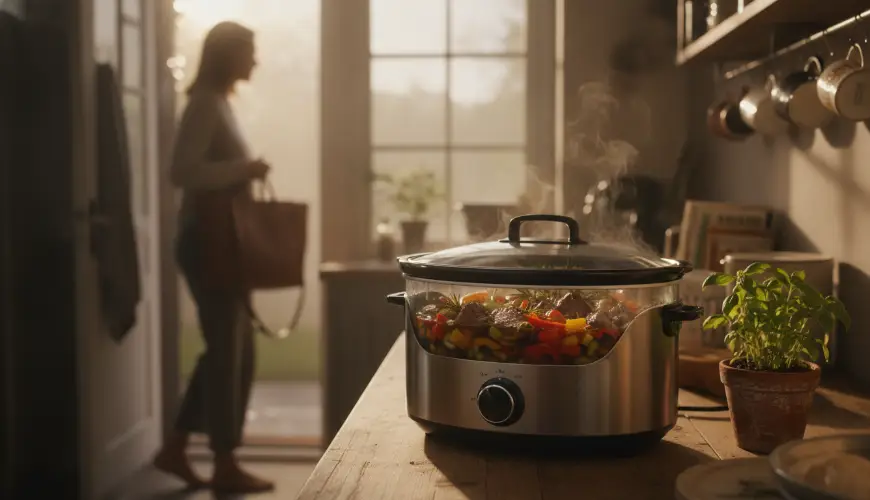
Modern life for a working woman is a bit like juggling too many balls at once. Getting up in the morning, getting the kids ready for school, making it to a meeting, dealing with emails, calling mum, and still cooking something decent for dinner in the evening. It is precisely in moments like these that one of the most underrated helpers in the kitchen comes into its own – the slow cooker. The principle is simple yet brilliant: in the morning you throw the ingredients into the pot, in the evening you come home and dinner is ready. No stress, no standing over the stove, no compromise in the form of a microwave ready meal.
A slow cooker works on the principle of long cooking at a low temperature – usually between 70 and 100 °C – over a period of several hours. This method has its roots deep in history, when food was prepared in clay pots over a slowly dying fire. Today, electric versions with digital timers exist that simplify the whole process even further. The result is food that is incredibly juicy, aromatic and full of flavour – and all without the cook needing to be constantly present at the stove.
Try our natural products




Why a slow cooker is the ideal companion for working women
It is no coincidence that the popularity of slow cookers has grown sharply in recent years. According to market research data, slow cookers are among the most sought-after kitchen appliances, particularly among people aged 25 to 45 who are looking for ways to make everyday cooking easier. And it is no wonder – preparing a meal in a slow cooker typically takes just 10 to 20 minutes in the morning, while the actual cooking takes place throughout the day without any supervision.
Take a real-life example: Jana, an accountant from the Central Bohemian Region and mother of two, admits that before she got a slow cooker, she was dealing with dinner in a rush almost every day. "Either we ordered pizza, or I cooked pasta in twenty minutes, but that stopped being enjoyable after a while. Now I prepare a bean goulash or chicken broth in the morning, set the timer, and in the evening I feel as though my grandmother had done the cooking," she says with a smile. This feeling is familiar to many women who have tried a slow cooker once and can no longer imagine life without one.
Another major advantage is energy savings. A slow cooker consumes significantly less electricity than a conventional oven, because it operates at low power over a longer period. It also retains more nutrients than cooking at high temperatures, which is particularly appreciated by those who care about the nutritional value of their food. Vegetables retain their vitamins better in a slow cooker than when cooked in boiling water, and meat becomes beautifully tender without added fat.
Another benefit that does not get talked about enough is the psychological relief. Knowing that dinner is "cooking itself" reduces everyday stress and allows a working woman to focus on her professional responsibilities without being plagued by guilt that she has once again failed to cook anything proper for the family. As American chef and writer Michael Pollan once remarked: "Cooking is one of the best ways to express care for others – and a slow cooker allows you to offer that care even when you have no time for it."
The practical side of things is surprisingly straightforward. Most slow cooker recipes follow the same basic pattern: chop the ingredients, place them in the pot in the correct order, add liquid, set the temperature and time – and that is it. No complex techniques, no stirring sauces for hours. All it takes is a little planning and the willingness to give it a go.
The best recipes to prepare in the morning and enjoy in the evening
The range of recipes for a slow cooker is surprisingly varied. From hearty meat dishes to vegetarian options, soups and desserts – the possibilities are almost endless. The key to success is choosing ingredients that are suited to long cooking at low temperatures. Fattier cuts of meat (such as pork shoulder, beef cheeks or chicken thighs), pulses, root vegetables and thick sauces all work best.
One of the most popular recipes is beef goulash with red pepper and marjoram. Simply cut the beef into cubes, add onion, garlic, tomato purée, paprika and a little stock. In the morning, put everything in the pot, set the low temperature for 8 hours – and in the evening you will be greeted by a goulash that smells of home cooking and where the meat falls apart under the fork. It can be served with bread dumplings, potatoes or fresh bread.
Another tip is chicken tikka masala, which will surprise you with its simplicity. Skinless chicken thighs, tinned tomatoes, coconut milk, onion, garlic, ginger and a tikka masala spice blend – all of this goes into the pot in the morning, and in the evening you have an exotic dinner worthy of a restaurant. This recipe is also popular because it goes wonderfully with rice or naan bread, and leftovers can easily be reheated the next day for lunch.
For lovers of vegetarian cuisine, red lentils with coconut milk and spinach are an excellent choice. Red lentils do not require pre-soaking and cook beautifully soft in a slow cooker. Simply add coconut milk, tomatoes, turmeric, cumin, garlic and a little chilli. An hour before the end of cooking, throw in a handful of fresh or frozen spinach. The result is a filling, nutritious yet light dish that will satisfy the whole family.
Soups belong in the slow cooker repertoire quite naturally. A hearty minestrone full of vegetables, beans and pasta, or a goulash soup with potatoes and smoked sausage – both options are ideal for cooler autumn and winter evenings. Simply prepare everything in a quarter of an hour in the morning and, when you get home, just season with salt and pepper.
A less well-known but very practical category is porridge and desserts. Oat porridge prepared overnight in the slow cooker on the lowest setting is a morning miracle – you wake up and breakfast is ready. Honey, cinnamon, apples or blueberries can all be added. A chocolate lava cake or rice pudding works in much the same way, delighting the whole family without hours spent in the kitchen.
For slow cooker recipes to really work, it is worth following a few basic rules. The pot should be filled at least halfway, but no more than two-thirds – otherwise the food will not cook evenly. Less liquid is added than you might expect, because vegetables and meat release their own juices during cooking. The lid should not be lifted unnecessarily during cooking, as each opening extends the cooking time by approximately 15 to 20 minutes.
Planning is the key to making a slow cooker genuinely easier in everyday life. Many women prepare their ingredients the evening before – chopping the vegetables, weighing out the spices, preparing the meat – and in the morning simply tip everything into the pot and head off to work. This approach saves both time and energy and ensures there is no unnecessary chaos in the morning. If you are interested in healthy eating tips more generally, the World Health Organization recommends a diet rich in vegetables, pulses and wholegrains – and these are precisely the kinds of dishes that are best prepared in a slow cooker.
It is also important to choose the right slow cooker. Models on the market range in capacity from 1.5 to 7 litres. A smaller model of around 3 litres is sufficient for a single person or couple, while a family of four would be well advised to invest in a 5 or 6-litre pot. Digital models with a programmable timer are more practical, because once the set time has elapsed they automatically switch to a keep-warm mode – meaning the food will not overcook even if you arrive home an hour later than planned.
A slow cooker is also well suited to those who care about sustainable living and minimising food waste. Cheaper and less attractive cuts of meat that would otherwise end up in the bin or go unbought are transformed into a delicious dish in a slow cooker. Similarly, vegetables that are already a little past their best can be used – in a slow cooker they become an excellent sauce or soup. This approach is in keeping with the philosophy of zero waste cooking, which is increasingly coming to the attention of environmentally conscious households.
A slow cooker is not a passing trend or just another kitchen gadget destined to gather dust at the back of a cupboard. It is a practical tool that is changing the everyday reality of thousands of working women – and men – who want to eat well, healthily and without unnecessary stress. All it takes is pausing at the kitchen counter for five minutes in the morning, throwing a few ingredients into the pot and letting time and heat do their work. Then, in the evening, coming home to a fragrant flat where a meal is waiting for you that tastes as though you had spent the entire afternoon at the stove.