

# How to Perfectly Cook Slow Oats (Slow-Cooked Oatmeal) ## What Are Slow Oats? Slow oats are **who
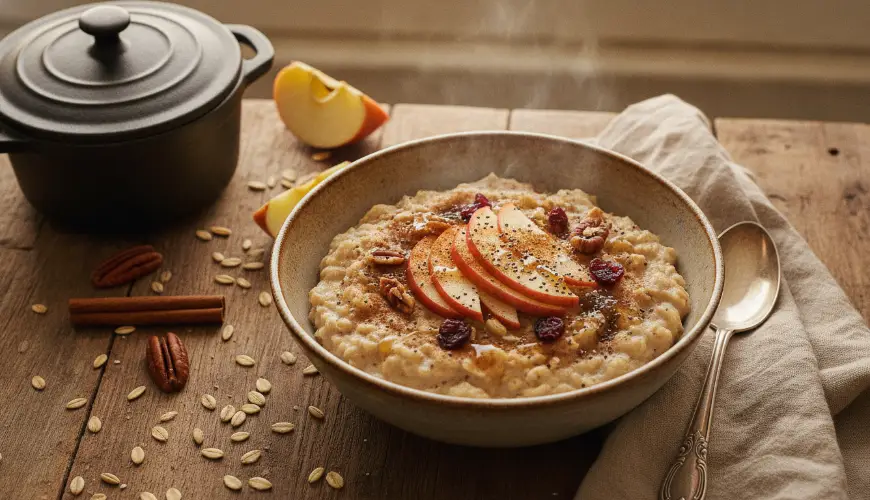
There is something soothing about the whole house smelling of warm, creamy porridge in the morning. It is not just food – it is a ritual, a way to start the day slowly and mindfully, in stark contrast to the rushed world where people replace breakfast with energy bars eaten on the subway. That is precisely why slow oats – slowly cooked porridge – have been gaining increasing popularity in recent years, not only among health enthusiasts but also among those who are simply looking for a nutritious, tasty and affordable breakfast.
Oats are among the oldest and most widespread cereals in the world. Their cultivation dates back thousands of years, and in Europe, oats became established as a food at least as far back as the Bronze Age. Today, porridge is a staple in kitchens from Scotland through Scandinavia to Japan, where each culture has adapted it to its own taste. And yet – or perhaps precisely because of this – it remains, at its core, surprisingly simple.
Try our natural products

What slow oats actually mean and why it matters
The term "slow oats" is used in the modern food world to refer to porridge prepared slowly, typically from whole or coarsely ground oats that are cooked for a longer time over low heat or even overnight in a slow cooker. This is a fundamental difference from instant oats, which are ready in three minutes but whose nutritional value falls far short of the potential that oats as such have to offer.
Whole or coarsely ground oats – referred to in English as "steel-cut oats" or "rolled oats" – retain more fibre, minerals and natural starch structure. This has a practical impact: porridge made from less processed oats is significantly more filling, because the body digests more complex starches more slowly, and the glycaemic index of such a meal is considerably lower than that of the instant version. For those who monitor their blood sugar levels or are trying to maintain energy throughout the morning without needing to snack every hour, the difference is very tangible.
Research repeatedly confirms that regular consumption of porridge is associated with a lower risk of cardiovascular disease, better digestive function and stable blood sugar levels. According to information from the Harvard T.H. Chan School of Public Health, beta-glucan – the soluble fibre found in oats – is one of the most extensively researched dietary components in relation to lowering LDL cholesterol levels. This is not a marketing slogan; it is solidly grounded science.
But science alone cannot make porridge taste good. So let us look at how to actually cook slow oats so that the result is worth the effort.
How to cook porridge with complete confidence
Preparing slowly cooked porridge is not complicated, but it hides a few small tricks that matter more than one might expect. Consider Markéta, a working mother of two from Brno, who decided to switch from instant oats to "the real thing". Her first two attempts ended with porridge that was either too watery or stuck to the bottom of the pan. The third attempt – with a new technique and the correct ratio of ingredients – was exactly what she was looking for: thick, creamy, fragrant porridge that the children ate without complaint.
The basic rule that saved Markéta is simple: the ratio of oats to liquid. For coarsely ground oats (steel-cut oats), the ratio is approximately 1 part oats to 3 parts liquid. For classic wholegrain rolled oats, which are the most widely available in the Czech Republic, a ratio of 1:2 to 1:2.5 is sufficient, depending on the desired thickness. The liquid can be water, milk, a plant-based drink or a combination thereof – each option gives the porridge a different character.
The process itself is then a matter of patience. The oats are placed directly into cold milk or water, brought to the boil and then left to simmer on the lowest possible heat with occasional stirring. For coarsely ground oats, cooking takes twenty to thirty minutes; for classic rolled oats, five to ten minutes. The key is not to stop stirring in the final stage of cooking – this is when the porridge most easily sticks to the bottom of the pan.
An alternative that has been winning the hearts of busy people around the world is overnight preparation. In the evening, the oats are covered with liquid in a 1:3 ratio, a pinch of salt and optionally a little cinnamon are added, and the whole pan is placed in the oven at the lowest temperature (around 80–90 °C) or in an electric slow cooker. In the morning, the porridge is ready, warm and perfectly consistent. This method of preparation is particularly popular in Scotland and Ireland, where porridge has a literally centuries-old tradition.
Salt is another point around which passionate debates are held. The Scots claim that porridge without salt is not porridge but a sticky mush. And they are right in that a small amount of salt – ideally added at the beginning of cooking – significantly deepens the flavour and reduces any potential bitterness of the oats. It is not about making the porridge taste salty, but about making it taste like itself.
Once the base is ready, an endless space opens up for adding further ingredients. This is where slow oats truly become a creative endeavour. Fresh or stewed fruit, nuts, seeds, spices such as cardamom or nutmeg, honey, maple syrup, tahini, peanut butter – everyone can put together their own version. It is important to add most toppings after cooking, so that they retain their texture and nutritional value. An exception is dried fruit such as raisins or dates, which can be added during the last few minutes of cooking – they will absorb the liquid and give the porridge a natural sweetness.
Nutritional advisors recommend one of the best combinations for an autumn morning as the pairing of porridge with sliced apple, cinnamon and a teaspoon of chia seeds added after cooking. The apple can either be added raw on top, or briefly stewed separately with a little water and cinnamon. The result is a breakfast that fills you up, warms you through and needs no added sugar.
A special mention also goes to the so-called "savoury" version of porridge – that is, the savoury variant, which is entirely common in Asia but still something of a curiosity in the Czech Republic. The cooked porridge is seasoned with soy sauce, a boiled egg is added along with chives and a drop of sesame oil. The result surprises anyone who thinks that porridge must necessarily be sweet. It is proof of just how versatile a food oats truly are.
One thing that is often forgotten when preparing slow oats is the quality of the oats themselves. Wholegrain, minimally processed oats without added sugar or flavourings are the foundation of good porridge. When shopping, it is worth looking for organic certification and the shortest possible list of ingredients – ideally just "oats". Organically grown oats also contain no pesticide residues, which is a significant factor for a food consumed every morning.
As British writer and food lover Nigel Slater said: "Good food doesn't have to be complicated. It has to be cooked with care." This captures the essence of slow oats perfectly – it is not about technique or sophisticated ingredients, but about intentionality and the attention paid to what one puts into one's body as the very first thing in the morning.
It is interesting how porridge has returned to the forefront of interest in recent years, also thanks to the slow food movement and the general trend of mindful consumption. People are increasingly thinking about where their food comes from, how it has been processed and what the time spent in the kitchen does to it. Porridge is in this respect a perfect symbol – it is food that cannot be rushed without the result showing it.
For those who want to start and do not know where to source quality ingredients, it is worth exploring the range offered by shops focused on health foods and organic produce. Choosing the right oats, and possibly supplementary ingredients such as chia seeds, flaxseeds or various types of nuts, can be the first step towards making the morning porridge a true ritual that you look forward to – rather than just an obligatory breakfast that you quickly swallow before heading out to work.
Slow oats are not a trend that will pass. They are a return to something that people have eaten for centuries, and which, in an age of maximum speed and minimum attention, takes on an entirely new meaning. Cooking yourself a proper bowl of porridge in the morning is a small but meaningful act of self-care – and that is something for which one can always find the time.