

# How circular economy at home saves
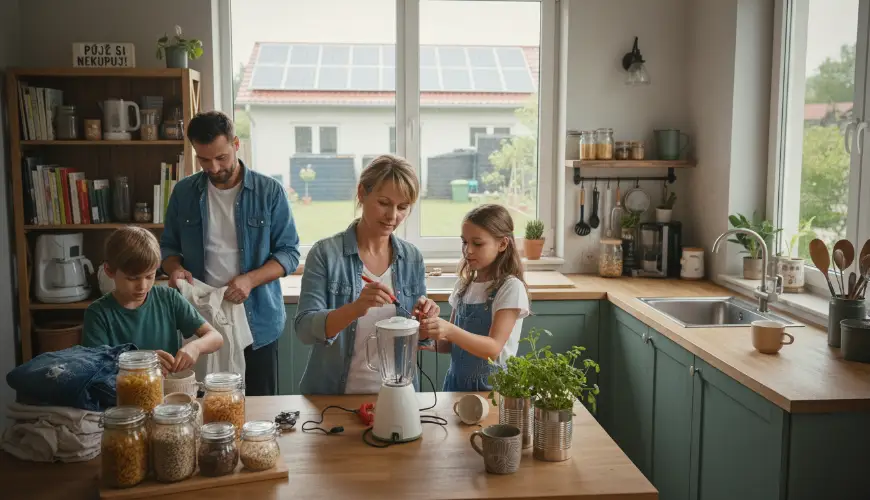
The word "circular" is everywhere today – in the media, in political speeches, in marketing campaigns of large companies. But what does it actually mean when this concept moves from conference halls directly into the kitchen, bedroom, or cellar of an ordinary Czech household? And most importantly – is it something that truly anyone can manage, or is it a privilege of those who have enough time, money, and idealism?
The answer is surprisingly simple. Circular economy in the household is not some radical philosophy or an expensive lifestyle. It is more of a way of thinking that changes how a person buys, uses, and disposes of things. Instead of the linear pattern of "produce – use – discard," a circle takes over: things are repaired, shared, returned to manufacturers, or transformed into raw materials for new products. And this is where it gets interesting – because this transition begins literally right outside your own front door.
Try our natural products



Why the linear model stopped working
For decades, the world operated on a simple principle: cheap production, cheap purchasing, quick disposal. This model was convenient, but its cost is gradually proving to be enormous. According to a report by the European Environment Agency, European households produce hundreds of millions of tonnes of waste every year, with a large portion consisting of things that could have been repaired, reused, or recycled. The consumption of natural resources continues to grow, even though the planet is unable to replenish their supplies.
Yet these numbers are abstract for most people. A much more relatable example comes from everyday life: Markéta from Brno buys a new blender once every year or two because the old one stopped working. She throws it in the general waste and buys a new one. Yet it would have been enough to replace one bearing or repair a faulty cable – the entire repair would have taken an hour and cost a few dozen crowns. But because a new blender costs thirteen hundred and the repair seems complicated, the logic of the winner in this contest is clear. The problem is that millions of households across Europe repeat this approach every year.
This is precisely where the idea of circularity comes into play. It is not about everyone starting to melt plastic themselves or weave clothing from recycled fibres. It is about changing the fundamental approach to consumption – and that is something that can be put into practice starting today.
How circular economy works at home – concretely and without compromise
One of the most direct ways to introduce circular principles into the household is to reconsider one's relationship with things even before purchasing them. Do I really need a new product, or is it enough to repair the old one? This question, seemingly trivial, can dramatically change both the family budget and the ecological footprint of a household.
In practice, this looks like reaching for a patch instead of buying new clothing, or visiting a local tailor. Instead of throwing away broken electronics, trying a repair at a so-called repair café – a place where volunteers help with repairs for free or for a nominal fee. The network of such places in the Czech Republic is growing, and an overview can be found, for example, on the Re-use.cz website. Similarly, tool libraries operate on the same principle, where you can borrow a drill, a tent, or a kitchen robot instead of buying one – saving not only money but also storage space in the cellar.
Another key element of the circular approach is conscious purchasing. Choosing products made from recycled or natural materials that can be decomposed or returned to the production cycle at the end of their lifespan is a concrete step with a measurable impact. This is not just about paper or plastic – this principle also applies to clothing, furniture, cosmetics, and cleaning products. For example, bamboo kitchen utensils, natural soaps in paper packaging, or solid shampoos without plastic packaging are accessible solutions that fit precisely into circular thinking.
It is also crucial what happens to things after they have served their purpose. Circular economy works with so-called loops – biological and technical. The biological loop includes everything that can be composted: kitchen waste, paper, natural textiles. The technical loop includes materials that are returned to production – metals, glass, plastics. A home composter or community composting within an apartment building is one of the simplest ways to enter the biological loop without much effort.
As economist and pioneer of circular thinking Walter Stahel summarised it: "The longer products remain in circulation, the less energy and resources we need to maintain our standard of living." This idea is decades old, yet it is only now finding mass application.
A sustainable household is not a utopia
One of the biggest obstacles to people adopting circular principles is the belief that these are complicated, expensive, or time-consuming changes. The reality, however, is different. Transitioning to a more circular way of life does not require a radical change all at once – on the contrary, the most effective approach involves small, gradual steps that gradually become habits.
Take the area of food, for example. Planning purchases, proper food storage, and using leftovers are basic circular practices that also save money. According to data from the United Nations Food and Agriculture Organization (FAO), approximately one third of all food produced in the world ends up as waste. In the household, this specifically means that the average Czech family throws away food worth hundreds of crowns every week. Yet it is enough to think slightly differently about purchasing and food preparation – and this loss can decrease significantly.
It is similarly straightforward with textiles. Fast fashion – that is, quick, cheap, and low-quality clothing – is one of the world's greatest polluters. Buying less but higher-quality clothing, taking care of it, and passing it on are exactly the steps that the circular economy supports. Second-hand shops, clothing exchange platforms, and textile repair shops have been experiencing a genuine boom in recent years – and it is no coincidence. People are beginning to understand that clothing that has been worn still has value.
In the area of household chemicals and cleaning products, the situation is similar. Concentrated cleaning products in refill cartridges, natural alternatives such as vinegar, baking soda, or citric acid, or products in recyclable or returnable packaging – these are concrete alternatives that reduce the amount of plastic waste while being gentler on both the wallet and the environment.
An interesting phenomenon is also the so-called Product as a Service model, where the manufacturer retains ownership of the product and the customer essentially leases it. In practice, this means the manufacturer has a direct interest in ensuring the product lasts as long as possible and is easily disassembled and recyclable at the end of its life. This model is beginning to establish itself in areas such as electronics, furniture, and even tyres – and it is entering households, for example, through appliance rental services or subscription models.
Energy is also an important part of the circular approach. Saving energy in the household – whether through better insulation, smart thermostats, or switching to renewable energy sources – contributes to reducing overall resource consumption. Solar panels on the roof of a family home or community energy schemes are examples of how even in the area of energy, it is possible to move from a linear model (I buy energy, I consume it) to a more circular one (I produce energy, what I don't need I return to the grid or share with neighbours).
Circular shopping as an everyday decision
Perhaps the most powerful tool available to every household is the decision about where and how it shops. Choosing products from manufacturers who transparently communicate the origin of materials, the product's lifespan, and the possibilities for its recycling or return is a direct way to support the circular economy by voting with one's wallet. Every purchase is essentially a small decision about what kind of world we want to have.
Online shops focused on sustainable living, such as Ferwer, offer products that take these principles into account – from eco-friendly household chemicals to sustainable fashion and everyday items produced with the entire lifecycle in mind. This is not a luxury for the privileged few, but an accessible alternative to conventional consumption.
The circular economy in the household is not a distant vision or a fashionable trend that will fade within a year. It is a practical response to a real problem – and a response that makes economic, ecological, and personal sense. The more households begin to think of things as resources rather than waste, the closer we are to a world where the linear model of "produce – use – discard" finally gives way to something smarter and more sustainable. And this shift begins literally with what we put in our basket tomorrow morning – whether in a shop or online.