

You can prepare piri piri chicken at home so that it is juicy, fragrant, and just to your taste.
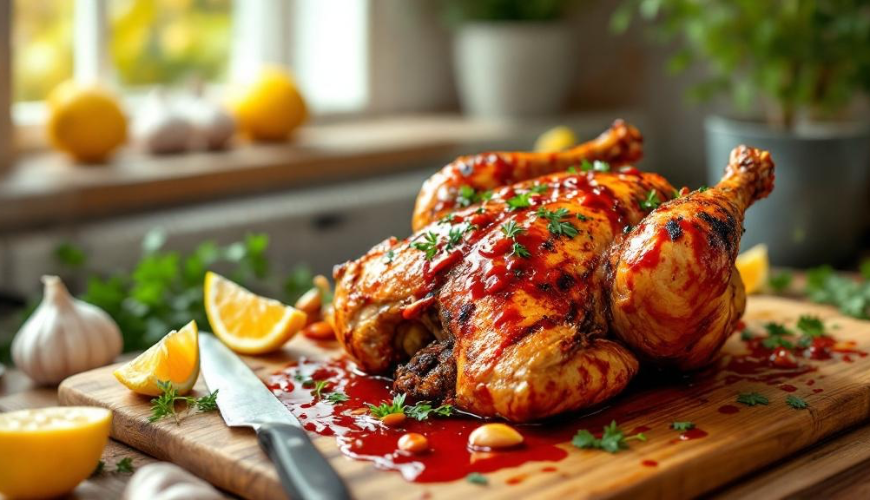
When you hear piri piri chicken, most people imagine juicy meat, crispy skin, and a spicy sauce that warms but doesn't overpower the taste. It's not just another "spicy chicken" in the collection - piri piri has its tradition and character, which is why it has become a hit that can be prepared at home without complicated equipment. Moreover, it makes for an excellent lunch or dinner that can be tailored to family preferences: from a mildly spicy version to a truly fiery one, where yogurt becomes the safety ring.
Piri piri (often spelled peri peri) is historically associated with Portuguese cuisine and its influence in Southern Africa. It typically includes chili, garlic, acid (lemon or vinegar), herbs, and quality oil. The result is simple yet surprisingly layered - it burns, smells, and is fresh at the same time. And the best part: once you learn a good piri sauce and marinade for roasted chicken, you have a universal trump card for weekend baking and quick weekday dinners.
Why Piri Piri Chicken is So Popular (and How Not to Mess It Up at Home)
The magic of piri piri lies in contrast. Chili brings energy and warmth, lemon adds juice and lightness, garlic with paprika adds aroma and depth. When combined with chicken that is roasted to golden brown, it creates a dish that feels "restaurant-quality" but is actually an easy recipe if a few principles are followed.
The first principle is not to underestimate time. Piri piri is not just a sauce poured over finished meat. It's also a recipe for piri piri chicken, where part of the mixture is used as a marinade and part as a final seasoning. The second principle is to work with temperature and moisture: the chicken should be roasted so that it's juicy but also has a skin that crunches. It helps to dry the chicken well before roasting and to lightly baste it during cooking, not "bathe" it in sauce from start to finish.
The third principle is perhaps surprisingly: spiciness is not the only goal. A good piri sauce is balanced. If you overdo it with chili and forget the acidic component or salt, you'll end up with an aggressive spicy paste. But when balanced, the spiciness tastes "clean" and pleasant. In this respect, it's good to stick to proven principles described by respected sources on safe food handling and poultry cooking temperatures – for example, the USDA recommendation for achieving a safe internal temperature of chicken (165°F) here: https://www.fsis.usda.gov/food-safety/safe-food-handling-and-preparation/poultry
And one more detail that decides the outcome: not all chili peppers are the same. Sometimes two small ones are enough, and sometimes one larger is needed. The spiciness varies piece by piece, so it's better to taste and add gradually. After all, as is often said: "You can always add spiciness, but you can't take it away."
Piri Sauce and Marinade for Roasted Chicken: A Basic Staple Worth Having on Hand
When talking about piri piri, people often imagine one universal "red sauce." In reality, there are many variations, and a homemade version can be milder so that even children or guests who aren't big on spicy foods can handle it. The important thing is for the sauce to be not just spicy but also aromatic and fresh.
The great thing is that piri sauce can work two ways: part is used as a marinade for roasted chicken, and the rest is saved for drizzling after baking or as a dip for potatoes or vegetables. And since Ferwer focuses on a healthier lifestyle and a more considerate household, it makes sense to think about practicality: the sauce can be prepared in a jar, stored in the fridge, and used gradually over a few days without unnecessary waste.
Homemade Piri Sauce (Balanced, Easily Adjustable)
This version is designed to be made from common ingredients and still taste "like piri piri." The amount of chili is indicative – it's worth adjusting to taste.
The basic principle is simple: chili + garlic + paprika (or smoked paprika) + lemon + oil + salt. Everything is blended and allowed to sit briefly. If there's no blender, everything can be finely chopped and mixed, it just won't be as smooth.
If the sauce should be milder, adding more roasted peppers or a bit of honey helps. If it should be sharper, add more chili or a pinch of chili flakes. If freshness is lacking, add lemon juice or zest. If the sauce is "flat," often more salt is enough.
Marinade for Roasted Chicken: Why It Works
The marinade is essentially piri sauce with an emphasis on blending well with the meat. The acidic component (lemon) helps "open" the flavor, while the oil carries the aroma and protects the surface from drying out. Garlic and paprika caramelize during baking, creating a beautiful surface on the chicken.
An important note: if marinating for a long time, there's no need to overdo the acidity. Too much lemon during long marinating can make the surface of the meat slightly "cooked," and the resulting texture may not be as pleasant. The ideal is a few hours, but even a short time makes a difference.
Easy Recipe for Piri Piri Chicken That Tastes Like Bistro (Only Better)
Here's a version suitable for a standard oven tray and manageable even by someone who doesn't want to spend half a day in the kitchen. The result is the kind of dish that gets eaten at home faster than you can set the second salad bowl.
What to Use for a Juicy Result
Chicken thighs, drumsticks, or quarters work best – they're juicier and forgive minor mistakes. Chicken breasts are also possible but require more care to avoid drying out. For a "restaurant" effect, you can butterfly the chicken (also known as spatchcock) – it then cooks more evenly and quickly.
Procedure That Can Be Managed Even on a Weekday
It's not about having precisely measured grams but maintaining logic: prepare the sauce, set aside some for marinating, bake, and then fine-tune. The advantage is that you can prepare the side dish in the meantime.
- Pat the chicken dry with a paper towel, salt it, and make slight cuts in the thickest parts (the flavor will penetrate deeper).
- Prepare the homemade piri sauce: blend chili, garlic, sweet paprika (ideally a pinch of smoked as well), lemon juice, lemon zest, olive oil, and salt until smooth.
- Set aside part of the sauce (for final seasoning) and use the rest as a marinade for roasted chicken. Coat the chicken in it and let it rest for at least 30–60 minutes, ideally 3–6 hours.
- Preheat the oven to about 200°C. Place the chicken on a baking tray (ideally on a rack or a layer of onions so it doesn't lie in the juices) and roast until golden. During baking, it can be lightly basted once with juices or a bit of sauce, but it's not necessary to overdo it.
- Check for doneness near the end (poultry must be safely cooked; aim for 74°C in the center of the thickest part).
- Let the cooked chicken rest for a few minutes, then drizzle with the reserved piri sauce or serve it as a dip on the side.
Prepared this way, piri piri chicken has one big advantage: even though it's roasted "just" on a tray, it tastes layered. And if you add a simple vegetable salad and roasted potatoes, you get an excellent lunch or dinner that feels festive but is very friendly to both time and budget.
Real-Life Example: A Dinner That Saves a "Last-Minute" Visit
A common scenario: on a Friday afternoon, a message arrives that someone will stop by "just for a moment." The fridge doesn't look like a food styling shoot, but there's almost always chicken. At this point, piri piri works as a clever trick – a sauce that makes an impression is made from a few basic ingredients. The chicken is quickly marinated, meanwhile, potatoes are cut into wedges, a bit of oil and salt is added, and everything goes on one tray. While it bakes, there's time to tidy the kitchen, prepare a salad bowl, and open a window to let the garlic and paprika scent fill the space. The guest often remarks something like "this is like from a bistro" – and yet it was an easy recipe that relies not on precise techniques but on good taste.
How to Customize Piri Piri to Be Healthier and More Sustainable (Without Losing Flavor)
Piri piri has the advantage that it can easily be shifted towards lighter cuisine. It's not about dieting, but rather smart choices. Instead of heavy creamy sauces, the flavor here relies on chili, lemon, and spices. If you want less fat, you can reduce the oil in the sauce and replace some with lemon juice or a bit of drippings. If you want more fiber and "volume" on the plate, add a large salad, roasted vegetables, or corn.
Sustainability can also be supported by using everything that's left. Leftover chicken can be used the next day in a tortilla with leafy greens, in a sandwich, or with bits of meat in a salad. Leftover piri sauce can flavor chickpeas, roasted cauliflower, or even plain rice. And if the sauce is stored in a jar, the need to buy ready-made dressings in plastic is reduced.
If you want to "round out" the flavor even more without adding sugar, you can work with roasted peppers or quality smoked paprika. It can create the impression of grilling even in winter when you're just baking in the oven. In this, piri piri is actually ideal: it's a cuisine that doesn't rely on complexities but on a combination of a few bold ingredients.
And finally, a small question that often decides: why settle for bland chicken when a few minutes on sauce can give dinner a completely new character?
If you manage to make a good piri sauce and the corresponding recipe for piri piri chicken at home once, it often becomes the type of dish that gets repeated. Not because of a lack of imagination, but because it works: it's juicy, fragrant, variable, and easily becomes a family staple that saves both weekdays and weekend gatherings.