
What to do with children in the spring to turn an ordinary walk into a little adventure
After a long winter, homes often transform into small universes where everything happens: school, work, activities, and relaxation. It's no wonder that when it finally warms up outside, a peculiar mix of excitement and uncertainty arises. What to do with children in spring, so it's not just "go outside," which ends with "I'm bored" after the first ten minutes? And how to naturally switch children from the couch-table-bed mode to a movement, curiosity, and fresh air mode without it feeling like another obligation?
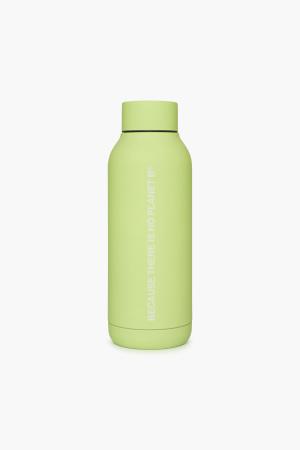
Spring has one big advantage: it offers small, quick rewards. The air smells different, the light changes every hour, and nature literally moves before your eyes. Children often respond best when adults don't prepare a perfect program but rather open the doors to discovery. And sometimes it takes just a little: a handkerchief in the pocket, a water bottle, something to change into, and a willingness to accept that mud in spring is more of a part of the gear than an accident.
Try our natural products




How to get children outdoors more after winter (and why it works better in small steps)
Winter is long, and habits are strong. Children get used to warmth, quick entertainment at their fingertips, and the idea that "not much happens outside." Transitioning to spring is easier when it doesn't start with big resolutions but with short, repeatable rituals that gradually grow. Instead of planning a two-hour trip, twenty minutes after school might suffice: walking around the block, going for rolls, peeking at the playground. Children often need to "taste" that it's pleasant outside first, and only then do they start wanting to go out.
A slight change in perspective helps too: it's not about "driving children outside," but giving them a reason why it's worthwhile to be out there. Spring is ideal for this because it offers simple goals. Find the first snowdrops, discover buds on a bush, listen to birds in the morning on the way to school. When the outdoors becomes a treasure hunt, children naturally get involved.
The rule "adventure begins outside" also works well. A child who hesitates often doesn't need to be convinced but given a role: today they're a "tracker" looking for the first signs of spring; another time a "photographer" capturing colors with a mobile or children's camera; or a "gardener" checking what's changed since yesterday. And when an adult joins in without directing like an instructor, something valuable arises: shared time that isn't about performance.
It's also worth reminding that staying outdoors and being active are long associated with better wellbeing and sleep. A solid guidance source might be a summary of recommendations on physical activity and health on the World Health Organization (WHO) website, which highlights that regular physical activity is meaningful across all ages. For families, this often means one thing: when children move outside, evenings at home are calmer.
Tips for spring activities with children: from mud to discoveries (and without big preparations)
Spring days are changeable, and that's their charm. Sometimes it's sunny, other times there's a shower, wind, or a cold shadow in the woods. Instead of battling the weather, one can work with what it brings. Spring activities with children after winter can be surprisingly simple, just best to choose those that make sense even in micro-scale — right behind the house, in the yard, in the park.
One of the most rewarding things is an ordinary "spring expedition" without a goal but with a task. A child gets a list of things to find (not necessarily to take away): something yellow, something that smells, something smooth, and something that rustles. Only four items are needed to turn a walk into a search. And in the process, they subtly learn to notice details. At that moment, it's no longer just "going outside," but exploring the world.
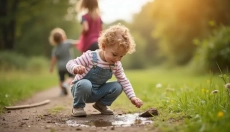
Spring is also a time of water — puddles, streams, melting snow on the northern sides, wet grass. Instead of prohibition, it can be used: build a small dam from stones at a stream, observe where the water finds its path, or let a bark boat drift downstream. Children love when something moves and reacts. And water always reacts. Yes, it will require spare socks, but the reward is concentration that is often hard to find at home.
For those with the opportunity, "urban botany" can be included. In parks and between buildings, small miracles happen in spring: lawns change, bushes sprout, a herb pops up somewhere. Children enjoy comparing "yesterday and today." It's great to choose one tree that is often passed by and make it a family project: take a photo of it once a week, notice buds, leaves, and the first flowers. A small time-lapse is created, showing that nature is not just a backdrop but an event.
And then there are activities that combine movement with a goal. In spring, a "runner’s" game works excellently: children get a simple task that requires them to go to a place and do something there. For example, find three benches and do ten jumps on each, or go to the nearest bridge and listen to the sounds of water and the city for a minute. It's subtle but works great because it alternates walking, short performance, and attention. And suddenly an hour has passed outside.
If a bit of creation wants to be added, spring is ideal for a natural "atelier." It's not about collecting protected plants, more about what's on the ground: twigs, stones, cones, petals fallen by the wind. It can be made into a picture on the pavement, a mandala in the park, or a simple collage at home. Children thereby gain a sense that they are not just visitors outside, but co-creators.
A sentence often found useful in families is: "There's no bad weather, just wrong clothing." It's an old cliché, but surprisingly practical in spring. When children have comfortable layers and shoes that can handle moisture, being outside stops being stressful. And adults stop monitoring every step.
Real-life example: "Spring bingo" changed the way home from school
In one ordinary family, it started unobtrusively. After winter, children refused to go out because "the playground is boring" and "it's wet." The adults didn't want to push, but it was clear that afternoons at screens stretched into evenings. A simple idea emerged: on the way back from school, they started playing "spring bingo." On paper were nine squares: puddle, bud, bird, something green, something that smells, small bug, flower, interesting stone, cloud that looks like an animal. Each day they checked off what they managed to find.
The first day it took ten minutes, and the children acted like it was "weird." The second day they stopped on their own. The third day they went a street further on the way home because "there are surely better puddles there." And after a week, the paper was no longer needed. The children got used to looking around. The outdoors changed from an obligation to a space where something always happens. That's the strongest thing about spring: once attention shifts, it works on its own.
When spring settles at home: small habits that maintain the outdoor rhythm
Spring energy doesn't hold with just one trip. Most families appreciate simple routines that can be repeated even when it's busy. And this is where the topic of a healthy lifestyle connects with what's practically feasible: less perfectionism, more regularity.
It works well when outdoor time becomes a "transition bridge" between obligations and the evening. A short walk after school or work is often better than waiting for the weekend when "there will be time." Children run around outside, adults clear their heads, and tension at home then decreases. Moreover, spring naturally encourages the desire to do something — just good not to overwhelm it.
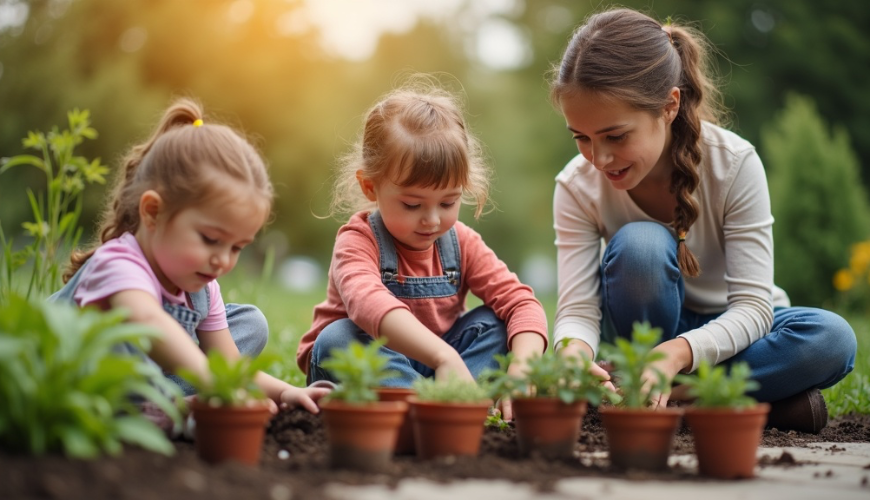
Those with a balcony, garden, or just a windowsill can add another very rewarding element: joint cultivation. It doesn't have to be anything big. Cress, sprouting peas, herbs, or a few radish seeds. Children love when something changes every day. And by taking care of a plant, they gain another reason to go outside: to check, water, compare. An ordinary spring becomes a story.
The spring period is also ideal for "outdoor cleaning," which isn't a punishment but a game. Here, sensitivity is key: it's not about children picking up litter instead of adults, but learning that the environment is shared. If approached as a short challenge — ten minutes, one bag, gloves, and then ice cream or hot tea — it can be surprisingly empowering. At the same time, it's good to remind that for safe handling of waste, there are recommendations, and sharp objects or syringes should not be picked up. As a comprehensive source on waste impacts and plastics, information on the UNEP – United Nations Environment Programme website can be useful, which has long emphasized how important it is to prevent pollution.
And speaking of sustainability, spring often brings practical questions: children have outgrown shoes, jackets are short, sweatpants worn out. Instead of quickly buying everything new, some things can be passed on, exchanged, or repaired. Children gain a lesson that is understandable without big speeches: things have value and it's normal to take care of them. Plus, it beautifully matches what spring symbolizes — renewal, but not wastefulness.
To prevent it from becoming a list of tasks, picking one or two things that suit the family best is enough. Some love the forest and streams, others city parks and playgrounds, and some mainly need short doses of movement between obligations. Spring isn't a competition about who achieves more. It's an invitation to slow down with screens and speed up on foot.
If it helps to have a few quick ideas at hand that don't require planning, one simple list can work, which can be pulled out anytime someone asks, "what are we going to do":
- Spring scavenger hunt (find 5 signs of spring in the area)
- Puddle expedition (boots, a stick, water observation)
- Tree project (choose one tree and monitor it week by week)
- Minute of silence (listen to sounds on a bench and then list them)
- Chalk sidewalk (draw an outdoor obstacle course and run through it)
- Micro picnic (an apple and tea in a thermos, even if just on the house steps)
The greatest magic of spring isn't in a perfect program but in the fact that you can be outside "just like that" — and yet something is always happening. Sometimes it's enough to slow down the pace, look at the world through a child's eyes, and allow the journey to become the destination. And when nobody feels like it, a simple question helps, which sounds almost banal but works reliably: What do you think has changed outside since yesterday?