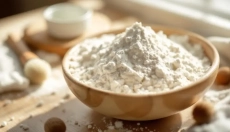

The konjac sponge, which gently cleanses the skin, can replace both exfoliants and cotton pads.
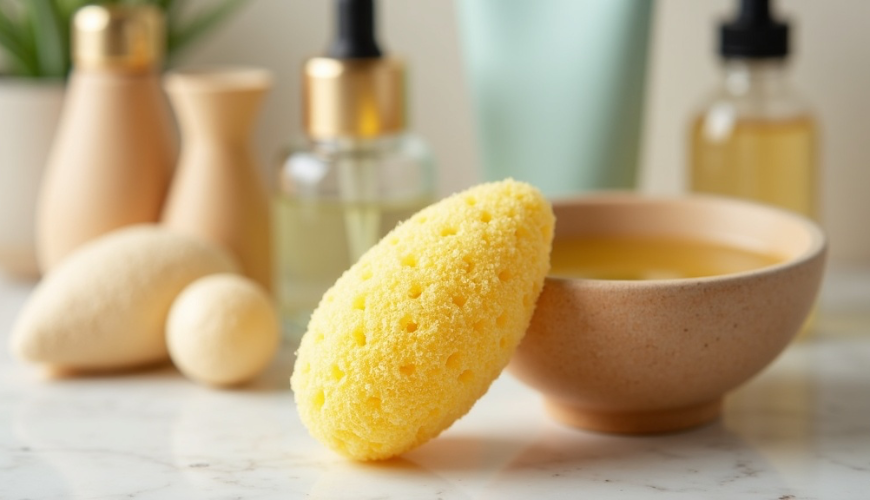
The konjac sponge has become a staple in the bathrooms of those looking to care for their skin more gently, using less cosmetics and with an eye towards nature. At first glance, it looks inconspicuous — a small porous sponge, often in natural shades, sometimes with clay or activated charcoal additives. Yet, it has gained an almost cult-like reputation: it can cleanse the skin without scrubbing, is suitable for sensitive skin types, and essentially replaces several steps in a regular routine. What's the reality, what is the konjac sponge good for, who benefits most from it, and how to use it properly to truly make it beneficial?
The konjac sponge (sometimes spelled “konnyaku” or “konjac”) is made from the konjac plant (Amorphophallus konjac), whose root is also known in the food industry — for example, thanks to konjac flour and pasta. In cosmetics, its fiber is used: after processing, it forms a light, porous, yet surprisingly durable structure that softens and feels pleasant to the touch when wet. This combination of softness and effective mechanical cleansing is why the konjac sponge is touted as a gentle alternative to scrubs or disposable makeup remover pads.
Try our natural products
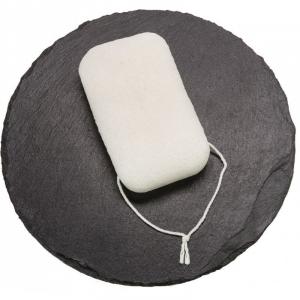
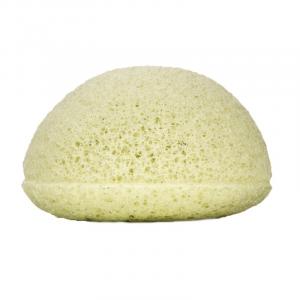
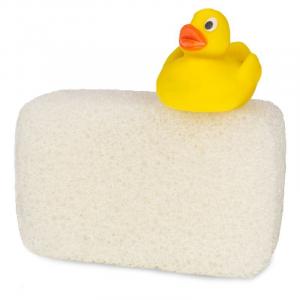
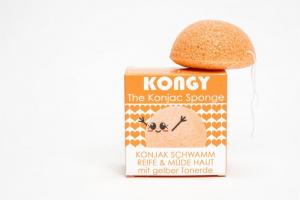
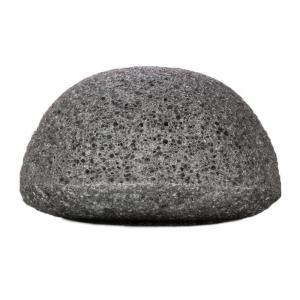
What is the konjac sponge good for and why does the skin often “accept” it right away
The most common answer to what the konjac sponge is good for is simple: for daily gentle cleansing of the skin. When the sponge is soaked, its pores fill with water, and the material softens to glide across the face without uncomfortable friction. Yet it still functions as very gentle mechanical exfoliation — helping to release dead skin cells, SPF residues, makeup, and everyday impurities that accumulate on the skin during the day.
It's important to have realistic expectations: the konjac sponge is not a “miracle” that will solve acne or pigment spots on its own. However, it can create conditions for the skin to appear cleaner, smoother, and for subsequent care (moisturizing serum, cream, oil) to be better absorbed. For sensitive skin that cannot tolerate aggressive scrubs, its use can be particularly practical — instead of a one-time “abrasion” once a week, the skin is cleansed gently but regularly.
The psychological effect is also important. Cleansing the skin is a moment for many people to slow down their day. The konjac sponge adds a pleasant massage and a sense that not too much is being done, yet enough. Sometimes this is precisely what helps with consistency — a routine that is pleasant is easier to maintain than one that burns, stings, and forces the skin to “endure.”
In terms of reliable information, it is worth recalling that exfoliation (whether mechanical or chemical) has its place, but it can also be overdone. This is clearly explained by, for example, the American Academy of Dermatology, which warns that overly frequent or aggressive scrubbing can disrupt the skin barrier. This is why people often reach for something gentler — and the konjac sponge fits into this logic.
Practically, the greatest benefit is often seen in these situations:
• The skin is dull, tired, and “rough” to the touch, but at the same time reacts with irritation to traditional scrubs.
• Makeup or SPF is hard to wash off in the evening, and one doesn’t want to use strong cleansing every day.
• The T-zone gets oily quickly, but the rest of the face is sensitive and dries out easily.
• The care routine should be minimalist and ideally use fewer disposable tools.
When discussing variants of konjac sponges with additives (such as activated charcoal, green clay, pink clay), it’s good to see them as a gentle “bonus,” not the main driver of effects. The decisive factor remains the sponge’s structure and how it is used.
How to properly use the konjac sponge to prevent irritation and ensure longevity
The question of how to properly use the konjac sponge is surprisingly important because this is where it is determined whether it will be more of a help or a hindrance. It’s not complicated, but a few details make a big difference — mainly in hygiene and how gently the skin is treated.
The basic rule is simple: never use the konjac sponge dry. When dry, it is hard and could unnecessarily irritate the skin. The correct process starts by soaking the sponge in lukewarm water, ideally until it is completely softened. Then it is gently wrung out — not twisted into a “rope,” but rather squeezed a few times in the palms so water doesn’t drip from it.
Cleansing should be light, without pressure. Many people tend to “add” pressure because they want to see results immediately, but skin is not a pot after goulash. The konjac sponge works best when the face is cleaned with circular motions, even for just one to two minutes. Less force, more regularity — this is often the safest combination.
As for cosmetics, there are two common paths. Either the sponge is used only with water (which suits people who tolerate minimalism and don’t wear heavy makeup), or a gentle cleansing gel or emulsion is added. With more pronounced makeup or waterproof mascara, it is often more practical to remove makeup first (for example, with oil or a two-phase product) and then use the konjac sponge as a second step. This reduces the need to “scrub” and allows the skin to remain calm.
Hygiene is a chapter that is sometimes underestimated. After use, the sponge needs to be thoroughly rinsed to remove any cosmetic residues. It is then wrung out and left to dry in the air — ideally hung on a string so air circulates around it. Leaving it wet on the edge of the sink or closing it in a cabinet is a reliable recipe for it to start smelling and become more of a breeding ground than a helper.
One sentence worth remembering: “What touches the face should be clean and dry between uses.” This applies to brushes, towels, and the konjac sponge.
How often should it be used? It depends on the skin. Some can tolerate it morning and evening, others might find it more comfortable every other day or just in the evening. For very sensitive or reactive skin, it makes sense to start slowly — maybe 2–3 times a week — and observe how the skin behaves. If tightness, redness, or a feeling of “over-scrubbing” appears, it’s a signal to reduce use.
And when to replace the sponge? It is usually suggested to replace it every few weeks to a few months depending on usage frequency and care. Once it starts changing texture, crumbling, smelling permanently, or showing suspicious stains, it’s time to retire it. The konjac sponge is a consumable item — and part of its charm is that it is relatively simple and inherently less burdensome on the household than disposable alternatives.
A small real-life example: when the routine simplifies, the skin often calms down
Imagine a common situation: a person works all day in an office, applies SPF in the morning, endures air conditioning during the day, and performs a quick cleanse in the evening with the feeling that the skin is still “clogged.” Occasionally, a scrub is used, which smooths the skin temporarily, but dry patches appear around the nose the next day. In such a moment, it often turns out that the problem isn’t that the care is not “strong” enough, but that it is irregular and sometimes too aggressive.
When the konjac sponge is introduced as a gentle daily step, the routine paradoxically simplifies: in the evening, it’s enough to remove makeup and then gently cleanse the skin with the sponge for a few tens of seconds. After a week or two, people often notice that the skin looks more even and that they no longer feel the need to “catch up” on neglected cleansing with a strong scrub. It’s not a dramatic overnight transformation, but rather a subtle shift that makes sense because it is sustainable.
Its role in a more sustainable bathroom: less disposables, more simplicity
The konjac sponge is often mentioned in the context of a more sustainable bathroom. It’s not a complete solution, but it naturally fits into the trend of “less waste, less plastic, less unnecessary stuff.” When it replaces some disposable pads or when one can manage with fewer cleansing products because of it, it’s a step in the right direction. Moreover, it’s a tool used long-term and is typically disposed of without leaving behind a plastic wrapper or microplastics from harsh synthetic fibers.
It’s also fair to say that sustainability isn’t only about material but also behavior. If the sponge is replaced every two weeks “just in case,” the effect is lost. Conversely, if it’s used too long and in unsuitable conditions, the hygienic purpose is lost. The ideal is to find balance: use it as long as it is safe and pleasant, but no longer.
When choosing the type, it’s worth considering the skin’s needs. The classic natural (without additives) is usually the most versatile. The variant with activated charcoal is often recommended for oilier skin or the T-zone, but it’s not obligatory — sometimes, for oily skin, paradoxically, gentleness without “extra promises” is better, as over-oiling can be a reaction to overdrying. If the skin is very dry, it might be wiser to use the sponge less frequently and focus on hydration and protecting the skin barrier.
And what about the body? Konjac sponges also come in larger sizes. Their use can be pleasant for the décolletage, neck, or for gentle exfoliation of shoulders and back, where pimples sometimes form. Here too, pressure and scrubbing are not the goal — the goal is regularity and gentleness.
Finally, it’s good to ask a simple rhetorical question: when the skin “endures” something every day — smog, dust, stress, sun — doesn’t it deserve gentleness rather than another battle in the evening? The konjac sponge is exactly the type of small detail that doesn’t seem revolutionary but can change the tone of the entire routine. Not by promising the impossible but by promoting cleanliness, gentleness, and simplicity, which often prove to be a surprisingly effective combination in skincare.
If reasonable use, proper drying, and timely replacement are added, the konjac sponge can be a small but stable point in daily care — and such things are what count most in the bathroom.