
Kaolin is a versatile white clay that you can use in cosmetics and in the household.
Kaolin belongs to those understated raw materials that appear more frequently in households and industry than one might expect. Some people know it as "white clay" from facial masks, others associate it with porcelain, and others encounter it when choosing gentle cosmetics or looking for a mild cleaning aid. Yet, the same question keeps coming up: what is kaolin and why is it talked about as one of the most versatile natural resources?
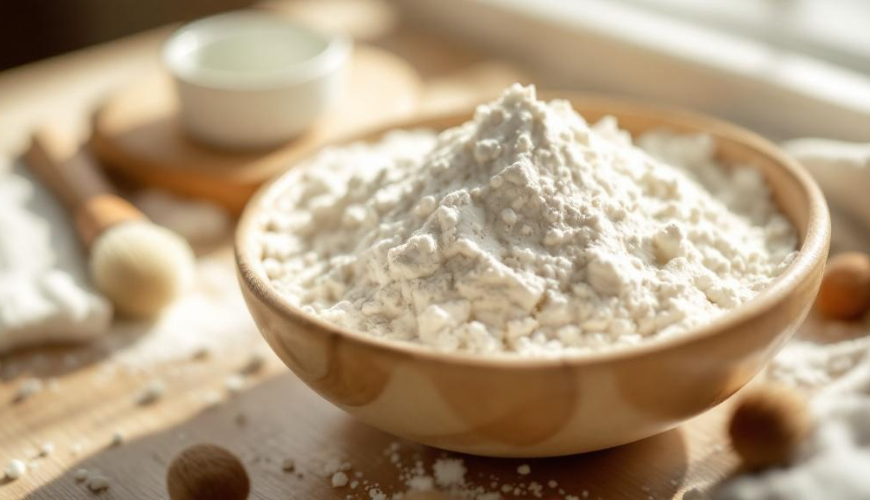
At its core, kaolin is a fine clay mineral (more precisely a clay rock rich in the mineral kaolinite), typically white to cream in color. It forms through the weathering of feldspar and other rocks, and because it's a very fine material, it is easy to process and mix into blends. This combination – fineness, relative purity, and "neutral" behavior – has made it a material that finds use from the bathroom to the workshop to the art studio.
For those seeking quick basic context, a clear description can be found on the Britannica website, where kaolin is presented as an important industrial raw material for ceramics and paper. In everyday life, however, kaolin often stands out more for how pleasant it feels to the touch, how well it absorbs grease, and how gently it behaves on the skin. This naturally leads us to the question of what kaolin is good for and why it has gained such a strong position in recent years in the field of sustainable body and home care.
Try our natural products
What is kaolin and how does it differ from other clays
When someone mentions "clay," many people think of green or bentonite clay, or perhaps Moroccan rhassoul. Kaolin differs mainly in that it is finer and usually gentler. This doesn't mean it's "better" in every situation – rather, it suits contexts where the goal is sensitive cleaning and calming, not intense degreasing at any cost. Therefore, it is often recommended for drier or sensitive skin, which might feel taut after using more aggressive clay.
It’s also worth remembering that the name kaolin can cover various degrees of purity and sources of origin. High-quality kaolin intended for cosmetics typically has clearly defined parameters to ensure it is suitable for skin contact. And with natural materials, a simple rule applies: quality, processing, and intended use matter.
Kaolin is furthermore interesting because it bridges the "old world" with modern demands. While ceramics and porcelain have a long tradition, today’s consumers also seek clean compositions, less environmental burden, and materials that make sense in a minimalist bathroom. Kaolin fits surprisingly well into this – it’s a material that can do a lot without requiring complex chemistry.
What kaolin is good for: skin, hair, and gentle cleaning
Once kaolin makes its way to the bathroom, its role most often revolves around one ability: gently absorbing excess oil and impurities. It’s not a "harsh cleanser," but rather a patient helper that allows the skin to breathe without unnecessary irritation. That’s why it shows up in masks, cleansing pastes, and powders.
For skin, kaolin is traditionally associated with helping to refine the appearance of pores, contributing to a feeling of cleanliness, and serving as a pleasant intermediate step between regular washing and intensive treatments. Used as a face mask, it is usually mixed with water or hydrosol into a smooth paste. The advantage is simplicity: no complicated recipes, just the raw material and liquid. In practice, a few drops of gentle oil or honey are often added to make the mask feel more comfortable – especially if the skin is sensitive and prone to drying out.
Kaolin isn't just limited to the face. In hair care, it appears in products for sensitive scalps or as part of dry shampoos. It makes sense: if it can absorb oil on the skin, it can do similar work with hair. In its gentle form, it can help hair feel lighter without needing to be washed every day. Of course, dry shampoo is no substitute for washing – but in a hectic week, it’s sometimes precisely the compromise needed to save the morning routine.
This ties into an area increasingly emphasized in sustainable households: gentle cleaning without aggressive agents. Kaolin is used as part of cleaning pastes and powders that help mechanically (but gently) release impurities. It’s typically suitable for smooth surfaces where you don’t want to risk scratching with coarser abrasives. And because kaolin itself is usually not scented, it can be a pleasant option for those bothered by strong fragrances.
One practical example from real life: in a household dealing with fragrance sensitivity, unused cleaning sprays often accumulate – one "too lemony," another "too floral." In such situations, a simple cleaning paste with kaolin (perhaps supplemented by a gentle degreasing ingredient) can be surprisingly liberating: a clean surface without the apartment "smelling of cleaning" for two more hours. As they say: "Not everything that’s clean has to smell."
Kaolin naturally has its limits. It’s not a disinfectant and shouldn't be expected to work miracles on burnt-on residues or heavy grease, where more targeted approaches are needed. Its strength lies elsewhere: in gentleness, versatility, and tolerability.
Kaolin and sensitive skin: why it’s favored
Sensitive skin is paradoxically most often "overloaded" – it goes through active ingredients, exfoliation, and strong cleansing gels, often resulting in increased reactivity. In this context, kaolin acts as a return to simplicity. Because it doesn’t work aggressively, it may be more acceptable for many people.
However, this doesn't mean it’s automatically suitable for everyone. Even a natural material can dry out the skin if used improperly – typically when a mask dries "to dust" on the face, causing uncomfortable tightness. For clays in general, it’s often better not to let them dry completely, or to lightly moisten them during application. Comfort is a good compass: if the face starts to feel uncomfortably tight, it’s time to wash it off.
Kaolin’s use in the household and industry: from porcelain to paper
When we talk about "all about kaolin," it would be a shame to stop at cosmetics. Kaolin is a material behind some everyday items that people use without even realizing it. The most classic association is porcelain and ceramics. Kaolin is added to ceramic mixtures because it helps create a solid structure and the typical light color of the final product. It’s no coincidence that kaolin is sometimes called "porcelain clay" – although in practice, it’s one of the key components, not the entire recipe.
Another significant chapter is the paper industry. Kaolin is used as a filler and coating component that can improve the smoothness and whiteness of paper and affect how it is printed. This is one reason why some magazines feel so "smooth" and why ink behaves differently on various papers. A more detailed look at kaolin’s role in the industry is offered by the U.S. Geological Survey (USGS) in their material overviews and statistics – it’s an authoritative source that has long mapped raw material usage.
Kaolin is also used in other directions: in building materials, some types of paints, the rubber industry, or as part of various technical mixtures. For the average reader, the most interesting aspect is the contrast: the same material that touches the face in a mask can also be part of the porcelain cup from which tea is drunk.
And here, a rhetorical question arises: how many things around us would feel just as natural if kaolin disappeared from them?
Kaolin in a sustainable context: fewer components, more function
In sustainable living, the idea is often emphasized that less can be more. Kaolin fits into this idea as a simple material with multiple uses. When several specialized products in the bathroom or household are replaced with one more universal one, it can mean fewer packages, less transportation, and fewer "leftovers" on the shelf.
Of course, it depends on where the material comes from and how it is processed. With kaolin, it’s important to check if it’s intended for cosmetic use, what declared parameters it has, and whether the seller has clear information about its origin. For products that touch the skin, transparency is crucial – and ecologically minded stores are expected to communicate such information clearly.
In practice, kaolin often appears in products that fit into a "low-waste" routine: solid or powdered cleaners, minimalist masks, or even decorative cosmetics where kaolin helps with texture. The result doesn’t have to be an ascetic bathroom devoid of joy, but rather a space where things make sense and don’t go unused.
All about kaolin in practice: how to choose and use it wisely
When selecting kaolin or a product with kaolin, it’s worth clarifying what is expected from it. Some seek a gentle facial mask, others need to gently clean a sink, and another wants to soothe the scalp. Kaolin is flexible, but it works best when used with realistic expectations: gently, regularly, and without overdoing it.
Basic orientation is simple. Kaolin for cosmetics should be clearly labeled as cosmetic (or pharmaceutical) and should come from a seller who can verify what they’re selling. For finished products, it makes sense to read the ingredients: if kaolin is high on the list, it’s likely one of the main components, not just a "marketing pinch."
The method of use is also important. With masks, a common mistake is letting the mask dry to the point it starts cracking. This can reduce comfort for the skin and sometimes unnecessarily highlight dry areas. A shorter application time or occasional moistening is often much more pleasant. Kaolin should act as a gentle helper, not as a test of endurance.
And how often? That’s individual. For sensitive skin, once a week may suffice, while oilier skin might benefit from twice weekly. For hair, dry shampoo with kaolin is best used sporadically. For household cleaning, the frequency is determined by need, but even there, gentle agents are great for ongoing maintenance.
Is kaolin "miraculous"? It’s more reliable. It’s not an ingredient that promises dramatic overnight transformation, but that’s precisely why people return to it. In an era where a new "must-have" active ingredient appears every moment, kaolin feels almost old-fashioned – as a material that existed long before marketing and will make sense long after it.
And perhaps that’s why it’s worth keeping kaolin in mind: as a material that connects body care, household management, and everyday items. Sometimes the greatest difference is made not by another complicated product, but by one simple thing that can be used intelligently and with respect for what we truly need.