

Stuffed peppers according to a Georgian recipe with walnuts
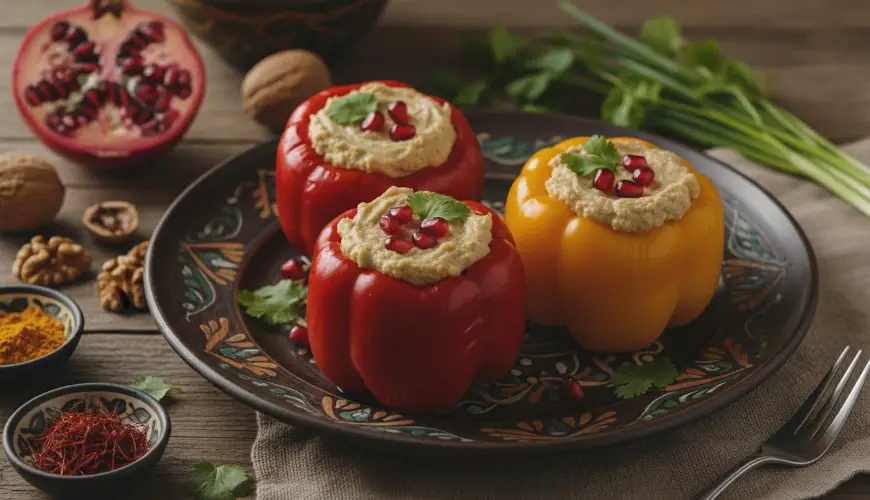
Georgian cuisine is one of those that, once tasted, you simply cannot forget. It is a cuisine full of layers, colours and surprising combinations, where sweet mingles with savoury, where herbs form the foundation of every dish and where nuts play a role that has no equivalent in European gastronomy. Walnuts in Georgia are something more than a mere delicacy – they are a pillar of the entire culinary culture. And when they meet with meaty, sweetly fragrant peppers, the result is a dish that carries the soul of the entire Caucasus.
Stuffed peppers with walnuts according to a Georgian recipe are not what most Czechs would imagine when they hear the term "stuffed peppers". No tomato sauce, no rice or minced meat in the traditional sense. Instead, a thick, aromatic filling of ground walnuts, garlic, fresh herbs and spices transforms the pepper into something utterly extraordinary. It is a recipe that has survived centuries and is still passed down from generation to generation in Georgian households, from Tbilisi to the mountain villages of Svaneti.
Try our natural products






Why walnuts are so essential in Georgian cuisine
To understand why this recipe works so well, one must first understand the place walnuts occupy in Georgian gastronomy. Georgia is among the countries with the longest tradition of walnut cultivation in the world – according to some botanical sources, the Caucasus and Central Asia region represents the original homeland of the species Juglans regia, the walnut as we know it today. Research published in specialist botanical databases confirms that this region was the centre of its spread for thousands of years.
In Georgian cuisine, walnuts are used in both hot and cold dishes, in sauces, soups, confections and as the basis for the famous satsivi sauce. Ground walnuts are mixed with garlic, vinegar, saffron, coriander, chives and a whole palette of spices that are virtually unknown in European cuisine in such combinations. The result is a thick, velvety mass with a deep, earthy flavour known as "bazhe", or used as the foundation for various stuffing variants called "nigvziani badrijani" – dishes filled with walnut paste.
It is precisely this walnut paste that is the heart of Georgian stuffed peppers. Its preparation is not complicated, but it requires attention and quality ingredients. The better the quality of the walnuts, the richer and more complex the resulting flavour. Freshly harvested walnuts with a delicately sweet, buttery taste will give the dish an entirely different dimension than old, bitter walnuts from the back of the pantry.
Consider Anna, a Czech traveller who visited Tbilisi and found herself at the invitation of a local family seated at an evening table set with dozens of small dishes. In the centre of the table stood red peppers filled with walnut stuffing, garnished with pomegranate seeds and fresh coriander. Anna, who had grown up at home with classic Czech stuffed peppers, initially regarded the dish with mild scepticism. After the first bite, however, she admitted it was one of the most powerful culinary experiences of her life. "It was like tasting an entire country in a single mouthful," she said afterwards. That is precisely the effect this dish has – it is a condensed essence of Georgian hospitality and culinary philosophy.
How to prepare Georgian stuffed peppers with walnuts at home
The good news is that this recipe is surprisingly accessible even for home cooks with no prior experience of Georgian cuisine. Most of the ingredients can nowadays be easily found in Czech health food shops or stores specialising in organic and natural produce.
For four to six servings, you will need approximately six medium-sized, meaty peppers – ideally red or yellow, which are naturally sweeter and complement the earthy flavour of the walnut stuffing better. For the filling, prepare around 300 grams of walnuts, four cloves of garlic, a bunch of fresh coriander, a smaller bunch of chives or parsley, one teaspoon of ground coriander, half a teaspoon of turmeric, half a teaspoon of chilli or cayenne pepper, two tablespoons of white wine vinegar or pomegranate juice, salt to taste and, optionally, a little saffron dissolved in warm water if you wish to enrich the dish with its characteristic golden colour and delicate aroma.
Preparation begins with dry-toasting the walnuts in a pan – briefly, just enough to release their natural aromatics without burning them. The walnuts are then ground in a food processor or grinder to a fine, almost flour-like consistency. Properly ground walnuts should begin to release their own oil and form a compact, oily paste. Add the pressed garlic, chopped fresh herbs, all the spices and the vinegar or pomegranate juice. Mix everything thoroughly, season with salt and, if necessary, add a tablespoon or two of cold water so the stuffing achieves the right, easily shapeable consistency – not too dry, but not too runny either.
Meanwhile, wash the peppers, carefully cut off the tops and scoop out the seeds and white membranes. If you wish to serve the dish as cold appetiser bites, you can slice the peppers into thicker rings and press the stuffing into each ring. The Georgian way, however, favours whole peppers, filled to the brim and closed with the cut-off top. Peppers prepared in this way are left to rest in the refrigerator for at least an hour, allowing the flavours to meld and the stuffing to firm up slightly.
Presentation in Georgian tradition is just as important as the preparation itself. The stuffed peppers are garnished with pomegranate seeds, which add a lightly tart, fresh contrast to the rich walnut flavour, and fresh coriander leaves. Sometimes a drizzle of quality olive oil or walnut oil is added. The result is visually stunning – a red pepper with white stuffing, ruby pomegranate seeds and a sweep of green herbs create a composition that could easily hang as a painting.
This dish is traditionally served as part of the Georgian "supra" – a festive table, where food is placed on the table all at once and everyone eats together, without a strict division into courses. The philosophy of the supra is deeply rooted in Georgian culture and expresses the conviction that shared food is the foundation of human community. As a Georgian proverb says: "A host who lets a guest leave hungry is like a gardener who forgets to water his trees."
Nutritionally, this is a dish worth noting from a healthy lifestyle perspective as well. Walnuts are among the foods with the highest content of plant-based omega-3 fatty acids, and according to data from the World Health Organization, an adequate intake of these fats is crucial for heart health and proper brain function. Spices such as turmeric and coriander have proven anti-inflammatory properties, and fresh herbs provide the dish with vitamins and antioxidants. The entire recipe is naturally gluten-free, lactose-free and, when plant-based ingredients are used, completely vegan – making it an ideal choice for a variety of dietary preferences.
Interestingly, a similar principle of walnut stuffing is used in Georgian cuisine for filling aubergines, vine leaves or cooked beetroot leaves as well. The basic walnut paste is therefore a versatile foundation that can be adapted to the seasonal availability of vegetables. In summer, peppers and aubergine dominate; in autumn, root vegetables and pumpkin are added; in winter, the walnut paste is served with cooked vegetables or as part of warm sauces.
For those who wish to experiment, there are a number of interesting variations. Some of the walnuts can be replaced with hazelnuts for a more delicate, sweeter flavour. A spoonful of tahini can be added to the stuffing for an oriental touch, or a little miso paste for umami depth. Some cooks also add dried plums or raisins, which bring a sweetness that contrasts with the piquancy of the garlic and chilli. Every household in Georgia has its own recipe, its own ratio of spices and herbs – and it is precisely this diversity within a single dish that shows how vibrant and creative Georgian cuisine is.
If Georgian gastronomy has caught your interest and you wish to explore it more deeply, it is worth knowing that in recent years interest in Caucasian cuisine has been growing in the Czech Republic as well. Specialist shops offer Georgian spices such as utskho suneli – a traditional herb blend that is as ubiquitous in Georgian cuisine as herbes de Provence in French gastronomy – or fenugreek, without which Georgian walnut paste cannot be made. It is fenugreek that gives the stuffing its characteristically slightly bitter, almond-like tonality, which is entirely typical and unmistakable in the Georgian style.
Georgian stuffed peppers with walnuts are therefore much more than just a recipe. They are a gateway into a culinary world that remains largely undiscovered territory for most Europeans. They are proof that healthy food need not be dull or ascetic, and a demonstration of how simple, natural and quality ingredients can create a flavour experience that lingers long after the last bite.