

Separate bedrooms as a path to a happy relationship
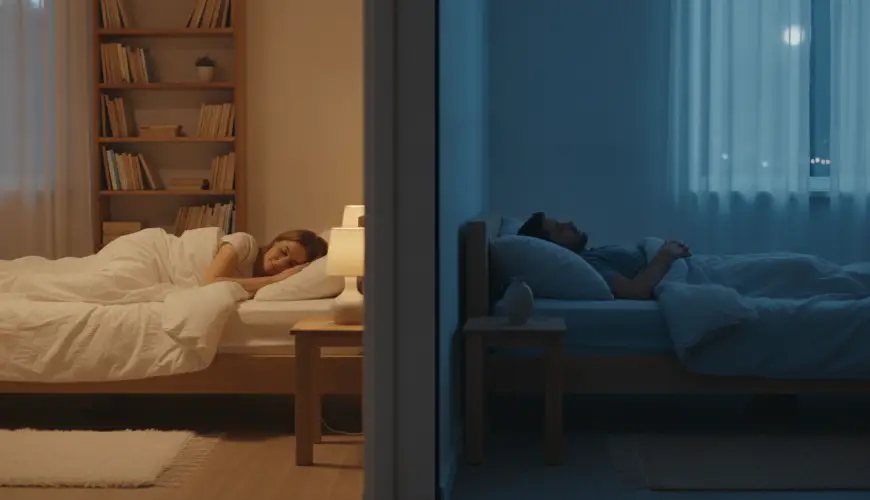
Imagine a situation that plays out in thousands of households every night. One partner lies awake, staring at the ceiling and counting the minutes until the alarm goes off, while the other half snores contentedly beside them. Or the opposite — a night owl can't fall asleep because an early bird went to bed three hours earlier, and the slightest movement wakes them up. Morning brings irritability, small squabbles, fatigue that accumulates week after week. And yet the solution can be surprisingly simple: each person sleeping in their own room.
In English-speaking countries, the term sleep divorce has become established for this phenomenon — literally "a sleep divorce." The name sounds dramatic, but the reality is far more mundane and — as expert studies show — very beneficial for many couples. This is not a relationship failure or a loss of intimacy. It is a pragmatic decision that can save not only a marriage, but also the health of both partners.
Try our natural products

Why a shared bed isn't for everyone
Humanity has shared beds for practical reasons for millennia — for warmth, safety, and economic necessity. The romantic image of two people sleeping in an embrace is, however, a relatively modern construct, strongly influenced by the Victorian era and the subsequent industrialisation that brought private bedrooms as a symbol of middle-class prosperity. Historians such as A. Roger Ekirch point out that sharing a bed has always been more of a compromise than an ideal.
Today we know that sleep quality is among the most important factors influencing physical and mental health. Chronic sleep deprivation increases the risk of cardiovascular disease, type 2 diabetes, obesity, and depression. According to data from the World Health Organization, approximately one third of the adult population suffers from sleep disorders — and a significant proportion of them have problems directly because of sharing a bed with a partner.
The causes vary. Snoring is the most common trigger, but far from the only one. Different sleep rhythms — where one partner naturally falls asleep around ten in the evening and the other cannot sleep before midnight — cause a nightly micro-conflict. Add to that different preferences for bedroom temperature, different sensitivity to light or sound, restlessness caused by restless leg syndrome, and you have a recipe for nights full of interrupted sleep. A study published in the academic journal Sleep showed that people who share a bed with a partner who has a sleep disorder exhibit on average 23% worse sleep quality than those who sleep alone.
What happens in the morning is not hard to imagine. Tired people are more irritable, less empathetic, handle conflicts less well, and have a lower tolerance threshold. Research in the field of relationship psychology, such as the work of Amie Gordon from the University of Michigan, has demonstrated a direct link between lack of sleep and an increase in relationship conflicts. A better-rested partner is simply a kinder partner.
Sleeping separately doesn't mean loving less
The greatest concern that deters couples from separate bedrooms is symbolic. A shared bed is strongly associated in our culture with closeness, trust, and an erotic life. Moving to another room can look like the first step towards estrangement — or even a public admission that the relationship isn't working. This concern is understandable, but according to relationship experts it is mostly unfounded.
As American therapist Wendy Troxel, author of the book Sharing the Covers, says: "Good sleep is the foundation of a healthy relationship. If a shared bed is systematically destroying your sleep, sleeping separately may be one of the most loving decisions you make as a couple."
The key is communication and intentionality. Couples who decide to sleep separately consciously and talk about it openly generally do not notice a decline in intimacy — quite the opposite. When sleep stops being a source of nightly frustration, the irritability that blocks intimacy disappears too. Time spent together in bed becomes a conscious choice, not an obligation or a source of conflict. Many couples describe how, after switching to separate bedrooms, they began to appreciate more the moments they spent together — including morning and evening ones.
It is important to emphasise that sleeping separately is not the same as living separate lives. Evening rituals together, morning coffee in bed with a partner, weekend "sleepovers" with each other — all of this remains. The only difference is who falls asleep and wakes up where. Physical presence in the same bed throughout the night is not a prerequisite for a healthy relationship, even though romantic films have been telling us otherwise for years.
Interestingly, in other cultures separate sleeping for partners is entirely normal and raises no questions. In Japan, for example, spouses very often sleep separately, without any social stigma whatsoever. Similarly, in Scandinavia it is customary for each partner to have their own duvet — a seemingly minor detail that dramatically reduces nocturnal disturbance while preserving a sense of closeness.
How do Czech experts view this topic? Somnologists — sleep specialists — agree that sleep quality should always take priority over conventions. If a shared bed demonstrably reduces the quality of rest for one or both partners, seeking an alternative is not only sensible but also beneficial to health.
How to approach sleeping separately in practice
The decision to sleep separately should not come as a bolt from the blue after one particularly bad night. Ideally, it involves a considered conversation in which both partners honestly name what sharing a bed at night takes from them and what it gives them. There is a difference between whether the problem lies in snoring — which can also be addressed in other ways, for example through orthopaedic aids or therapy — or in fundamentally different sleep rhythms that are biologically determined and difficult to change.
If a couple decides on separate bedrooms, it is worth establishing new shared rules. When will they say goodnight to each other? Will they spend time together in bed before falling asleep? How will they handle weekends or holidays? These rules are not rigid — they change according to needs and circumstances — but their existence gives both partners the assurance that sleeping separately is not the beginning of estrangement, but a conscious strategy for better cohabitation.
Practically speaking, not every household has two full bedrooms available. In such cases, intermediate solutions exist: a temporary sofa in the living room for whoever comes to bed late, or conversely for whoever gets up early. Or an investment in a quality mattress with zero motion transfer, which minimises disturbance. Sometimes even simpler solutions suffice — each partner has their own duvet, or one of them wears earplugs. What matters is that both sides feel their needs are being taken seriously.
It is worth noting that sleeping separately has become an increasingly open topic in public discourse in recent years. Surveys in the USA show that up to a third of couples sleep separately for at least part of the week, and this figure is growing. The American Academy of Sleep Medicine (AASM) has responded to the topic with cautious openness — acknowledging that for some couples, sleeping separately may be the right choice if it leads to better rest and does not harm the relationship.
Let us return to the beginning — to that tired couple lying next to each other, experiencing each night as a silent struggle instead of rest. Perhaps their situation is somewhat more complex than just a matter of snoring or different sleep rhythms. Perhaps there are deeper communication problems behind it that need to be addressed with a professional. But equally, perhaps all that is needed is a simple, courageous step: telling each other the truth about what each of them needs for quality sleep, and finding a solution that works for both.
Healthy sleep is not a luxury. It is a foundation without which neither body, nor mind, nor relationship functions. And if the path to it leads through two separate bedrooms, it does not mean the end of love — it can, on the contrary, be one of the most practical expressions of mutual respect and care that life as a couple has to offer.