
Repair or Throw Away When Something Breaks, and How to Decide Without Regrets
In every household, there's that familiar moment that occasionally arises: a cracked handle on a mug, a zipper that gets stuck, a vacuum cleaner making suspicious noises, or a T-shirt with a hole that "mysteriously" grows with each wash. And in your head spins a simple yet surprisingly challenging question: repair or throw away – how to decide quickly, without regrets, and at the same time sensibly? In times when there's increasing talk about the impact of waste on the environment and the cost of new things, it's not just a minor dilemma. It's a small test of what a sustainable household looks like in practice.
It's not about becoming a DIY guru or turning your home into a storage of broken "I'll fix it someday" treasures. The aim is to find a simple system that helps distinguish which things are worth repairing and which are better to throw away (or rather send on – to collection, recycling, a bazaar, or for spare parts). The good news is that such a system exists. And even better, it can be used on days when you don't have the energy to deal with anything more complex than dinner.
Try our natural products


Why the question "repair or throw away" is more than just a household decision
It's often simplified to a moral appeal: repair, save the planet. But reality is more colorful. Repair can be a great choice, but sometimes it's a dead end – expensive, time-consuming, and with uncertain results. It is also true that the largest part of the ecological footprint of many products is created during manufacturing and transport, not when the item breaks. Therefore, it makes sense to keep things operational for as long as possible, if feasible.
It's useful to keep a simple rule in mind: the most sustainable thing is the one you already have at home. If it can be easily maintained, it's usually worth a try. After all, the European Union has long been pushing for the so-called "right to repair", to make products repairable and spare parts accessible. You can get a good overview of the topic through summaries on the European Commission's Circular Economy pages, which explain why extending the lifespan of products is an important part of modern waste management approaches.
But to bring it back to reality – let's return to the kitchen, bathroom, wardrobe, and workshop. Because it's precisely there where decisions are made about how a sustainable household truly looks.
A simple decision-making framework: how to decide correctly and simply
When something breaks, people often act based on emotions: frustration, annoyance, fatigue, the feeling that "it's not worth it". Sustainability, however, isn't a competition in self-denial. It's more of a good habit. And good habits work when they're simple.
It helps to ask a few questions in a fixed order. Not as if it were an Excel spreadsheet, more like a mental checklist:
Cost and availability of repair: is it quick, cheap, and feasible?
The first filter is purely practical: can it be easily repaired? Here, small things often win – sewing on a button, replacing a seal, tightening a screw, degreasing a contact, straightening a bent part. When the repair is a matter of ten minutes and minimal costs, there's little to hesitate about.
At the same time, it's fair to admit that some things are deliberately designed to be difficult to repair. If it requires sourcing a special part, waiting weeks, and paying for service close to the price of a new product, the decision changes. In such a case, it makes sense to move on: what is the quality and lifespan of the alternative one would buy?
Safety and hygiene: does the repair pose a health risk?
The second filter is crucial: safety. If it's about things that can cause injury or fire (electrical appliances, damaged cables, overheating adapters), it's better to be conservative. DIY repair is only suitable if you're really skilled and know what you're doing. Otherwise, service makes sense – or a reasonable replacement.
Similarly with hygiene items: for example, significantly damaged plastic containers that can't be cleaned well, or kitchen tools with cracks where bacteria can linger. Here, sustainability is more about choosing a better material for the future than holding onto an unsuitable piece at all costs.
Emotional and functional value: is it often used, or does it just get in the way?
The third filter can be surprisingly liberating: it's worth repairing mainly what has a clear function or value. If something is used every day (a favorite pan, electric kettle, work backpack), repair can save a lot of money and hassle. If it's something that has been sitting in the closet for years and is taken out once every two years, it's good to ask: is it being repaired because it makes sense, or because it's uncomfortable to let go?
One sentence that helps with this is: “Repair is an investment – both time and money.” And an investment should have a return, perhaps in the form of additional years of use.
Material and construction: can it be repaired to last?
The fourth filter is quality. Some things are made to be repaired: solid wood, metal, quality textiles, simple mechanics. Others are more disposable: thin plastic, glued parts, complicated material combinations. Sometimes a repair is just cosmetic, and the problem returns in a month.
Here, it often becomes clear that it's not just about "repair or throw away" but also about what to buy next so that it can be repaired or at least well-maintained. A sustainable household isn't about perfection, but about gradual improvement.
What is usually worth repairing (and why it makes sense)
In practice, it turns out there is a group of items for which repair is often worthwhile even for people who aren't "DIYers". Not because it's always cheaper, but because it's simple and has a big effect.
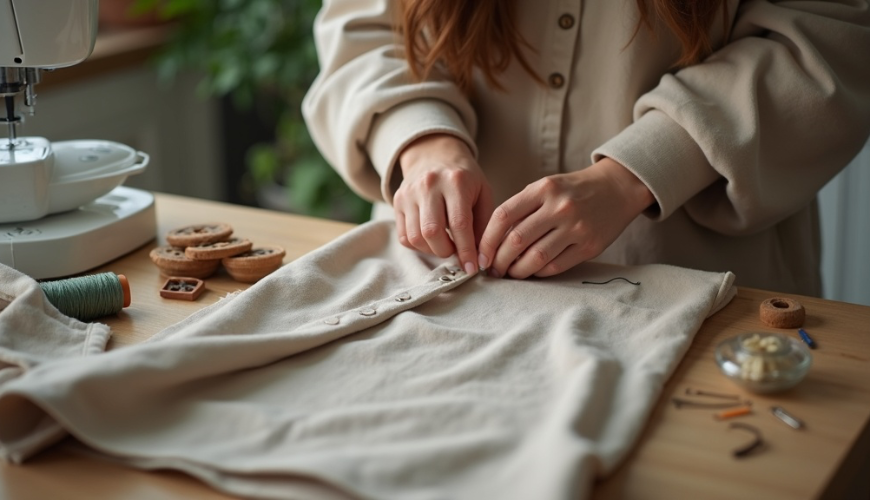
Typically, this includes clothing and textiles: sewing on a button, stitching a seam, patching a knee, replacing the elastic in a waistband. Repairing clothes also has a pleasant side effect: people stop looking at clothing as consumables for a few months. When something is repaired occasionally, the wardrobe slows down. And slowing down is often what today's shopping is missing.
Similarly, it's the case with household "small items": a dripping faucet due to a seal, a loose handle, a squeaky hinge, a wobbly chair. These repairs are usually cheap, spare parts are available, and the result is immediate relief – not just financial, but also psychological. The home suddenly doesn't feel like a place where things are gradually falling apart.
And then there are items worth repairing because new variants often have a shorter lifespan. For instance, quality older furniture or some appliances where older models were more robust. This isn't always true, but it often is.
One well-known thought in sustainability that repeats is: "The cheapest energy is the one we don't have to produce." Similarly, it can be applied to products: the least material is used by the product that doesn't need to be replaced with a new one.
What is better to discard (and how to do it gently, not impulsively)
Let's say it straight: sometimes it's better to throw away – or more precisely discard and send the item on the right path. Sustainability isn't about accumulating non-functional items at home that no one repairs. Such "stock for later" often ends in burnout and eventually in the trash, only later and with a greater dose of frustration.
Discarding makes sense mainly when:
- repair is repeatedly unsuccessful and the item keeps failing,
- the construction is so damaged that the repair would only be temporary,
- it poses a safety risk (especially electricity, overheating, damaged batteries),
- hygiene reasons prevail (mold in the material, uncleanable cracks),
- the item no longer has a use in the household and just takes up space.
However, here's an important detail: discarding doesn't automatically mean throwing it in the mixed waste. There is often a better path – collection yards, electronic waste, textile containers, reuse centers, or donating if the item is functional but unwanted at home. In the Czech Republic, for e-waste, a good starting point is a network of collection points (overviews and rules are usually available from municipalities or collective systems like ASEKOL). When an item must part with the household, it makes sense to ensure it doesn't end up unnecessarily in a landfill.
Real-life example: broken zipper and "cheap" jacket
A typical city scenario: a jacket bought on sale, after two seasons the zipper stops working. At that moment it seems clear – the jacket was "cheap", so it shouldn't be repaired, right? But then reality hits: a new jacket that would be similarly warm and fit no longer costs a few bucks. Plus, it needs to be chosen, ordered, possibly returned, chosen again. Suddenly, the "cheap" option is time expensive.
When the jacket is taken to a repair shop, replacing the zipper costs a certain amount, but the jacket can serve for years. And what's more – you avoid an impulsive purchase, which often ends in compromise: "I'll take this one, just to have it quickly." In the end, such a decision often moves the household closer to what's called a sustainable household: less shopping, more care, less waste. Not because it's perfect, but because it's practical.
And that's precisely the magic of the question is it worth repairing things and which ones. Sometimes it's about money, other times about convenience, often about both.
How to set up a "repair-friendly" calm at home without accumulating chaos
One of the biggest problems with repairs isn't the repair itself, but the interim state: the broken item sits aside, waiting for the right time. And time isn't there. The result is a corner of shame that grows. Yet a small change is enough: give repairs a clear place and date.
A simple rule works: if an item can't be repaired within two weeks (either DIY or by taking it in), it goes out – either to service with a specific order, or to the correct collection. Not because you're giving up, but because home shouldn't be a warehouse of postponed decisions.
A small "repair kit" helps: needle and thread, a few buttons, glue suitable for common materials, spare seals, basic screwdrivers. Not to fix everything at home, but so that small things don't remain unresolved just because one little thing is missing.
And if no one wants to repair, that's valid too. Sustainability isn't just about home skills. It's also about supporting services and crafts that keep repairability alive: seamstresses, shoe repair shops, watchmakers, appliance service. In this sense, "having something repaired" is often as sustainable as "repairing it yourself".
Sustainable household as a collection of small decisions, not grand gestures
Perhaps the biggest trap of the question “repair or throw away” is the feeling that there's one right answer. But a household is a living organism. Sometimes a repair is great and quick. Other times it's sensible to discard and next time choose something that lasts longer, is easy to maintain, and ideally repairable.
When looking for how to decide correctly and simply, it's worth sticking to three things: safety, realistic repairability, and whether the item truly serves at home. Everything else is just fine-tuning details. And even if you occasionally make the "wrong" decision, the world won't collapse. The important thing is that the decision isn't automatic, but conscious.
So next time the handle of a favorite mug cracks or a small appliance stops working, maybe it helps to pause for a second and ask a simple question: is this a problem that can be solved with a little care, or is it a sign that it's time to let it go? In this small moment, sustainability truly happens – quietly, without grand declarations, in the rhythm of a regular day.