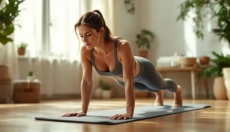

Movement during work improves concentration because short breaks awaken both the body and the mind.

Sitting for eight hours straight is almost the "norm" in modern work. However, the body doesn't see it that way. Stiff back, heavy head, tired eyes, a feeling that energy is draining somewhere under the desk – all these can appear even in work that doesn't seem demanding at first glance. Often, it's not about starting to train like for a marathon, but rather subtly moving during the workday in a way that's feasible in the office, at home, and "on the go". And to manage it even on days filled with meetings, calls, and deadlines.
It might sound too simple, but small movements throughout the day are surprisingly significant for the body. It's not about perfection. It's about regularly "waking up" the body and reminding it that it's not just a head holder in front of a monitor. After all, WHO has long emphasized that regular physical activity benefits health across ages – and even smaller doses of movement make sense. And when considering that prolonged sitting is linked to higher health risks, movement during work makes even more sense (on the topic of sitting and health, Harvard Health often returns).
Try our natural products




Why it's beneficial to move during work (even if just a little)
The body is built for alternating positions. When sitting for long periods, some muscles "laze" (typically glutes and abdomen), others get overworked (often neck, trapezius, and lower back), and blood circulation slows down. The result may manifest subtly: afternoon slump, poorer concentration, jaw tension, pressure between the shoulder blades. Simple quick exercises during the workday work as a short reset break – the body gets blood circulation, and the brain gets a signal to "kick-start" again.
Movement is also practical psychologically. Most people know the moment when a problem in an email or spreadsheet seems unsolvable, but after a short walk down the hallway, an idea suddenly appears. It's not magic – it's just that the body and mind detach from one position and one perspective for a moment. As a frequently quoted saying goes: "The best position is the next position." And that's what it's about – not worrying whether there's "enough" movement, but subtly moving during the workday so that it becomes part of the rhythm.
A common real-life situation illustrates this well: someone works from home, sits down at the laptop "just for a moment" in the morning, then it takes off and suddenly it's afternoon – without standing up once, with a second coffee and a stiff neck. However, if they incorporate three short moments of movement into the day (for example, every time a video call starts, when a file loads, or while waiting for the kettle), it often surprises in the evening that the back isn't as tired and the head doesn't press as much. Not because it was a big workout, but because the body was intermittently "flushed" with movement.
How to subtly move during the workday (office, home office, and field)
Subtle movement at work has one major advantage: it doesn't raise resistance. One doesn't need a change of clothes, a mat, or a free meeting room. Just small changes that can be made without attracting attention – or without disrupting the work flow. Tips for movement during the workday in the office, at home, or elsewhere often differ only in details. The principle is the same: engage the legs, open the chest, relax the neck, move the hips, and briefly raise the heart rate.
In the office, it's helpful to use what's already happening. A phone call? Instead of sitting, one can walk slowly along the desk or at least stand and shift weight from side to side. The printer is "over there"? Great – the walk is a mini-break. A meeting without a camera? One can stand or at least sit on the edge of the chair and gently engage the core. Even a simple act of getting up for a glass of water is an opportunity. When it becomes a habit, the body will start to ask for movement on its own.
At home, the situation is tricky because everything is within reach. That's why small "anchors" work: every time an email is sent, take two deep breaths and a short chest stretch; while waiting for a page to load, do a few heel raises; after completing a task, walk to another room. It sounds trivial, but subtle movement at work often hinges on these micro-moments.
And what if someone works "in the field", switching cars, meetings, and places? Even there, space can be found: park a few meters further in the parking lot, do a few shoulder rolls before entering a building, gently shift weight and activate calves while waiting in line. In transit, work with posture: relax the jaw, pull shoulders down, extend the neck, press feet into the ground a few times, and relax.
An important detail: "subtly" doesn't mean "half-heartedly". Even small movements can be effective when done consciously. When standing up, it's good to feel the feet for a moment, straighten up, open the chest, and breathe. The body gets a clearer signal than with nervous fidgeting.
Simple quick exercises during the workday that almost anyone can do
There isn't always a desire to figure out exactly what to do. That's why having a few "emergency" exercises that can be done anytime works. The advantage is that they are short, safe, and don't require space. And mainly: they are usable as tips for movement during the workday in the office and at home.
Neck and shoulder relaxation in 30 seconds
Sitting or standing, shoulders down. Gently pull the chin back (as if making a "double chin", but without pressure), hold for a moment, and release. Then do a few slow shoulder rolls backward. This mini-ritual is useful after prolonged screen time or phone calls. It often immediately relieves tension that otherwise accumulates subtly.
Chest opening at the desk
Join hands behind the back (or just place palms on the pelvis), lift the chest, and gently pull the shoulder blades together. It's not about arching the lower back, but rather feeling "straightened from the chest". A few calm breaths in and out. For a body that spends all day curving forward, it's a small but very effective counter-movement.
Glute and leg activation "in place"
Stand up and raise the heels a few times as if trying to lift up. Then pause and consciously tighten the glutes, release, and tighten again. It's simple yet reminds the body of muscles that often "sleep" when sitting. If space allows, add a few slow squats to a comfortable depth.
Hip stretching without a mat
One foot back into a slight lunge (even at the desk, for support), pelvis straight, gently push forward to feel a stretch in the front of the hip of the back leg. Hips tend to shorten from sitting, and it shows up in the lower back. Just a few seconds on each side and walking feels lighter.
Mini "reset" for the back on a chair
Sit on the edge of the chair, feet under the knees. With an inhale, stretch upwards, with an exhale lightly tuck the pelvis and round the back (just gently), then straighten again. A few repetitions help move the spine without it looking like exercising. In an open space, it's an ideal subtle movement at work.
To keep it as simple as possible, it pays to choose just a few movements and alternate them. Too many options sometimes lead to nothing being done. For those who want a quick "rescue kit", choosing one short sequence – and sticking to it – can be beneficial.
A single short list that can be followed even on a busy day
- Every hour: stand up and walk for 30–60 seconds or at least stand and take a few breaths into the chest and abdomen
- After every long call: shoulder rolls + chin slightly back
- Before lunch and in the afternoon: 20–40 seconds hip lunge on each side
It's simple, but such routines are the most effective because they can be repeated long-term.
Subtle movement during work ultimately isn't another task on the list, but rather a way to make work more pleasant. When the body is periodically stretched, comfort improves, often mood as well, and sometimes surprisingly even patience during lengthy meetings. And perhaps that's the most practical argument: work generally can't be "sat through" without consequences, but it can be experienced in a way that doesn't leave one feeling like a rusty machine in the evening. Just a few subtle moments – and the body will notice before pain sets in.