
Longevity is not a pursuit of immortality, as in practice it is mainly about more healthy years.
The word longevity has appeared everywhere in recent years – in conversations with doctors, in podcast debates about health, and on the packaging of dietary supplements. Yet the question "what is longevity?" is surprisingly simple and complex at the same time. Simple, because in translation it means long life. Complex, because today's concept of longevity is not just about "living to an old age," but mainly about how long you can maintain good condition, independence, and joy in everyday things. In other words: what does longevity mean in practice? It's not a chase for immortality, but an effort to extend the healthy years of life.
This change in perspective is important. Longevity is often romanticized as a number on a cake, but the real victory is the ability to climb stairs without panting, to get up from a chair without pain, to feel like going outside, meeting friends, and sleeping at night without the body protesting. And because longevity is also discussed in the context of lifestyle and environment, it makes sense to open the topic not only from a biological perspective but also from everyday habits – from food to movement, to what we use for cleaning at home and what we wear on our bodies.
Try our natural products
Longevity: long life as "healthy endurance," not just a long ride
When we say longevity, some people think of genetics: "Some are blessed from above, others are not." Genes play a role, that's fair to admit. However, current research consistently shows that environment and lifestyle significantly contribute to the overall picture. Authoritative institutions such as the World Health Organization (WHO) in the area of healthy ageing or the American National Institute on Aging also address the topic of healthy ageing. It's not a fashion trend but a real societal shift: the population is aging, and the question is not just "how long," but "how well."
Today's concept of longevity thus stands on two pillars. The first is the length of life, and the second is its quality – sometimes referred to as "healthspan," the period of life spent in health. And it is here that longevity becomes a useful topic for everyone, not just for biohackers or athletes. Because the quality of healthy years is influenced by small choices: what is eaten for dinner, whether one takes a walk, how one sleeps, how one manages stress, what relationships one has, and often what substances are present in the household.
It may be a bit unexpected, but longevity doesn't look like one big revolution. It looks more like a sum of small things repeated day after day. And therein lies its strength: it's not an exclusive discipline for the chosen few, but a practical direction for everyday life.
How to live for longevity: habits that make the biggest difference
Search engines are full of queries like "how to live healthy" or "tips for longevity," but the good news is that the answers surprisingly often agree across cultures and studies. It's not about miraculous tricks, but rather a return to what the body needs in the long term: regular movement, simple food, quality sleep, less chronic stress, and good relationships. And also less burden from toxic substances, where it makes sense – because longevity is not just about what one "adds" (supplements, superfoods), but also about what one reasonably "subtracts."
One of the most tangible topics is food. Longevity is often associated with a diet rich in vegetables, legumes, whole grains, nuts, and quality fats – the Mediterranean style of eating is often mentioned. It's not a dogma, rather a direction: more real foods, fewer ultra-processed products. It's useful to pay attention to a simple signal that is repeated in discussions about longevity: if food has a long list of ingredients and one wouldn't normally have them at home, it's good to be cautious.
In addition, it is often mentioned that the body benefits from a certain regularity and moderation. Not necessarily fasting, but the ability not to overeat every day "to fullness." In some research directions, caloric restriction and various forms of time-restricted eating are discussed, but for everyday life, something simpler is often more effective: eating to satisfaction, not exhaustion, and having most meals based on quality ingredients.
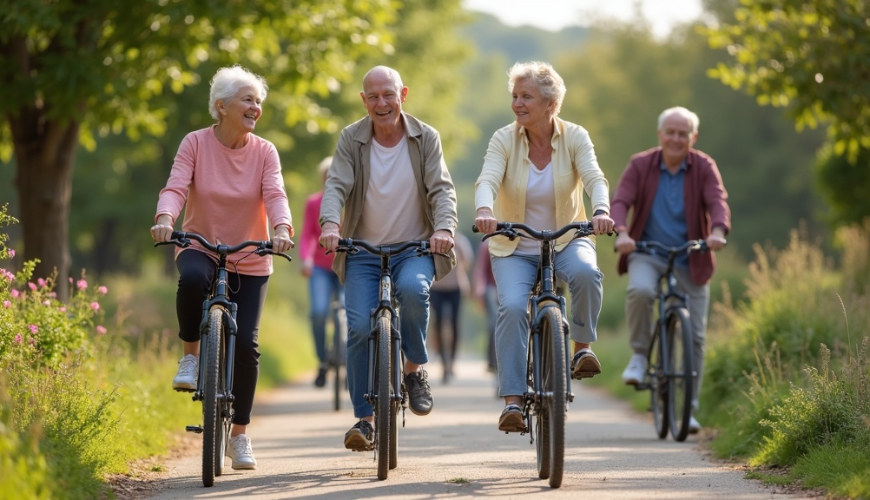
Movement is the second big chapter. And good news: longevity doesn't require running a marathon every day. On the contrary, habits that are sustainable often win. Regular walking, cycling, gardening, taking stairs instead of the elevator – and a few times a week something to strengthen muscles. Muscle mass and strength are essential for healthy aging because they relate to stability, fall prevention, and the ability to manage daily life without assistance. In the context of longevity, it is sometimes said that "strength is an insurance for old age" – and it makes sense.
And then there's sleep, often underestimated but crucial for long-term health. Those who sleep little regenerate worse, have a greater craving for sweets, and handle stress worse. In practice, simple hygiene helps: regular bedtime, fewer screens before bed, a cooler and darker bedroom, a calmer evening. Sleep is not a reward after performance; it is a basic need. And in longevity, it shows that the body does not "forgive" long-term neglect of regeneration.
Stress is a chapter in itself. There is no life without stress, but there is life without chronic stress that stretches for weeks and months. Longevity paradoxically often relates to what cannot be bought: a sense of security, good relationships, having a reason to get up in the morning. In communities that are studied for higher longevity, common traits repeat – regular natural movement, simple food, but also belonging and purpose. One sentence that appears in various forms in health discussions captures it: "The best diet is the one you can live with." And the same applies to the entire concept of longevity.
The environment also plays a role. One spends a large part of life at home – and the household can either be a silent ally or a source of unnecessary burden. Ventilation, dust, scents, cleaning agents, materials that touch the skin… These are all small things that add up. Those looking for "biohacking" often end up with complex protocols, but sometimes the biggest shift is simple: simplifying household chemistry, choosing gentler options, and reducing unnecessary fragrances. It's less flashy than a new pill, but surprisingly practical for everyday life.
Real-life example: when longevity becomes a side effect
Imagine a common situation: someone starts dealing with fatigue and frequent colds. They don't want to "go on a diet" or turn their life upside down, just feel better. They start taking brisk walks three times a week, pause from their phone an hour earlier in the evening, and replace sugary breakfast with yogurt with nuts and fruit. They also open windows more often at home, reduce the number of heavily scented cleaners, and stop buying "all-in-one" products that smell like a chemical garden. After a few weeks, sleep improves, the craving for sweets decreases, energy increases, and suddenly it's easier to add light strength training.
What's interesting about this story is that the goal wasn't longevity. The goal was to function. And that's how longevity often happens: as a side effect of sensible habits that give the body a chance to do its job.
Longevity tips that don't sound like a list of prohibitions
There are plenty of tips to be found everywhere, but to be truly usable, they must be understandable and realistic. And they should not sound like an endless list of prohibitions. Longevity is not a punishment, but a long game in which consistency pays off.
What can work in a regular week
Below is a single list – not as a dogma, but as inspiration on how to translate the topic of longevity into everyday life:
- Movement every day at least a little: ideally walking (even 20–40 minutes), and 2–3 times a week strengthening (body weight, resistance bands, weights – according to possibilities).
- Food based on real ingredients: more vegetables and legumes, fewer ultra-processed foods; sweets more as a supplement than the basis of the day.
- Sleep as a priority: regularity, less light in the evening, a calmer routine; if someone wakes up feeling bad for a long time, they also address the cause (stress, alcohol, overload, environment).
- Relationships and contact with people: regularly see someone with whom it feels good; longevity is not just a biological discipline but also a social one.
- Less unnecessary chemistry at home: reduce strong scents, unnecessarily aggressive cleaners, and air fresheners; often gentler products and good ventilation are enough.
- Sense and rhythm: having something in the week to look forward to and something that gives a sense of usefulness. It's not a "soft" topic – it's a part of health.
Does it sound too ordinary? That's precisely the point. Longevity is not about living sterilely, but living in a way that the body and mind can handle reality over the long term.
Another practical level can be added: prevention and monitoring of basic health indicators. Blood pressure, blood sugar, blood fats, waist circumference, fitness. Not to stress over numbers, but to have a map. Longevity isn't about perfection; it's about timely small course corrections.
And if a change can be made gently, it's often at home. The household is where habits repeat: how food is cooked, what is used for laundry, what is slept in, what is breathed. Gentler choices are not only "ecological," but often more pleasant – less irritating scents, fewer unnecessary substances on the skin, less chaos on the shelf. In the context of a healthy lifestyle, it surprisingly makes good sense.
Finally, there's a question that sometimes gets lost in discussions about longevity: what is longevity for, if it stops you from living? It's reasonable to want to be healthy as long as possible, but just as reasonable not to make health another source of anxiety. Longevity is best built where it can be sustained over the long term – in food that tastes good, in movement that doesn't hurt, in a routine that isn't a prison, and in an environment that supports rather than exhausts you.
"Longevity is not a sprint, but a way to maintain a good pace." And perhaps that is the most practical answer to what longevity is: an approach to life where healthy choices become the norm, not the exception. And when a bit of curiosity and willingness to do things in small steps is added, longevity stops being a foreign word – and becomes a natural part of everyday functioning.