

# Decision-making that silently exhausts us
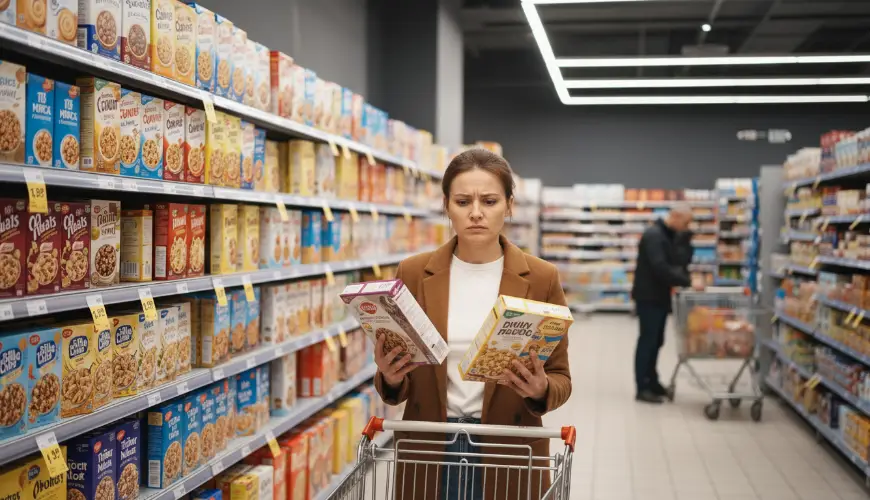
Everyone knows the feeling. You're standing in a store in front of a shelf with thirty kinds of muesli, and instead of just grabbing one and moving on, you spend five minutes comparing ingredients, prices, and packaging design. In the end, you might leave with nothing, or you grab the same one as last time — not because you're satisfied with it, but because choosing something new is simply too exhausting. This isn't laziness or indecisiveness. It has a name: decision paralysis. And in an era when we have more options than ever in history, it has become a silent epidemic that affects everything from buying yogurt to choosing a life partner.
The concept of the "paradox of choice" was popularized by American psychologist Barry Schwartz in his book of the same name from 2004. His main thesis sounds surprisingly simple: the more options we have, the worse we decide — and the less satisfied we ultimately are with what we've chosen. Schwartz draws on a series of experiments, the most famous of which is the so-called "jam study" by Professor Sheena Iyengar of Columbia University. In one supermarket, customers were offered a tasting of six types of jam; another time, twenty-four. The result? The larger selection attracted more curious onlookers, but in the end, ten times fewer people actually bought jam compared to the stand with the limited selection. More options, then, didn't lead to greater satisfaction but to less action.
And we're talking about jam. Imagine what happens when you're deciding about something truly important — a job, housing, health insurance, or your children's education. In such moments, the brain processes an enormous number of variables, compares scenarios, and tries to predict consequences. And when there are too many scenarios, it simply freezes. Neuroscience explains this phenomenon as an overload of the prefrontal cortex — the part of the brain responsible for planning and decision-making. When we overwhelm it with too many options, its performance paradoxically decreases, much like when you open too many applications on a computer at once.
Try our natural products
Why the more options you have, the worse you decide
Decision paralysis isn't just an academic concept. It manifests in everyday life in ways we often don't even realize. One of the most visible symptoms is procrastination. Putting off decisions "until tomorrow" is actually often a defense mechanism of the brain trying to avoid the unpleasant feeling of making a choice. Another manifestation is so-called "decision fatigue" — after a series of even minor decisions throughout the day (what to wear, what to have for breakfast, which route to take to work), we simply no longer have the capacity for the truly important ones. It's no coincidence that Steve Jobs wore the same black turtleneck every day or that Mark Zuckerberg reaches for the same gray T-shirts. It's not a fashion statement but a deliberate strategy to save mental energy for more important choices.
Interestingly, decision paralysis affects those who want to choose "the best" more than others. Schwartz distinguishes two types of people: maximizers and satisficers. Maximizers constantly search for the optimal solution, go through all available options, and even after deciding, doubt whether something better existed. Satisficers, on the other hand, look for a "good enough" solution — once they find an option that meets their criteria, they take it and move on. Research repeatedly shows that satisficers are more satisfied in life, even though they objectively sometimes choose a "worse" option. The reason is simple: they don't torment themselves with doubt.
This has a direct impact on consumer behavior as well. When you're choosing, for example, natural cosmetics or eco-friendly cleaning products, you face dozens of brands, certifications, ingredient lists, and price levels. Should the product be vegan, organic, zero-waste, local, or all of the above? Each additional requirement increases the number of variables while simultaneously decreasing the likelihood that you'll decide at all. The result is that people often end up reaching for a conventional product from a large chain — not because they don't care about sustainability, but because the process of choosing an eco-friendly alternative is simply too demanding. This is precisely why curated e-shops exist — they do the pre-selection for you and offer a limited but carefully assembled collection of products whose quality and values you can trust.
But decision paralysis isn't just about shopping. Psychologists from Princeton and Stanford published a study in 2019 showing that people with too many investment options in pension plans often chose none — and thus missed out on employer contributions, essentially free money. A similar effect is observed with dating apps: research published in the Journal of Personality and Social Psychology suggests that an overabundance of potential partners leads to less satisfaction in relationships and a tendency to constantly search for "someone better." As philosopher Søren Kierkegaard aptly noted back in the nineteenth century: "Anxiety is the dizziness of freedom."
The modern world amplifies this dizziness exponentially. The internet has given us access to a practically unlimited amount of information, reviews, comparisons, and recommendations. This is, of course, wonderful in many respects, but it also creates the illusion that the "perfect choice" exists and that we just need to find it if we search long enough. But it doesn't exist. Every choice comes with trade-offs, and every decision means giving up something else. Economists call this opportunity cost — and the more alternatives we see, the more painfully we feel what we're giving up.
How to escape decision paralysis
The good news is that decision paralysis isn't incurable. There are a number of strategies that help unburden the brain and simplify decision-making — without it meaning a resignation from quality of life.
The first and most effective strategy is consciously limiting options. It sounds banal, but it works reliably. Instead of browsing twenty websites with reviews, set a rule that you'll compare a maximum of three options. Instead of endlessly scrolling through offers, define clear criteria in advance — and buy the first product that meets them. This transforms you from a maximizer into a satisficer, and research shows that this leads to greater satisfaction.
Another effective technique is creating routines and automating recurring decisions. If you cook the same thing every Monday, you don't have to think about what's for lunch. If you have your favorite shampoo and it works, you don't need to browse the entire selection with every purchase. Routines aren't boring — they're liberating. They free up mental capacity for decisions that truly matter.
It also helps to set a time limit. Give yourself five minutes to choose a restaurant. Ten minutes to pick a gift. An hour to choose a new backpack. When time runs out, decide based on what you have — even if it's not perfect. Perfectionism is, after all, one of decision paralysis's main allies. Researchers at Florida State University found that people who decide faster not only save time but on average are just as satisfied with their choices as those who spent many times longer deliberating.
Also worth mentioning is a technique sometimes called the 90% rule. If an option convinces you 90 percent, take it. The remaining ten-percent difference between a "very good" and a "theoretically best" choice is almost never worth hours of additional deliberation. This philosophy is also advocated by author and entrepreneur Derek Sivers, who formulates it even more radically: "If it's not a clear YES, it's a NO." In other words — if something doesn't immediately excite you, move on without guilt.
A practical real-life example: Jana, a thirty-year-old graphic designer from Brno, decided to transition to a more eco-friendly lifestyle. She started by spending an entire weekend browsing blogs, forums, and reviews about natural cleaning products, eco-friendly laundry gels, and sustainable fashion. By Sunday evening, she was exhausted, frustrated, and hadn't ordered a single thing. The following week, she tried a different approach: she chose one trustworthy e-shop with a narrowed-down selection, bought three products that seemed reasonable, and started using them. Some suited her, one she swapped out. But the important thing was that she started — instead of remaining paralyzed in an endless loop of comparison.
This is perhaps the most important lesson. Decision paralysis doesn't just rob us of time and energy; it often keeps us stuck in a status quo that doesn't serve us. People stay in jobs they don't enjoy, in relationships that don't work, or with habits that harm them — not because they don't want change, but because the sheer number of alternative paths overwhelms them. Paradoxically, an excess of freedom leads to inaction.
Psychologist and professor Sheena Iyengar, author of the book The Art of Choosing, recommends yet another approach: categorization. Instead of comparing twenty individual products, a person can first divide them into categories (price range, type, brand) and then choose only within one category. This simple trick dramatically reduces cognitive load while preserving the feeling that we have a choice.
In a broader context, it's also worth considering how decision paralysis affects society as a whole. When people can't decide whether to sort their waste, eat less meat, or buy local products — not because they don't want to, but because they don't know exactly where to start and what's "good enough" — we lose enormous potential for positive change. That's why it's so important that information about sustainable living is not only accessible but also simple and specific. The most effective call to action isn't "change your lifestyle" but "try swapping one thing next week."
Finally, it's good to remember that most decisions in life are reversible. If you buy the wrong shampoo, you'll buy a different one next time. If you choose a less-than-ideal career path, you can change direction. The brain tends to overestimate the consequences of individual decisions and underestimate its own ability to adapt. Psychologists call this the "psychological immune system" — our ability to come to terms with an outcome and find the positives in it is much stronger than we think.
So the next time you're standing in front of a shelf full of options and feel that familiar pressure in your head, try taking a breath and reminding yourself of one thing: the worst decision is no decision. Choose, move on, and trust that "good enough" is almost always more than enough.