
Naturalistic home staging bets on stone and wood
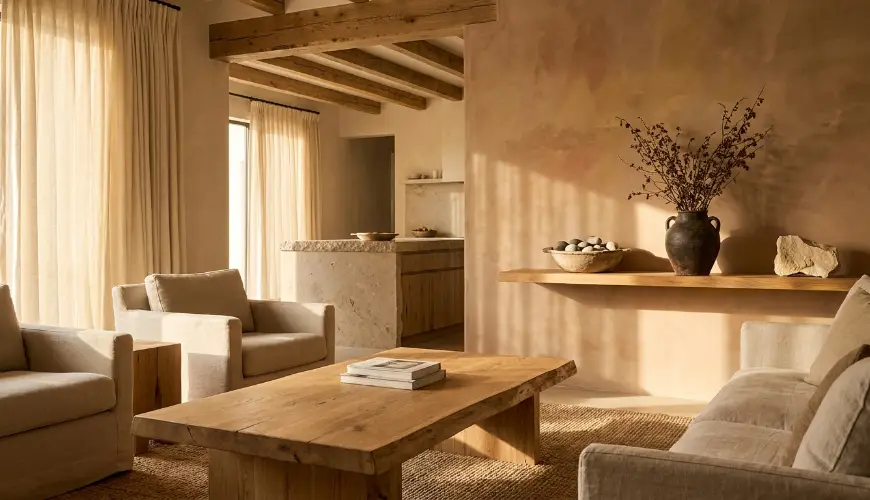
When you walk into a well-furnished apartment where the raw surface of a stone slab, the warm texture of wooden beams, or a finely worked clay plaster on the wall immediately catches your eye, you rarely stop to think about why you feel so comfortable there. Yet the answer is surprisingly simple – nature in the interior acts as a natural anchor point for our psyche. And it is precisely on this principle that naturalistic home staging is built: an approach to presenting and arranging homes that has been attracting growing interest in recent years, both among real estate agents and property owners who want to get the most out of their home – whether for sale, rental, or simply out of a desire to live more beautifully.
Home staging itself is nothing new. It is the thoughtful preparation of a property so that it appears as attractive as possible to potential buyers or tenants. While classic staging worked primarily with furniture, colours, and lighting, the naturalistic variant goes a step further and places natural materials at the centre of attention – stone, wood, and clay. These three elements have the ability to transform a cold, impersonal space into a place that immediately says "home." This is no coincidence or passing trend, but the result of a deep human relationship with the natural world that persists within us despite the modern way of life in concrete cities.
Try our natural products





Why natural materials attract us so strongly
Psychologists and architects have been studying this phenomenon for decades. The concept known as biophilia – the innate human affinity for nature and living systems – explains why we feel calmer, safer, and more content in spaces featuring natural materials. Research repeatedly shows that the presence of natural elements in an interior lowers stress hormone levels, improves concentration, and promotes overall wellbeing. These are precisely the feelings we want to evoke in a potential buyer when they first step through the door of a property they are viewing.
Naturalistic home staging is therefore not just about aesthetics, although that naturally plays a key role. It is about deliberately creating an atmosphere that resonates with the deepest layers of our psyche. Stone evokes permanence and solidity, wood warmth and naturalness, and clay groundedness and authenticity. Together they form a trio capable of balancing a modern interior and lending it a depth that no synthetic substitute can achieve.
Imagine a specific situation: a family is selling an older brick apartment in the city centre. The walls are plain, the floors standard laminate, the kitchen functional but lacking character. The real estate agent suggests a simple staging – a solid oak coffee table with a natural edge is added to the living room, a few river stones and a small ceramic vase of rough, dark clay appear on the shelf, and a wooden step stool and stone soap dishes are brought into the bathroom. The result? The photographs from the viewing take on an entirely different character, the apartment begins to feel "cosy and authentic," and visitors describe it during viewings with phrases like "I could feel at home here." That is not magic – that is naturalistic staging in practice.
How to work with stone, wood, and clay
Let us begin with stone, as it tends to be the least accessible material for many people and at the same time the one that most dramatically transforms the overall impression of a space. Stone in an interior does not necessarily mean massive wall cladding or expensive marble slabs – although neither can be dismissed if the space calls for it. In the context of staging, it is often more effective to work with stone as a detail. River pebbles in a bowl, a slate tray under candles, a stone coaster under a houseplant, or a small piece of unworked limestone on a shelf – all of these add a layer of authenticity to a space that simply cannot be purchased at any chain decoration store.
When it comes to larger investments, a stone sink in the kitchen or bathroom, natural stone cladding behind a fireplace, or a stone kitchen island worktop are all elements that significantly increase the perceived value of a property. As the National Association of Realtors notes, well-executed staging can increase a property's sale price by 1 to 5 percent and reduce the time to sale by tens of percent – and natural materials are among the most powerful tools for achieving this.
Wood is probably the most versatile material in naturalistic staging. Its great advantage is its immense variability – from light birch through warm oak to dark walnut or exotic hardwoods. Each type of wood brings a different character, which is why it is important to choose with the overall interior style in mind. Solid wood with visible grain and natural texture creates a different impression than smoothly sanded veneer, and both approaches can be right – it depends on the context.
In staging practice, wood is most commonly used as an element that brings warmth to an otherwise neutral space. Wooden ceiling beams, even purely decorative ones, instantly change the character of a room. A solid wooden dining tabletop creates the centrepiece of an entire room. Wooden frames for mirrors and pictures unite diverse elements into a coherent whole. And then there are the small touches – a wooden fruit bowl, bamboo placemats, a small branch magazine rack. These details are precisely what determines whether an apartment looks in photographs like a natural, lived-in place or a sterile showroom.
Clay and ceramics are perhaps the least appreciated but all the more powerful tool in the context of naturalistic staging. Clay plasters have been experiencing a genuine renaissance in recent years – and with good reason. Their texture is unique, the surface never perfectly smooth or uniform, and it is precisely in that imperfection that their charm lies. Clay plaster on a single accent wall can transform an ordinary room into a space that people describe as having "a soul." Clay plaster also has excellent properties in terms of humidity regulation and thermal comfort, making it a material that is not only beautiful but also functional.
Ceramics made from coarser clay – whether vases, bowls, candleholders, or tiles – bring an organicism to an interior that synthetic materials simply lack. Each piece is slightly different, each bearing the traces of the potter's hand. This aspect of handcrafted objects is extraordinarily valued in an age of mass production and gives a space a sense of uniqueness. It is no coincidence that Scandinavian design, which has always favoured naturalistic elements, remains one of the most popular interior styles in the world.
Naturalistic staging in practice: what not to forget
The transition from theory to practice is surprisingly smooth in the case of naturalistic staging, because the fundamental principle is simple: less is more, and less is more natural. The biggest mistake people make is overcrowding a space with natural elements in an attempt to create the strongest possible impression. The result is often chaos that has precisely the opposite effect to the intended sense of calm. Naturalistic staging operates on the principle of deliberate restraint – every natural element should have its place, its space, and its reason for being there.
A useful guideline is the rule of three: a group of three objects of varying heights and textures creates a visually interesting composition without overwhelming the space. A stone bowl, a wooden figurine, and a clay vase with dried branches – this is an example of such a trio that works in almost any interior. As the celebrated Japanese designer Kenya Hara says: "Beauty lies not in presence, but in the tension between presence and absence." And it is precisely this tension that is key in naturalistic staging.
It is also important to think about the relationship between materials. Stone and wood communicate naturally with each other – they are two elements that occur together in nature, and our brains perceive them as a harmonious whole. Clay then acts as a binding agent that connects these two worlds. The combination of all three in a single space therefore does not feel like a random collection of decorations, but as an intentional and considered whole.
When selecting specific products and materials, it is worth reaching for local and natural sources. Czech sandstone, Moravian ceramics, or timber from domestic forests are not only a more ecological choice – they also have the advantage of being authentically connected to the place where the property stands. This local rootedness is an increasingly valued quality, as buyers and tenants are seeking homes with a story and an identity.
For those who wish to carry the naturalistic approach into everyday life – not just into staging for a sale – eco-friendly shops focused on natural materials and sustainable household products are an excellent starting point. At Ferwer.cz you can find a wide range of products that resonate with this approach – from natural cosmetics and eco-friendly household accessories to objects that bring a natural aesthetic to an interior without unnecessary ecological impact.
Naturalistic home staging is not merely a trend that will fade with the arrival of the next design movement. It is a response to a deep need of modern people – the need for contact with nature, authenticity, and meaningful beauty in everyday surroundings. Stone, wood, and clay are materials that have endured thousands of years of human civilisation, and they have endured because they give us something essential. Homes that work with these materials consciously and sensitively are not merely selling square metres – they are selling the feeling of finally returning to where one belongs.