

Self-care in motherhood, grounded in reality, not in perfect rituals
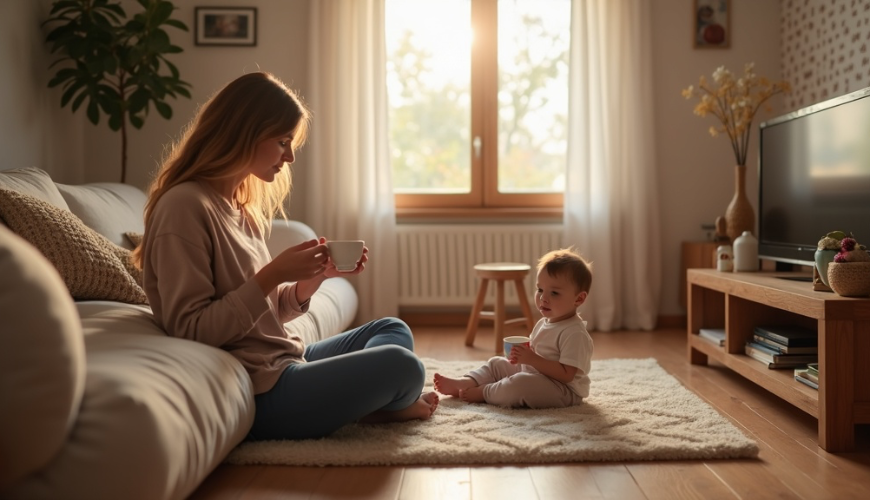
Motherhood is a unique period: on one hand, there is intense closeness, a new daily purpose, and the discovery of one's own abilities; on the other hand, there is fatigue, performance pressure, and the feeling that life has narrowed down to an endless list of someone else's needs. This is where a topic arises that has been discussed almost everywhere in recent years – self-care in motherhood. However, there is often a gap between the inspiring quotes on social media and a real day with a toddler. Therefore, it's worth speaking openly about how to take care of yourself during motherhood – reality versus expectations. Not as another obligation, but as something that should be supportive, not burdensome.
In everyday life, “self-care” is easily mistaken for luxurious rituals: a long bath, silence, a book, yoga by candlelight. But what if the biggest victory of the day is a warm cup of tea drunk before it gets cold? Self-care in motherhood takes on a much more practical form. It’s the ability to recognize your own needs, set boundaries, and take small steps that keep both body and mind functioning. Sometimes, it’s also the courage to admit that saying “I can’t do this today” is just as legitimate as saying “I did it.”
Try our natural products


Reality versus Expectations: Why Self-Care So Easily Breaks Down
Expectations can be subtle. They come in the form of well-intentioned advice (“sleep when the baby sleeps”), in comparisons (“she handles it with a smile”), and in one’s own visions of what motherhood will look like. Reality often looks like this: the baby doesn’t sleep when it “should,” the household doesn’t maintain itself, and fatigue can’t be solved in one afternoon. On top of this, there’s the pressure to be not only a loving mother but also a partner, employee (or at least “someone who is progressing”), ideally with time for friends, exercise, and healthy cooking.
The problem is that self-care during motherhood is sometimes presented as another project: “make a plan,” “set routines,” “ensure 10 minutes for yourself daily.” But when the day is broken into short segments and the baby needs physical closeness, it’s more about flexibility than plans. It’s also about understanding that self-care isn’t just what you do but also what you stop doing – like trying to always be available and pleasant at any cost.
Biology also comes into play. Interrupted sleep at night, hormonal changes, breastfeeding, recovery after childbirth – these aren’t “trivialities,” but significant factors affecting the psyche. It’s no coincidence that expert sources have long emphasized the importance of mental health support during the postpartum period; useful frameworks are provided by the World Health Organization’s information on mental health in the perinatal period on the WHO website. If self-care is reduced to a cosmetic ritual, it easily misses the essence: without basic rest, food, support, and safety, “wellness” becomes just a nice word.
And then there’s another thing: motherhood is often invisible work. When things are going well, no one notices; when they’re not, it’s immediately apparent. This creates an environment where women learn to “keep it together” even at the expense of themselves. Yet, sometimes, a simple reframing suffices: self-care is not selfishness, but maintenance of the system that looks after the child.
“You don’t have to do everything. You have to do what is sustainable.”
It sounds banal, but in practice, it’s one of the most relieving sentences motherhood can offer.
Self-Care in Motherhood: Small Steps That Truly Count
When we say “take care of yourself,” many parents envision time alone. This is important but often unavailable. Therefore, it makes sense to start from the most basic layers: body, mind, environment, and relationships. Not as four chapters in a textbook, but as four places to seek relief.
In the body, it’s often most visible. Meals are eaten standing up, drinks are postponed because “there isn’t time now,” and sleep becomes a rarity. Yet, even small adjustments can change the entire day. Sometimes, it helps to have a water bottle on hand at every “station” (by the bed, the stroller, in the kitchen), or a prepared simple snack that satiates – nuts, fruit, bread, hummus. It’s not about a perfect diet but about ensuring the body doesn’t get the signal “we’re in emergency mode” by ten in the morning. Self-care in motherhood often begins with the most ordinary things: eating and drinking on time.
Similarly, it’s with movement. The approach “either an hour of exercise or nothing” often leads to nothing in motherhood. Yet, a short walk, a few minutes of stretching, or a quick airing of the room can do more than an ambitious plan left on paper. And if combined with a sustainable approach – like walking instead of driving short distances – the body receives a regular signal that it’s being cared for.
A big topic is also the psyche. Motherhood can be isolating, even when one is constantly with someone. The mind runs in the background: what the child ate, when it slept, when the next check-up is, what’s run out at home. Therefore, it’s important to seek “micro-rest.” Not necessarily meditation in the lotus position, but perhaps three minutes of silence when the child looks at a book. Or mindful breathing by the window before starting dinner. Short breaks aren’t embarrassing or insufficient – they are realistic.
It also helps to reduce the mental load at home. Not by perfectly organizing everything, but by simplifying some things: fewer toys in circulation (and less tidying), simple cooking that can be repeated, and acceptance that a household with small children will be lived in. A sustainable home isn’t just about ecology, but also about the nervous system: fewer unnecessary things often mean fewer decisions. When choosing eco-friendly home products and cosmetics without unnecessary chemicals, it’s not just a trend – for many families, it’s a way to reduce stimuli and worries. When the routine is simpler, there’s more room for relaxation.
And then there are relationships. Self-care in motherhood often hinges on whether it’s possible to ask for help without feeling guilty. Many women have the notion that a “good mom” can handle it all. But motherhood was never meant to be a solo discipline. Support from a partner, family, friends, or community services isn’t a sign of weakness but of healthy settings. Sometimes, it’s enough for someone else to take out the trash, cook soup, or take the child out for half an hour. Not so the mother can “catch up on cleaning,” but so she can take a moment to breathe.
Real-Life Example: A “Free Half Hour” Doesn’t Have to Be Productive
A common situation in many households might look like this: the toddler finally falls asleep. Instead of relief, an internal alarm goes off – quickly tidy up, quickly reply to messages, quickly finish something. After twenty minutes, one feels just as exhausted as before, only with the added feeling of having “done too little.” In one family, they solved this with a simple rule: when the child falls asleep, the first ten minutes it’s “forbidden” to do housework. Tea, a shower, lying on the couch, anything. Only then do they decide whether it makes sense to tackle anything. The result wasn’t a more perfect apartment, but that the mother stopped feeling like she was on shift without a break. And sometimes, that’s what determines how the rest of the day will go.
This rule is surprisingly effective because it teaches one important skill: distinguishing what is necessary from what is just a voice in the head wanting to have everything under control.
How to Manage Self-Care with Small Children Without Feeling Like a Failure
When children are young, time isn’t divided into hours but into windows between needs. Therefore, it’s useful to view self-care as something that can be “inserted” into the day in small doses. Not as a perfect regime, but as a set of small habits that can be repeated even in chaos.
Often, the biggest change comes from working with expectations. If self-care is understood as “I must indulge myself,” it easily turns into additional pressure. But if it’s understood as “I must maintain basic capacity,” it starts to make sense even on the busiest days. And sometimes, it means making a decision that doesn’t look pretty at first glance: ordering food, skipping a visit, postponing cleaning, asking for babysitting. Sustainability is often more important than the ideal in motherhood.
The practical question is: what specifically helps when there’s no babysitting, the child is often sick, and energy is at zero? In such a situation, it’s worth relying on a few “safety points” that don’t require much logistics. And mainly: that work not only when things are going well, but also when they’re challenging.
As the only single list in the entire text, here are some realistic options for managing self-care with small children in daily operation:
- Lower the bar for things that won’t significantly harm anyone if done later: perfect cleaning, complex cooking, ideal daily routine.
- Introduce a “minimal version” of self-care: a quick shower, clean clothes, simple food, ten minutes of fresh air.
- Create one small anchoring ritual that can almost always be done: morning tea, evening hand cream, two pages of a book, short stretching.
- Agree on specific help, not on vague “if you need something”: for example, weekly babysitting for an hour, shopping, picking up a package.
- Limit comparisons, especially online: if content creates pressure or guilt, it’s okay to mute it.
Essentially, self-care in motherhood often happens “despite” circumstances, not because of them. Therefore, it’s fair to stop evaluating it based on how it looks from the outside. Sometimes the greatest self-care is stopping punishing oneself for not being in top form.
An important role is also played by how exhaustion is talked about. Maternal fatigue is sometimes trivialized as something “that comes with it.” It does – but that doesn’t mean nothing can be done about it. If long-term sadness, anxiety, irritability, loss of joy, or a feeling of disconnection are added, it’s time to seek professional help. A good starting point can be information on postpartum depression and anxiety from the NHS (the British public health service offers an understandable description of symptoms and support options). In the Czech environment, a general practitioner, gynecologist, psychologist, or crisis lines can help – and mainly the awareness that asking for help is not a failure, but a mature decision.
Motherhood also often reveals how much the environment matters. When the home is set up so that everything “must be” – fragrant, polished, perfectly coordinated – it’s beautiful but sometimes unsustainable. A more sustainable path is often simpler: fewer things that need to be managed, and more things that serve. Even small things, like having a gentle universal cleaner that handles most of the household or gentle cosmetics suitable for sensitive skin, save time and mind. When the routine is simplified, there’s room for real relaxation.
And what if the question arises: “And where do I find the time?” Perhaps a more accurate question is: where can something be trimmed? Trim obligations based on impressions, not needs. Trim perfectionism. Trim efforts to be available to everyone. Motherhood itself is a big job; self-care isn’t something extra, but a way to do that job without burning out.
In the end, the most interesting thing is: children learn from self-care. Not from what is said, but from what they see. When they see a parent who can eat, rest, ask for help, and set boundaries, they receive a silent lesson in self-respect. And perhaps that’s one of the most practical answers to how to take care of yourself during motherhood in reality, not expectations: don’t wait for ideal conditions, but look for small, repeatable opportunities that keep you afloat – today, tomorrow, and on those days when everything falls apart.
When you manage to drink a warm tea, sit down for a moment, or calmly wash your face in the evening, it’s not “little.” It’s a signal that even in a period when you care for others almost continuously, there’s still space for one important person who shouldn’t disappear from the list of needs: mom as a person.