
How to Rinse Your Nose Properly With a Neti Pot and Avoid Common Mistakes
The nose is the human body’s first line of defense against viruses, bacteria, allergens, and dust. Yet we pay surprisingly little attention to it—until it starts causing trouble. Rinsing the nose with a special pot, known as a neti pot, is one of the oldest and most effective ways to keep the nasal passages clean, moisturized, and healthy. It originated in Ayurvedic medicine, where it has been practiced for thousands of years, and today it is also recommended by modern otolaryngologists around the world. But as with anything that seems simple, mistakes can turn the whole ritual into an unpleasant or even dangerous experience.
Consider the experience of Markéta, a thirty-year-old teacher from Brno who suffers from seasonal allergies. “I tried rinsing my nose with a neti pot for the first time in the spring because a colleague had told me how much it helped her. I poured tap water into the pot without dissolving any salt in it, and the result was disastrous—burning, pressure in my head, and a feeling that I was drowning,” she recalls. Unfortunately, this experience is all too typical. Not because the method doesn’t work, but because Markéta—like many other beginners—did it incorrectly.
Try our natural products



Why technique matters more than we think
Nasal irrigation with a neti pot works on a simple principle: a saline solution flushes through one nostril, passes through the nasal cavity, and flows out of the other nostril. In the process, it removes mucus, allergens, dust, and bacteria. According to the Mayo Clinic, regular use can significantly relieve the symptoms of chronic rhinitis, sinusitis, and seasonal allergies. It sounds simple—and it really is. But that apparent simplicity makes it easy to overlook details that determine whether the rinse will be pleasant and beneficial or unnecessarily uncomfortable.
The most significant mistake, and the one people make most often, is using unsuitable water. Although tap water from Czech water supplies is safe to drink, it is generally not recommended for rinsing the nasal cavity—for several reasons. It contains chlorine and other substances that can irritate the sensitive mucous membrane. More serious, however, is the risk posed by microorganisms. In its guidance on the safe use of neti pots, the U.S. Food and Drug Administration (FDA) expressly warns against using untreated tap water because it may contain microorganisms that are harmless to a healthy digestive tract but can cause serious infections in the nasal cavity. The ideal choice is water that has been boiled and cooled, distilled water, or a special saline solution intended specifically for nasal irrigation.
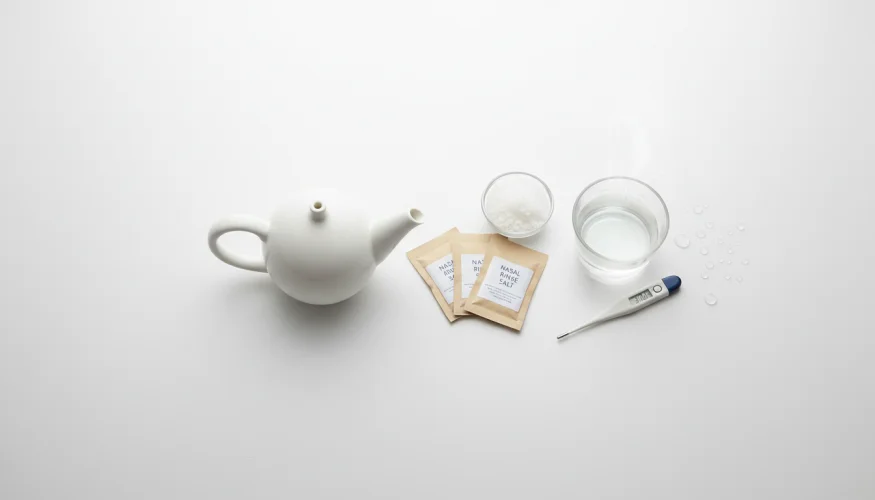
The second most common mistake is closely related to the first: the wrong salt concentration. A nasal rinse should have approximately the same osmotic concentration as body fluids—that is, roughly a 0.9% sodium chloride solution, similar to physiological saline. If there is too little salt or none at all, the water causes burning and irritation of the mucous membrane. If there is too much salt, the membrane dries out and becomes even more irritated. Premeasured salt packets, available at pharmacies and healthy-living online stores, make accurate dosing easier—one packet per approximately 240 milliliters of water is usually the right amount.
A third problem, discussed less often but troubling many beginners, is water temperature. Cold water causes an unpleasant shock to the mucous membrane and can trigger a reflex contraction that makes rinsing difficult or impossible. Water that is too hot, on the other hand, can cause burns. The optimal temperature is body temperature—approximately 36 to 37 degrees Celsius. The water should feel pleasantly neutral, neither cold nor hot. A simple test: place a few drops on the inside of your wrist, as you would when preparing baby food.
Body position, breathing, and other details that make a difference
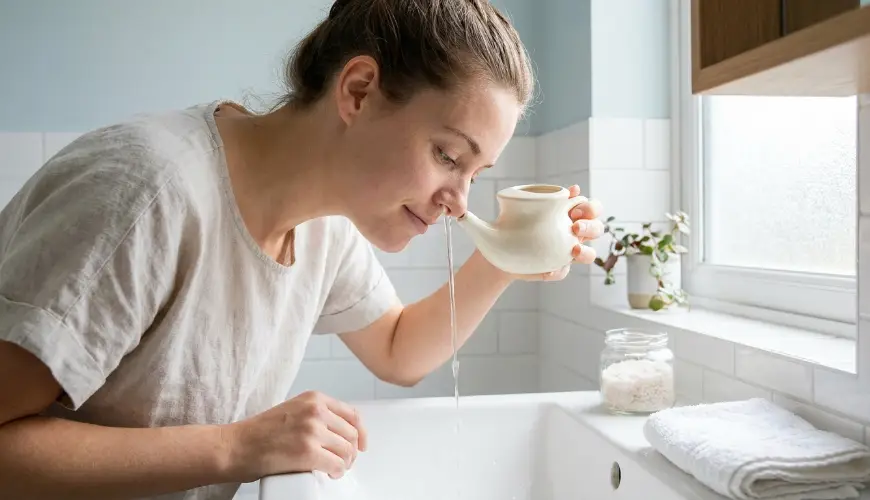
The rinsing technique itself is perhaps where mistakes are most common. Correct body position is absolutely essential. The head should be tilted approximately 45 degrees to the side over a sink, not backward. Many people instinctively tilt their heads back, causing water to flow into the throat or into the Eustachian tube leading to the ear—and this can be not only unpleasant but also risky. An incorrect head position is often the cause of a feeling of pressure in the ears or a headache after rinsing.
Just as important as position is breathing. During the rinse, you need to breathe through your mouth—calmly, slowly, and regularly. If you hold your breath or try to breathe through your nose, the natural pressure balance in the nasal cavity is disrupted and water may be forced into the wrong areas. As Czech otolaryngologist Dr. Pavel Komínek says: “Nasal irrigation is like meditation—it works best when you don’t try too hard but simply let things flow.” This metaphor may be a little poetic, but it captures the essence of the matter very accurately.
Another often overlooked point is blowing your nose properly after the rinse. Many people immediately blow both nostrils forcefully at once, creating pressure that can push residual water or mucus into the sinuses or middle ear. The correct approach is to blow gently, one nostril at a time, without using too much force. Some experts recommend waiting upright for a while after rinsing so that the water can drain naturally.
The frequency of rinsing is another subject surrounded by myths. There is no need to rinse your nose with a neti pot every day throughout the year. A daily routine makes sense during an acute cold, allergy season, or exposure to a dusty environment. When you have no symptoms, rinsing once or twice a week is sufficient as a preventive measure. Paradoxically, rinsing too often can disrupt the natural environment of the nasal mucous membrane and deplete the beneficial bacteria that form part of its natural microflora. A study published in the professional journal American Journal of Rhinology & Allergy suggests that long-term daily rinsing may reduce the natural resistance of the nasal mucous membrane in some people.
A major mistake related more to the choice of equipment than to the technique itself is inadequate neti pot hygiene. Whether ceramic, plastic, or silicone, the pot must be thoroughly washed after every use and—crucially—completely dried. A damp environment is an ideal breeding ground for bacteria and mold. Experts recommend regularly sterilizing the pot by boiling it or putting it in the dishwasher, if the material allows. Plastic pots should also be replaced approximately every three months, as microscopic scratches on the surface can harbor microorganisms.
A separate category of mistakes involves situations in which nasal irrigation with a neti pot is not appropriate at all. A rinse should not be performed when the nose is completely blocked—if the nasal passages are entirely obstructed, the liquid has nowhere to drain and pressure in the sinuses rises dangerously. In that case, it is better to first use nasal drops or a spray to reduce swelling and only then proceed with the rinse. People with a perforated nasal septum, those who have undergone surgery on the nose or sinuses, and those with an acute middle ear infection should also avoid rinsing.
For clarity, here are the most common mistakes in one place:
- Using untreated tap water instead of boiled or distilled water
- Incorrect salt concentration—too little or too much
- Water that is too cold or too hot
- Tilting the head backward instead of correctly tilting it to the side
- Holding your breath or breathing through your nose during the rinse
- Blowing both nostrils forcefully at once immediately after the rinse
- Neglecting to clean and dry the pot
- Rinsing when the nose is completely blocked
Nasal irrigation with a neti pot is a method that produces genuinely demonstrable results when performed correctly. It helps people with chronic sinusitis, pollen allergies, or a dry nose caused by air conditioning or heating, and it can also serve as supplementary care after respiratory infections. It is not a substitute for medical care, but it has an important place as part of daily upper respiratory hygiene—much like brushing your teeth.
Markéta from Brno, whose first attempt at nasal irrigation went so badly, did not give up in the end. After reading the proper instructions, she bought a new ceramic pot and premeasured salt packets and began using boiled water. “Now I do it every morning during pollen season, and it feels completely different. I can finally breathe through my nose, and I don’t have to take as many antihistamines,” she says. Her story shows that the difference between an unpleasant experience and a genuinely beneficial routine lies in the details—and those details are worth paying attention to.