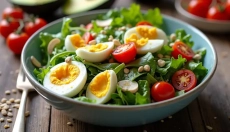

Living healthily without pressure is possible, even when self-care becomes just another task.

Living in a healthier rhythm is often marketed as a project today. Charts, apps, pedometers, thirty-day "challenges," shopping lists of superfoods, and alongside them, a subtle feeling that if you're not doing it, you're neglecting something. But here's where a paradox arises: the effort to live healthily can turn into another source of tension. Instead of peace, performance pressure comes in, posing as motivation but tasting more like stress inside.
This might sound familiar. In the morning, a person wakes up and even before getting up, there's a list running through their head: more exercise, better diet, less sugar, more sleep, more water, less phone, more presence. And then there's work, family, responsibilities, and a world that doesn't stop. It's no wonder that an insistent question sometimes arises: When will it be enough? That's why it makes sense to talk about how to live healthily without pressure – and at the same time, how to get rid of the feeling that I must do more, without giving up on self-care.
Try our natural products
Healthy Lifestyle Without Pressure: Why Self-Care Becomes Another Task
In recent years, health has shifted from the realm of natural care to the sphere of personal performance. Those who "work hard" are praised. Those who rest feel guilty. Those who try to eat reasonably may feel like every bite is a test. And those who try to lose weight often slip into an "all or nothing" mode. Meanwhile, the body reacts to stress in very specific ways: stress hormone levels rise, sleep worsens, cravings for quick energy increase, and patience dwindles. In other words, stress and excessive demands on oneself can complicate even the best-intentioned changes.
It's important to notice that pressure often doesn't just come from outside. Yes, social media can create the feeling that everyone else manages to run, cook, meditate, and still smile. But the biggest driver is usually inside: an inner voice that says a "proper" person should be more disciplined, slimmer, more productive, calmer, more grateful. And when it doesn't work out, punishment comes: self-deprecation.
Yet health cannot be won. It's a relationship – changeable, sometimes gentle, sometimes challenging. And a relationship cannot be improved by reproaches. Curiosity and kindness are much more effective: What will really help me now? What is realistic at this moment? It's not a comfortable question for a perfectionist, but it is a question that brings a healthy lifestyle back to human dimensions.
A broader context of how stress affects the body can also be a support – for example, an overview of the stress response and its impacts from the American Psychological Association shows that long-term tension is not just "in the head," but it affects sleep, immunity, and mood. Combined with the constant pressure to "improve," it creates the perfect recipe for exhaustion.
How to Get Rid of the Feeling "I Must Do More" When You're Already at Your Limit
The feeling that one must do more often doesn't stem from laziness but from unclear boundaries. The day is full of small "shoulds" that together create a heavy backpack. And sometimes health gets added to it: "I should exercise more." "I should cook something better." "I should meditate." But when energy is limited, each additional task means something else falls away – and often it's rest that falls away.
It helps to stop treating healthy habits as a moral obligation. A healthy habit isn't a mark of character, but a tool that should serve. Once it becomes a whip, it stops working. In practice, this can mean a simple shift: instead of "I must," try "I choose." It's not just semantics; it's about regaining control. Performance pressure often grows where a person forgets they have a choice.
It's also very useful to work with the minimum that is achievable even in a challenging week. Not with an ideal, but with a version for reality. Instead of an hour-long workout, the goal can be twenty minutes of brisk walking. Instead of a perfect meal plan, one nutritious meal a day. Instead of "no sugar," conscious limitation of sweets in situations where they are really grabbed automatically. This approach has one major advantage: it's not based on euphoria, but on continuity.
And then there's one more thing that's talked about less: when a person tries to be "healthy," they're often actually addressing a sense of safety. When life is confusing, control over food, exercise, or routine gives the impression that at least something is in hand. That's human. It's just good to notice when care turns into control. Because at that point, the goal is not health, but calming anxiety – and that's a different need that is treated in other ways.
One quote that captures this without unnecessary harshness: "You don't have to do everything. It's enough to do enough." In that sentence, there's room for life – and for health not being another competition.
When Performance Pressure Turns into Chronic Stress: Practical Steps
In a typical day, stress appears subtly: faster pace, tight stomach, tense shoulders, restlessness. Then comes the evening when a person "rests" by mindlessly scrolling because there's no strength left for anything else. The next day it repeats. Stress and excessive demands on oneself gradually become the norm – and that's when it's hard to recognize that it's too much.
Here, it helps to return to the basics, but without fanaticism. A healthy lifestyle without pressure often consists of small, seemingly ordinary things that add up:
- Sleep as a priority, not as a reward for completed tasks. If you can't sleep longer, you can often sleep more regularly.
- Food as stability, not as a project. In practice, sometimes it's enough to have basics at home: oats, legumes, quality bread, vegetables, eggs, or tofu – and from that, you can put together a simple meal even in stress.
- Movement as relaxation, not as punishment. Walking, short stretching, biking to work. The body often doesn't need extremes, but rhythm.
- Micro-breaks during the day. Two minutes without a screen, a few deep breaths, short stretching – little things that reduce internal pressure.
It's surprising how much the psyche changes when you stop pushing for perfection. Instead of the question "How to manage it all?" the question "What is the smallest step today that will help me?" is more appropriate. Such a step can be simple: prepare a water bottle, add vegetables to lunch, walk one stop. Living healthily without pressure isn't about achieving the maximum every day; it's about stopping treating the body as another checklist item.
A Real-Life Example: "Healthy Regime" as Another Stressor
A typical situation looks like this: a person works in an office, deadlines pile up, and in the evening they return home late. They decide that "now I'll really start living healthily." They buy lots of things, plan to exercise four times a week, and follow a strict meal plan. The first three days go well, on the fourth day comes poor sleep, and on the fifth day, a demanding meeting. In the evening, there's no energy left. Instead of a short walk, there's a reproach: "Again, nothing." And to cover up the unpleasant feeling, they have something sweet because it's a quick comfort. This leads to even greater guilt and an even stricter plan. The cycle closes.
In such a moment, paradoxically, it's helpful to do less. Not out of resignation, but out of wisdom. When the week is tough, the goal doesn't have to be training but regeneration: go out for fresh air, have a warm meal, go to bed half an hour earlier. From the outside, it doesn't look like "performance," but inside, capacity begins to restore. And it's capacity that allows for long-term changes.
Why "Stricter" Usually Doesn't Mean "Better"
Excessive strictness often works short-term because it relies on adrenaline and determination. But long-term, it collides with reality: illness, work peaks, family duties, menstruation, mental fatigue. The body is not a machine, and life is not a straight line. Those who count only on ideal days will always feel like they're failing.
A much more stable strategy is the "good enough" approach. Not as an excuse, but as a realistic philosophy. When a person stops punishing themselves for fluctuations, they return more easily. And that's ultimately healthier than a cycle of extremes.
In this regard, it's worth noting the perspective on movement and health from authoritative sources – for example, the World Health Organization's recommendations on physical activity show that even regular activity throughout the week, not just "hard training," is beneficial. This is good news for anyone who feels that if they're not exercising fully, it doesn't count.
Subtle Signals That It's Too Much
Sometimes, performance pressure poses as a virtue. But the body sends signals that it's time to ease up. These include irritability, frequent headaches, impaired digestion, insomnia, fatigue upon waking, loss of joy in things that once pleased, or conversely, numbness. These aren't diagnoses, but rather a map saying: something is happening here.
In such moments, the healthiest step can be surprisingly simple: cancel one "should" task. Give yourself space for downtime without productivity. Stop viewing rest as a weakness. Because when rest is delayed too long, the body eventually takes it by force – in the form of illness or exhaustion.
And if stress persists long-term, it's fair to say what is sometimes trivialized: seeking professional help isn't a failure. It's a form of care. Just like you go to a doctor for back pain, it makes sense to address mental strain when it becomes overwhelming.
A Healthier Home and Sustainable Rhythm as Quiet Support
Health isn't just about food and exercise. The environment in which one lives can either increase or alleviate stress. When a home is full of irritating scents, aggressive cleaners, and the feeling that there's always "something" to clean, it adds another layer of tension. On the other hand, simple, gentle products and routines that aren't demanding can act as quiet support – you don't feel like you're constantly catching up on chores, and at the same time, the home breathes more easily.
Similarly, with fashion and shopping: here too, there can be pressure to "be perfect" – to have a capsule wardrobe, always choose ethical brands, never make a mistake. A more sustainable path often means less drama: wearing things longer, choosing more quality, repairing, shopping thoughtfully. Not perfectly, but consciously.
Ultimately, it shows that how to live healthily without pressure is not a secret system. It's more about the ability to stop chasing an ideal and start noticing what works in real life. Sometimes the biggest change is that health stops being a measure of a person's worth and becomes what it should be: practical, kind care for the body and mind, which have to carry the whole life every day. And when the old familiar feeling "I should do more" arises, a small course correction might suffice – not towards higher performance, but towards more peace.