

You can prepare hard-boiled eggs without cracking by monitoring the time, cooling, and maintaining a
Eggs boiled hard are among those kitchen certainties that seem suspiciously simple. Just water, a pot, and a few minutes. But then reality hits: one egg has a grayish ring in the middle, another peels off in millimeters, the third cracks at the start, and the white turns into a "cauliflower." It's no wonder people keep asking, how long to boil hard-boiled eggs, how long eggs generally boil, and whether there are tips and tricks for boiling and peeling hard-boiled eggs that work in everyday practice.
Good news: they do. Moreover, hard-boiled eggs can be transformed into simple and quick recipes that save a work lunch, a last-minute dinner, or a hearty snack for the road. At the same time, it's an ingredient that stores well, can be combined with legumes, vegetables, and bread, and often helps reduce waste—like when there are leftover boiled potatoes, rice, or the last leaves of lettuce.
Try our natural products
How long to boil hard-boiled eggs: the minutes that matter
First, the most important thing: hard-boiled eggs are not boiled "by eye" but according to time and starting temperature. Eggs from the fridge behave differently than eggs that have been on the counter for a while. It also depends on the size (S, M, L) and whether the egg is placed in cold or boiling water. Both methods are fine, but it's good to stick to one and adjust the time accordingly.
In households, two approaches are most commonly used:
1) Starting in boiling water (more precise and often better for peeling)
Eggs are carefully placed in gently boiling water and only from this moment is the time measured. The advantage is that how long eggs boil can be determined more accurately—since the water already has a stable temperature.
2) Starting in cold water (convenient but less precise)
Eggs are put into a pot, covered with cold water, brought to a boil, and then the time is calculated from a certain point. It's simple, but results may vary depending on the stove's power, the amount of water, and the type of pot.
Now to practice: when it comes to how long to boil hard-boiled eggs, most people prefer a completely firm yolk without a greenish-gray edge. This typically occurs with overly long cooking or slow cooling. The egg can still be eaten, but the taste and appearance suffer.
Approximate times (for size M eggs from the fridge, starting in boiling water):
- 9 minutes: firm white, yolk almost firm (still a bit creamy)
- 10–11 minutes: classic hard-boiled egg, yolk firm and bright yellow
- 12 minutes and more: risk of a drier yolk and gray-green edge increases
If boiling size L eggs, it's worth adding about half a minute to a minute. For small eggs, reduce accordingly. And if the eggs are "from room temperature," the time may be slightly shorter.
Surprisingly, what happens after cooking plays a big role too. An ice bath or at least quick cooling under cold water is not a culinary quirk—it's a simple way to stop the cooking process and keep the yolk nicely yellow. As noted in the USDA's egg safety recommendations, proper handling and quick cooling of boiled eggs make sense not only for quality but also for hygiene in subsequent storage.
And what if the time "slips"? An egg boiled a minute longer is not a disaster. It's just good to cool it quickly to prevent further cooking.
Tips and tricks for boiling and peeling hard-boiled eggs (without stress and waste)
Anyone who has ever tried to peel an egg that stubbornly clings to its shell knows it's not just about aesthetics. When part of the white tears off, the egg loses shape, is harder to slice, and looks battle-worn in a salad. Fortunately, there are a few tricks that increase the chance of smooth peeling.
The age of the egg matters more than it seems. The freshest eggs often peel worse. This doesn't mean you need to wait weeks, but when planning hard-boiled eggs for a spread, sometimes it's helpful to use eggs that have been at home for a few days. Freshness is great for fried or poached eggs, but for hard-boiled peeling, it might be the opposite.
Temperature shock is your friend. As soon as the eggs finish boiling, ideally, they go straight into cold water, even better into ice water. Leave them there for a few minutes. This causes the proteins to contract slightly, creating a "gap" between the shell and the white, making peeling easier.
Start from the right side. Eggs usually have a small air pocket at one end. If you start peeling from there, the shell often comes off more easily. It helps to gently tap both ends and then roll the egg a few times on the counter to crack the shell into a fine mosaic.
Peeling under running water is not a myth. Water gets under the membrane and helps separate the shell from the white. Especially for eggs that are "stuck," it's often the difference between a minute and ten minutes.
Salt or vinegar in the water? It's often recommended to add salt or a little vinegar to the water. It's not a miraculous peeling trick, but it can help when an egg cracks—the white then sets more quickly and doesn't leak out as much. When the main goal is smooth peeling, the correct time and quick cooling have a greater effect.
Gentle boil instead of wild bubbling. A rapid boil increases the risk of cracking and "battering" the shell against the pot's bottom. A gentle boil (a calm bubbling) is kinder to the eggs. It also helps if the eggs are placed in the water with a spoon, not dropped in.
In everyday life, this all fits in easily. Imagine a situation from the workweek: a quick snack is being prepared in the morning, there are a few eggs in the fridge, and you want assurance that in the evening they will peel easily and look good sliced on bread. Just bring water to a boil, place the eggs in the gentle boil for 10–11 minutes, then pour cold water over them and let them cool. In the evening, just peel under a thin stream of water, and it's done—no cutting craters in the whites.
And one more often overlooked thing: storage. Hard-boiled eggs last several days in the fridge, but they are best stored in their shells. Peeled eggs dry out faster and absorb fridge odors. If already peeled, they should be stored in a sealed container and ideally consumed as soon as possible. "Less air, more freshness" applies doubly here.
"Simplicity is strength," is often said—and with hard-boiled eggs, it fits almost literally. A few extra minutes or missing cooling, and a simple task becomes an unnecessary complication.
Simple and quick recipes with hard-boiled eggs that don't take half a day
Once the hard-boiled eggs are ready, the more enjoyable part begins: utilization. Eggs are great for a travel box, salad, spreads, and as an "enhancement" to an ordinary soup. Yet the real magic is in combining them with what you already have at home—leftover cooked lentils, a jar of pickled vegetables, the last piece of bread, a bit of yogurt.
Below are a few ideas that are truly quick and rely on common ingredients. And because sometimes the biggest problem is figuring out what to actually make, they are deliberately practical and versatile.
Egg spread "with three things" (yet not boring)
The base is simple: hard-boiled eggs, quality mustard, and something creamy (plain yogurt, quark, or mayonnaise). Chop or grate the eggs, add a teaspoon of mustard, a pinch of salt, pepper, and something green (chives, spring onion, parsley). For those who want, add a pickled cucumber or a splash of lemon. The result is perfect for sourdough bread, tortillas, or as a dip for vegetables.
In this recipe, it's easy to make a small change that shifts everything: instead of mayonnaise, use yogurt and a bit of olive oil, or add a pinch of smoked paprika. Simple and quick recipes with hard-boiled eggs often rely on such small variations.
Salad that saves a work lunch
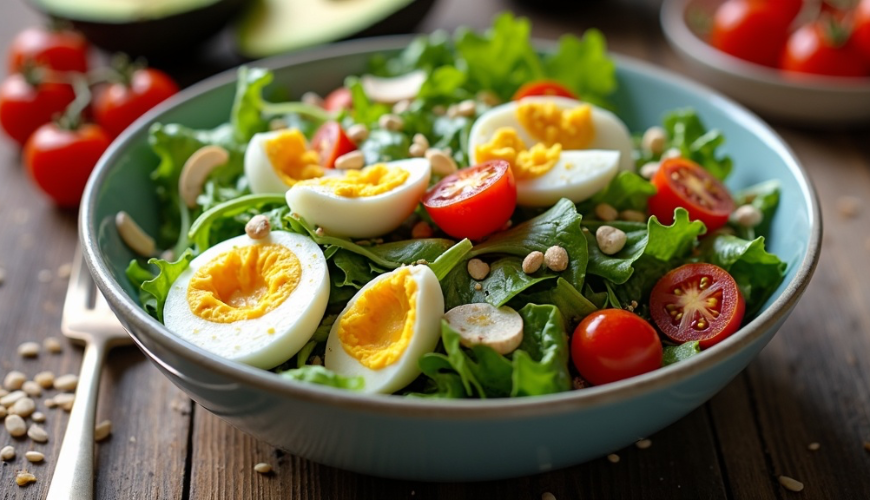
A bowl of leafy greens (or just chopped cucumbers and tomatoes), hard-boiled eggs, a handful of cooked lentils or chickpeas, and a simple dressing of olive oil, lemon, and salt. The egg adds satiety, the legume provides steady energy, and the vegetables offer lightness. Add a handful of seeds or a few olives, and it's a lunch that doesn't feel like a "last resort," even though it was made in ten minutes.
By the way, if you're pondering how long to boil eggs for a salad, it's worth sticking to a firm yolk (10–11 minutes) because the eggs slice better and don't fall apart in the container.
Quick dinner: potatoes, eggs, a bit of acidity
A classic that works even in a modern version: boiled potatoes (even from the previous day), hard-boiled eggs, onions, and a pickled cucumber or sauerkraut. Add a spoonful of quality oil, pepper, and possibly mustard. It's a dish that seems modest but fills you up and simultaneously uses leftovers. And if there's kimchi at home, even a small portion will turn "ordinary potatoes" into something with flair.
Weekday "ramen": broth and hard-boiled eggs
It doesn't have to be cooked for hours. Just a good broth (homemade or quality store-bought), noodles, whatever vegetables the fridge offers, and finally halved hard-boiled eggs. Those who want can add soy sauce and sesame. The egg here serves as a quick protein and simultaneously gives the dish a sense of being a "complete meal," even though it was made quickly.
Travel snack: eggs, salt, something crunchy
The simplest idea is often the best: peeled hard-boiled eggs, a pinch of salt, and then carrots, kohlrabi, or whole-grain crackers. Add a small cup of hummus, and it's a snack easy to eat without utensils and yet not just "something to fill the stomach." It's practical to boil more eggs at once—and that's when it's handy to know how long to boil hard-boiled eggs so they all turn out well.
If the kitchen also considers broader contexts—like where the eggs come from, how they're handled, and how to store them safely—it's good to rely on verified information. Alongside USDA recommendations, the European Food Safety Authority (EFSA) provides a food safety overview in general, as cleanliness, temperature, and time play a role with eggs.
In the end, the most pleasant thing about hard-boiled eggs is their reliability: if you keep an eye on a few minutes and one quick cooling, the result is a versatile ingredient for dozens of dishes. And anyone who has ever opened the fridge in the evening, found two boiled eggs, and within a few minutes made a dinner that makes sense knows that this "ordinary" food has a firm place in quick and sustainable cooking. Hard-boiled eggs aren't just a side dish—they're plan B, which often tastes like plan A.