

How to Clean a Mattress Without Chemicals to Keep It Fresh, Hygienic, and Dust Mite-Free
Sleep is one of the few everyday things we take for granted—until it starts to deteriorate. Often, people focus on a new pillow, the firmness of the bed base, or an evening routine without a phone, but surprisingly, the mattress is often neglected in this equation. Yet, it is the mattress that absorbs sweat, catches dust, crumbs, and skin flakes, and gradually becomes a breeding ground for things we'd rather not have in bed: dust mites, bacteria, and musty odors. The good news is that cleaning a mattress can be done gently—and in many situations, how to clean a mattress without chemicals is not only possible but also practical. It just takes knowing a few principles, sticking to regular maintenance, and knowing what to do when stains appear.
A mattress is more than "just" a piece of foam or springs under the sheets. It's a material meant to last for years, reacting to moisture, temperature, and usage. If neglected, it can affect sleep quality, trigger allergies, and lose shape more quickly. It's not an exaggeration to say that simple and hygienic mattress cleaning without chemicals is one of the cheapest ways to improve home comfort.
Try our natural products
Why Mattresses Get Dirty Faster Than You Think
At first glance, a mattress looks clean—after all, it's hidden under the sheets. Yet, even with regular washing of bed linens, moisture from the body and microscopic dirt gradually seep into it. According to long-shared information about household allergens (a good reference context can be found at Mayo Clinic – Dust mite allergy), dust mites thrive where it's warm, humid, and there's plenty of "food" in the form of skin cells. The mattress is simply an ideal environment for them, especially if the bedroom is poorly ventilated or used for drying clothes.
In addition to dust mites, dust, pollen (transferred on clothes and hair), cosmetic residues, or skin oils gradually accumulate. And then there are accidents: spilled tea, night sweats, a child's "surprise," or a pet. Not every stain marks the end of a mattress, but every stain signals the need to act quickly and gently. The longer a stain remains, the deeper it soaks—making it harder to remove without aggressive agents.
Another factor is that people often "cover up" mattress problems. They add a topper, flip the sheet, or spray a fragrance. While the fragrance can mask odors temporarily, it solves nothing. Once the room heats up or the body sweats at night, the mustiness returns. Refreshing the mattress is better done at the source—mechanically and gently.
How Often to Clean the Mattress to Make Sense
The question of how often to clean a mattress doesn't have a one-size-fits-all answer, as it depends on the household, allergies, and season. However, a simple rhythm can be followed, realistic for busy households and significantly improving hygiene.
Generally, it's divided into three levels: ongoing maintenance, seasonal deep cleaning, and "intervention" for stains. Ongoing maintenance means regularly airing and vacuuming the mattress. Seasonal cleaning is more thorough—often combined with flipping the mattress and checking the bed base. An intervention is a quick response to stains and odors.
If there's an allergy sufferer, a small child, or a pet in the household, it's worth increasing the frequency. The same applies in summer, when there's more humidity and more sweating. Conversely, in winter, if the bedroom is dry and well-ventilated, the regimen can be slightly milder—but skipping maintenance altogether is not wise.
A practical guideline is usually to stick to this rule: vacuum the mattress at least once a month, clean and air it thoroughly several times a year, and address stains immediately. It sounds like "another obligation," but it's ultimately a few minutes that return as better sleep and longer mattress lifespan.
"A clean bed is not a luxury, but a basic form of daily health care," is sometimes said concerning allergies—and this is doubly true for a mattress since it is in direct contact with the body for many hours a day.
Tips for Simple and Hygienic Mattress Cleaning Without Chemicals
When it comes to cleaning, many people think of strong sprays and the "smell of cleanliness." Yet, simple and hygienic mattress cleaning without chemicals mainly relies on three things: dry removal of dirt, gentle odor absorption, and sensible moisture management. Mattresses don't like being oversaturated—and too much water is the most common mistake in home cleaning.
Before starting anything, it's worth removing the sheets, letting the mattress "breathe," and opening the window. If possible, also remove the mattress protector and wash it according to the instructions. A protector, by the way, is one of the best investments in hygiene—it catches a large part of sweat and stains, requiring fewer interventions for the mattress.
Dry First Aid: Vacuuming and Ventilation
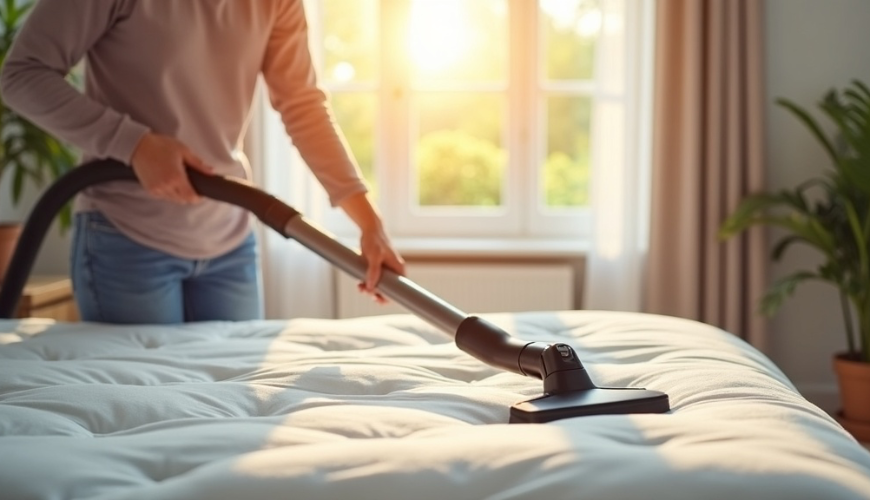
The simplest step that makes a big difference is vacuuming the mattress. Ideally, use an upholstery attachment and do it slowly, without rushing—especially in areas where most lying occurs (shoulders and hips region). Vacuuming removes dust, crumbs, and some allergens. If the vacuum has a HEPA filter, it's a plus because fine particles won't end up back in the air.
Right after that, it makes sense to air the mattress. Sometimes it's enough to prop it on its side to ventilate the underside and let air flow for at least 30–60 minutes. In homes where beds are made quickly in the morning, moisture often gets trapped inside. Leaving the bed "open" for a while in the morning is a small habit that works surprisingly well.
Baking Soda as a Gentle Helper (and How to Use It Properly)
When discussing how to clean a mattress without chemicals, baking soda is often the first choice—and rightly so. It's cheap, accessible, and can absorb odors. The important thing is to use it so that it doesn't remain in the mattress like "sand."
The procedure is simple: lightly sprinkle the mattress surface with a thin layer of baking soda (not piles), let it sit for at least 30 minutes, ideally a few hours, and then vacuum thoroughly. If the room is humid, it's better to opt for a shorter duration and more intensive ventilation to prevent the soda from absorbing too much moisture.
For a gentle scent, it's sometimes recommended to add a few drops of essential oil to the soda, but caution is advised here: oil can leave spots and irritate sensitive individuals. If adding something, do so minimally and test on a small area first. Cleanliness shouldn't rely on fragrance.
Stains: Less Water, More Patience
The biggest challenge is when a stain appears. Whether it's sweat, blood, urine, or a spilled drink, the basic rule is: don't soak, don't scrub aggressively, work in layers. A mattress isn't a carpet—moisture stays in it and can lead to odors or even mold.
In practice, this gentle approach works: first, absorb the liquid with a paper towel or clean cloth (press down, lift, repeat—don't scrub). Then use a lightly damp cloth with lukewarm water. If something extra is needed, a solution of water with a bit of vinegar often helps (e.g., a 1:1 ratio or weaker). Vinegar is strong but its odor usually dissipates after drying and helps with neutralization.
For biological stains (e.g., blood), cold water is traditionally recommended rather than warm, as heat can "fix" proteins. For sweat and yellow stains, a combination of gentle cleaning, soda, and patient drying is effective. The biggest success factor is quick intervention and thorough drying, not the strength of the cleaning agent.
And now an example from everyday life that many households know: in a home with a small child, a diaper can leak at night. In the morning, the mattress seems "just a bit damp," so it's covered with a sheet and dealt with in the evening. But during the day, moisture gets trapped in the mattress and by evening, a musty smell has formed. Conversely, if the affected area is absorbed immediately in the morning, lightly wiped with a weak vinegar solution, sprinkled with soda, and the mattress is placed by an open window, the difference is dramatic—the smell often doesn't develop at all. Time and air are almost more important in this regard than anything else.
What to Do About Odor (and Why Not Cover It with Scent)
Odor from a mattress doesn't usually come "from nothing." It's a mix of moisture, sweat, and microorganisms. If the mattress smells, it's good to check the surroundings: the bed base, the underside of the mattress, and the space under the bed. Sometimes the issue is poor air circulation or dust accumulation under the bed.
For the odor itself, a combination often suffices: vacuum, sprinkle with soda, let sit and vacuum again, then ventilate thoroughly. If the odor returns, the cause is usually deeper—repeated moisture or insufficient drying. In such a case, a change of habits helps: not making the bed immediately after waking up, ventilating the bedroom more often, and considering a more breathable protector.
Turning and "Lightening" the Mattress as Part of Hygiene
In discussions about how to clean a mattress, it's sometimes forgotten that hygiene isn't just about stains. Mattresses also wear out mechanically, and moisture tends to accumulate in worn areas. If the mattress type allows, it's worth regularly rotating it (head/feet) and flipping it if it's double-sided. This helps with more even wear and often better ventilation.
Equally important is the bed base: if it's dusty or there's poor airflow under the bed, the mattress will never feel "fresh." Occasionally, wiping the bed base and vacuuming the space under the bed is enough. A clean mattress on a dirty bed base is like freshly laundered clothes in a smoky room—the effect is lost.
A Single Short List That's Handy to Have on Hand
To prevent it all from turning into an endless home project, a simple cheat sheet helps keep maintenance and quick interventions together:
- Once a week: air out the duvet and leave the bed "open" for at least 20 minutes in the morning
- Once a month: thoroughly vacuum the mattress (including sides), check the bed base and space under the bed
- 3–4 times a year: rotate/flip the mattress (if possible), sprinkle with soda, air out for an extended period
- Immediately: absorb stains, clean with only lightly dampened cloths, thoroughly dry and ventilate
This routine is realistic and sufficient for most households to keep the mattress in good condition over the long term.
In times when the composition of cosmetics, ecological laundry, or gentle cleaning agents for the kitchen are being addressed, it's logical that attention is also turning to the bedroom. How to clean a mattress without chemicals isn't esoteric or extreme—it's more of a return to what works: air, regularity, dry cleaning, and gentle moisture management. The mattress then not only smells and looks better but is also easier to breathe in. And for a place where one spends a third of their life, that's a pretty good reason to make a few simple steps a new habit.