

Exercising outdoors without equipment is ideal in the spring when you want to start simply and persi
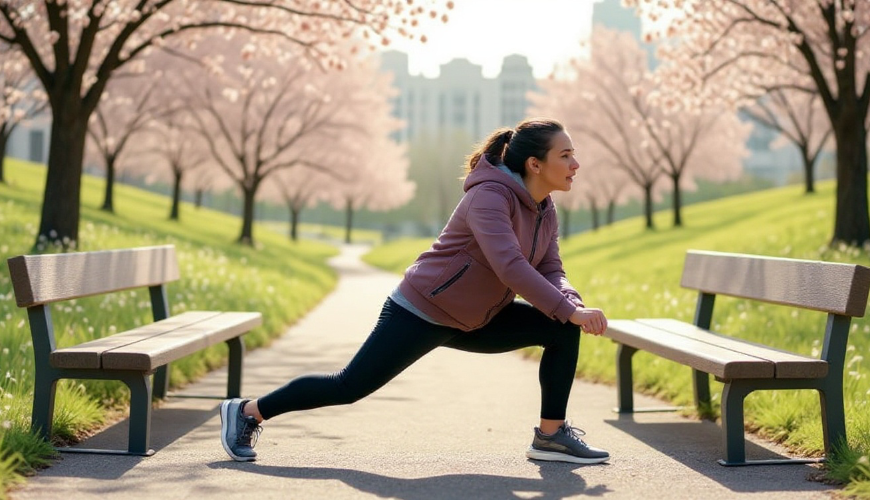
Spring has a special ability to get even those who convinced themselves over winter that "I'll start again on Monday" moving. Suddenly, the days are longer, the air smells of rain and blossoming trees, and there's a desire to be outside—not just rushing to work, but to truly breathe in. That's why the topic of spring weather and outdoor exercise returns every year like a boomerang. Along with it comes a question that sounds simple but can be troubling: what and how to exercise outdoors, when one doesn't want to go to the gym, doesn't have equipment, or just doesn't want to carry anything around?
The good news is that outdoor exercise without equipment is not a stopgap "when there's nothing else" solution. On the contrary: it can be surprisingly effective, refreshing, and sustainable in the long term. The body is built for movement in space—for walking, running, squats, climbing, carrying, jumping. And the outdoor environment adds something extra: varied terrain, natural light, wind, the sounds of the city or forest. It's no coincidence that there's increasing talk in recent years about how being outdoors is linked to mental well-being; a useful context is offered by the World Health Organization (WHO), which has long emphasized the importance of regular movement for health across ages.
Yet, spring isn't just romance. It can be unpredictable: chilly in the morning, sunny in the afternoon, windy in the evening. And that's where an approach that's not overly "sporty" but practical comes in handy. Outdoor training can be short, simple, yet still make sense. It's not about executing a "perfect session," but creating a rhythm that works in real life.
Try our natural products




Why Spring Weather Favors Movement (and When It Can Be a Hindrance)
In spring, exercising often feels better than in summer. It's not as hot, the air tends to be fresh, and the body doesn't overheat. Plus, the days are getting longer, so there's still light and the urge to "accomplish something" after work. Many people notice that with the first warmer days, energy levels rise—and even though it sounds like a cliché, it often relates to moving more, being more in the light, and breathing more outdoor air.
However, spring also has its pitfalls. The most common is overestimating one's abilities: after winter, there's a desire to catch up on everything at once, but tendons and joints have memory. The second issue is layering clothes—you go out in a sweatshirt, and after ten minutes you're hot, you take it off, and soon you're chilled. The third factor is the surface: wet sidewalks, muddy grass, slippery roots in the park. It's not about being afraid, but rather being wisely prepared.
A simple rule applies here: better a training session that's five minutes shorter, but regular, than a heroic effort once a week. And if a bit of consideration for the body is added, outdoor movement quickly becomes one of the most enjoyable parts of the day.
"The best workout is the one that can be repeated," is often said—and it applies doubly outdoors, because conditions are never quite the same. But it's that variability that creates a natural diversity that's often hard to find in a gym.
What and How to Exercise Outdoors Without Equipment to Make It Meaningful
When it comes to exercising outdoors without equipment, many imagine squats and push-ups on a bench. Yes, that works too. But outdoor training can be much smarter and at the same time more natural. Ideally, it should be arranged to include a warm-up, main part, and cool down—while not taking forever. For most people, 20 to 40 minutes is realistic. And when there's less time, a ten-minute version can be surprisingly intense.
Warming up outside doesn't have to be complicated: brisk walking, light jogging, a few arm and hip circles, a short "awakening" of the ankles and knees. This signals to the body that it's going to move and reduces the risk of the first squat resulting in a knee twinge. Especially in spring, when mornings are cooler, warming up is more than just a formality.
And what next? Outdoor training without aids can be built on movements that engage multiple muscles at once. It's not about isolated "bicep burning," but about functional movement that supports strength, stability, and fitness. Great options include:
- Squats (even slow and controlled ones), or walking lunges
- Push-ups (on the ground or with support from a bench, depending on the level)
- Plank and various plank variations for the core
- Bridges for the glutes and hamstrings (perhaps on grass or a mat)
- Bear crawl for coordination and strength
- Line jumping or short sprints for conditioning
In practice, it can look simple: choose 4–6 exercises, set a time (e.g., 30–40 seconds work, 20 seconds rest), and do 3 rounds. If you don't like timers, you can go by reps: maybe 10 squats, 8 push-ups, 20 seconds plank, 10 lunges on each leg… and repeat. The important thing is for it to be sustainable and for you to feel pleasantly tired after the workout, not destroyed.
The outdoor environment also offers "aids" that aren't aids: a bench, a step, a curb, a low wall, a playground. A bench can be used for push-ups, tricep dips (carefully, to avoid shoulder strain), step-ups, or as support during lunges. Steps are great for both conditioning and leg strength—just a few minutes of brisk running up and down and the body immediately wakes up. And playgrounds? They're a chapter of their own: bars for pull-ups, climbing frames for hanging, benches for balance exercises. It's not about "parkour for the chosen ones," but about natural movement that the body knows.
And then there's the often overlooked discipline: walking. In a time when everything is measured in running kilometers and calories burned, ordinary walking sounds almost boring. Yet regular brisk walking is one of the most accessible ways to improve fitness and support health—and it can be done almost anytime. If you want to add intensity, you can include short segments of faster walking uphill or light jogging.
A nice example from real life is a situation many city dwellers know: the workday is long, dinner and fatigue await at home, but outside there's fresh air after the rain. Instead of the mindset "I have to train for an hour," it's enough to head to the park for twenty minutes of brisk walking and make two stops along the way: 10 squats and 8 push-ups at a bench, two short runs up the steps. You'll return home with a clearer head, a warmed-up body, and a feeling that the day wasn't just about sitting. It's these small, repeated victories that often decide whether the spring enthusiasm becomes a habit.
How to Simplify Outdoor Training So You'll Want to Do It Again
Sometimes it's not about motivation, but about friction—about the little things that deter you. It helps to be clear on a few points: where you're going, what you'll be doing, and how long it will take. When the plan is too complicated, the brain can easily dismiss it on a busy day.
If one short checklist is useful, it's this:
- Choose one place (park, playground, trail) and stick to it until a routine forms
- Have ready two training variants: a shorter one (10–15 minutes) and a longer one (25–40 minutes)
- Remember that spring is changeable, and dress so that you can remove a layer
- Don't underestimate hydration and recovery, even if the workout seems like "just" walking and a few exercises
It's almost banal, but banality can be powerful. Having a plan means you don't need to renegotiate with yourself every day.
Benefits of Exercising Outdoors Even Without Equipment: Body and Mind in One Equation
When talking about the benefits of exercising outdoors even without equipment, most people think of burning energy and improving fitness. That's certainly true. But being outside adds other layers that are surprisingly important—and sometimes decide whether one sticks with exercise long-term.
The first benefit is natural variety. Even when doing the same exercises outside, conditions change: slightly different surfaces, different temperatures, different winds. The body learns to react, stabilize, and work as a whole. The second benefit is mental relief. Being outdoors can reduce the feeling of constraint that often builds up after a day in front of a screen. There's no need to label it; just notice that after twenty minutes outside, the head is usually lighter.
The third benefit is availability and freedom. Outdoor exercise without equipment costs almost nothing, isn't tied to opening hours, and doesn't require complex logistics. In practice, that's a huge advantage—especially in a time when many people are overwhelmed with responsibilities. When the barrier of "I have to get somewhere" is removed, the chance of regularity increases.
The fourth benefit is greater contact with the body. Without machines and the "guides" of the gym, there's more focus on technique, breath, and stability. A push-up on the ground quickly shows what the shoulder blades are doing. A squat on uneven ground reveals how the ankles are working. It's not about finding faults, but sensing signals and gradually improving.
And the fifth benefit? Joy from simplicity. In a time when movement often turns into a project (watches, apps, stats, plans), it can be liberating to just go outside and move. If you want, you can measure time and performance. If you don't, you can go by feel. Both paths are valid if they lead to moving more often.
In spring, there's often a desire to "clean the house"—not just of things, but also of unnecessary chemicals. Movement naturally goes along with this: when the body sweats more and regenerates, people tend to be more mindful of what they put on their skin, how they wash, or which deodorants they choose. In this direction, it makes sense to stick to simplicity at home as well: gentle laundry detergents, natural body care, and materials that are comfortable to wear during movement. A sustainable lifestyle often doesn't start with a big gesture but with a series of small decisions that fit together.
Spring is an ideal starting line for this. You don't have to wait for "when it gets warmer"—just take advantage of the first days when you can be outside without it being a test of endurance. And when you add a reasonable pace, outdoor exercise without equipment can become something that's not just a short episode, but part of a regular week. After all, how many things in life are as accessible as stepping outside, taking a deep breath, and doing a few honest movements?