

# Why Stretching After Exercise Is More Important Than Before It Many of us have learned that we sh
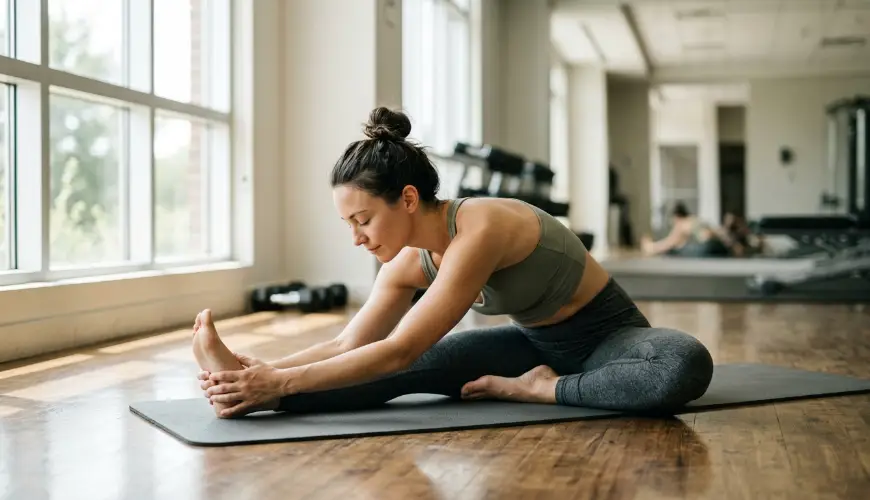
Most people who exercise regularly have one and the same routine ingrained: a few minutes of stretching before training, then the workout itself, and straight to the shower when it's done. Yet this very part – post-workout stretching – is, from the perspective of recovery and long-term physical health, the most valuable of all. Science and sports practice are increasingly aligned on this point: stretching after training is not an optional add-on, but a key component of any exercise programme.
To be clear from the outset – stretching before exercise has its purpose and should certainly not disappear entirely. What matters, however, is distinguishing between the type of stretching involved and what we expect from it at any given moment. Static stretching, where a single position is held for 20–30 seconds or longer, is not ideal before a workout. A study published in the Journal of Strength and Conditioning Research showed that static stretching before training can temporarily reduce muscle strength and explosiveness. This is why sports physiologists today recommend a dynamic warm-up before exercise instead – movement-based preparation that warms the muscles and readies the joints for load without reducing their performance.
After exercise, the situation is entirely different. The muscles are warm, well-perfused and – crucially – shortened. Every strength or endurance training session causes muscle fibres to contract and stiffen. Without subsequent stretching, the body "remembers" this shortening and gradually becomes less mobile, more prone to injury, and slower to recover. This is precisely where stretching steps in as an essential tool for restoring the body's equilibrium.
Try our natural products





What happens in the muscles after training and why it matters
To understand why post-exercise stretching is so important, it helps to look beneath the surface – literally. During physical exertion, microscopic damage occurs to muscle fibres. This is entirely natural and desirable, because it is precisely this damage that leads, after recovery, to muscle growth and improved performance. The problem arises when the body is not given the space to recover properly.
Muscle fibres tend to contract after exertion, and metabolic waste products such as lactic acid accumulate within them. Post-workout stretching helps accelerate the removal of these substances from the tissues and promotes the supply of oxygenated blood to fatigued muscles. The result is a shorter period of muscle soreness, clinically known as DOMS (Delayed Onset Muscle Soreness). Anyone who has ever struggled to sit down on the toilet the day after an intense workout knows exactly what this means.
But it is not only about pain. Regular post-exercise stretching has a fundamental impact on joint range of motion, or flexibility. This quality naturally deteriorates with age, and if we do not actively cultivate it, it can significantly limit the quality of everyday movement. As world-renowned physiotherapist Kelly Starrett puts it: "Flexibility is not a luxury – it is a basic function that we must maintain." Post-workout stretching is one of the most effective ways to cultivate it.
Muscles are not isolated structures either – they are connected by fascia, the connective tissue that surrounds and permeates the entire body. When muscles repeatedly shorten without subsequent release, the fascia stiffens and creates restrictions that can cause pain in areas far removed from the original problem. Shortened hamstrings at the back of the thigh can thus be the cause of lower back pain, even though the two may seem unrelated.
There is a further dimension to consider: the effect of stretching on the nervous system. After intense training, the body is in sympathetic nervous system mode – the so-called "fight or flight" state, in which hormones such as cortisol and adrenaline are elevated. Slow, mindful stretching activates the parasympathetic nervous system, the state of rest and recovery. This transition is essential for regeneration. Without it, the body remains in a state of tension longer than necessary, which impairs sleep quality, slows tissue repair, and increases the risk of overtraining.
How to stretch correctly after exercise – and how much time to devote to it
Theory is one thing, practice another. Many people skip post-workout stretching simply because they are tired, in a hurry, or unsure how to go about it. Yet relatively little is needed – 10 to 15 minutes of targeted stretching after each training session can make an enormous difference.
Take a specific example. Markéta is a thirty-year-old accountant who goes to the gym three times a week. She combines strength training with conditioning work and has long suffered from tension in the neck and shoulder area, which she attributes to her sedentary job. On her trainer's recommendation, she began dedicating 15 minutes after each workout to static stretching focused on the upper body, chest, and hips. After six weeks, she noticed a marked improvement – the tension in her neck eased, her movement became smoother, and the quality of her sleep improved as well. Her story is not exceptional – physiotherapists and sports coaches describe similar experiences as a matter of course.
In terms of technique, static stretching is appropriate after exercise – slow, sustained elongation of the muscle with a hold of 30 to 60 seconds in each position. The movement into the stretch should be smooth and without jerking, with the goal being a pleasant pulling sensation rather than pain. If stretching hurts, it is too intense.
Special attention should be paid to the areas most heavily loaded during a particular training session. After running, these are the calves, hamstrings, and hip flexors. After strength training focused on the upper body, it is the chest, shoulders, and biceps. A popular and scientifically supported method is also yoga as a form of regenerative stretching – research published in the International Journal of Yoga confirms its positive effects on flexibility, muscle tension, and psychological wellbeing.
Alongside classical stretching, the PNF technique (proprioceptive neuromuscular facilitation) is also worth mentioning. It combines stretching with isometric muscle contraction. Originally developed for rehabilitation purposes, this method is now widely used in sports practice and is considered one of the most effective ways to rapidly increase range of motion. It works on the principle of first actively tensing the muscle against resistance, then releasing it, and at the moment of release stretching it further than would otherwise be possible.
Breathing also plays an important role. Correct, deep breathing during stretching deepens muscle relaxation and enhances activation of the parasympathetic nervous system. With each exhalation, the muscles naturally relax and the stretch deepens – a simple but powerful mechanism that many exercisers ignore entirely.
It is also worth knowing that regularity is more valuable than intensity. Five minutes of stretching after every workout will produce greater results over a month than a one-hour stretching session once a fortnight. The body responds to repeated stimuli – and flexibility is built gradually, not in a single session.
A comparison with professional athletes offers an interesting perspective. Elite athletes devote as much time to recovery – of which stretching is a part – as they do to training itself. It is no coincidence that footballers or swimmers, for instance, spend tens of minutes on a mat or in recovery zones after a performance. Their bodies are their working tools, and they know well that without proper care, they deteriorate quickly. The same applies to recreational exercisers – simply on a smaller scale.
Post-workout stretching also has a psychological dimension that tends to be overlooked. The ritual of consciously concluding a training session – slow breathing, releasing the muscles, transitioning from exertion to rest – helps to mentally process the physical effort and shift into recovery mode. For many people, this moment becomes an enjoyable meditative practice that reduces stress and improves overall mood. It is little wonder, then, that those who develop this habit find it hard to give up.
The overall picture is clear: post-workout stretching is not a pointless formality or a mere supplement for those with time to spare. It is an investment in one's own body that pays returns in the form of better mobility, faster recovery, lower injury risk, and an overall higher quality of movement. Every minute spent stretching after training is a minute that protects all the other minutes spent exercising. And that is why post-workout stretching should come first – not as an afterthought before leaving the changing room, but as a full and conscious part of every exercise programme.