
Learn how to keep your wardrobe organized
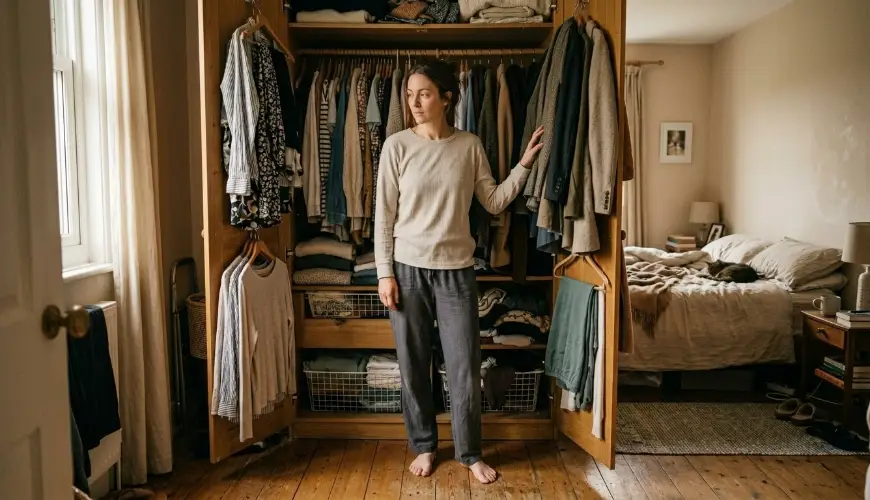
Imagine a Monday morning. The alarm goes off at half past six, children are shouting from the next room, and you're standing in front of an open wardrobe feeling like you have nothing to wear – even though clothes are literally spilling out of it from every direction. This scene is an everyday reality for many people, not an exception. And although the internet overflows with advice about minimalism, capsule wardrobes and Marie Kondo-style organisation methods, for most of us such an approach is out of reach – either in terms of time or space. So what do you do when you live in a smaller flat, have a packed schedule, and yet want to have at least a basic overview of your clothing?
Wardrobe organisation doesn't mean having fifty items of clothing arranged by colour and fabric. It means knowing what you have, where it is and how to find it quickly – even when you're under time pressure. And for that, you don't need a luxury built-in wardrobe or an entire weekend free.
Try our natural products


Why conventional wardrobe organisation advice so often misses the mark
Most popular clothing organisation methods are based on the assumption that you have enough space, enough time and enough determination to go through all your possessions piece by piece. Marie Kondo, in her book The Life-Changing Magic of Tidying Up, recommends picking up each item and asking yourself whether it sparks joy. It's a poetic idea – but in practice, very few people manage to see it through to the end. Research in behavioural psychology also shows that decision fatigue is a real phenomenon: the more decisions we have to make during the day, the worse our later choices become. Going through a wardrobe item by item requires exactly the kind of focused energy that most working people simply don't have.
Add to that the fact that the average Czech flat has a bedroom of around 12 to 15 square metres, and you'll understand why the advice to "get more storage space" is often more of a joke than a solution. Limited space is not a failure – it's a reality that needs to be worked with intelligently, not ignored.
Furthermore, minimalism as a life philosophy isn't for everyone. Some people love vintage pieces, some collect sportswear for various activities, some simply need a formal work wardrobe as well as casual clothes for the weekend – and all of it has to go somewhere. Forcing yourself into a template that doesn't suit you is counterproductive – and needlessly frustrating.
The key isn't fewer clothes at all costs. The key is a system that works even when you have no energy or inclination to maintain it.
Small changes that make a big difference
You can start surprisingly simply – and without having to spend an entire Saturday sorting through clothes. One of the most effective strategies is the so-called "one in, one out" rule. Every time you buy a new item of clothing, you set one old item aside. It's not about drastically clearing out your wardrobe, but about gradually maintaining a balance. This principle is also recommended by home organisation experts such as The Container Store, one of the largest American companies specialising in storage solutions, which has long emphasised that sustainable tidiness comes from habits, not one-off actions.
Another practical step is to divide your wardrobe into zones based on frequency of use – rather than by clothing category. Things you wear every day should be within easy reach: at the front of the rail, in the top drawers or on hooks by the door. Things you put on once a month or less can happily move to less accessible spots – on upper shelves, in under-bed storage boxes or in fabric bags hung on the wall. This simple reorganisation will save you literal minutes every morning, which over the course of a week adds up to tens of extra minutes.
A greatly underestimated helper is velvet hangers. At first glance a trivial detail, but in practice a genuine breakthrough. They take up significantly less space than plastic or wooden hangers and also prevent clothes from slipping off – so the rail in the wardrobe can hold a third to a half more items. An investment of a few hundred crowns can solve the problem of an overcrowded rail without getting rid of a single item.
If you're troubled by drawers full of creased clothing where nothing can be found, it's worth trying so-called vertical folding – a method in which T-shirts, jumpers or jeans are folded into rectangles and stored upright like bookmarks in a book, rather than stacked on top of each other. The result? At a single glance you can see everything in the drawer, and nothing gets creased under the weight of other clothes. This technique was popularised by Marie Kondo herself, but its practical value goes beyond any philosophical framing.
Seasonal items are a chapter of their own. Winter coats, ski trousers or summer dresses unnecessarily take up space all year round. The solution is vacuum bags, into which you place the clothing, suck out the air and reduce its volume by up to two thirds. Alternatively, simple fabric storage boxes that can be slid under the bed or stored on upper shelves will suffice. Moving seasonal clothing twice a year – in spring and in autumn – takes about an hour, but frees up wardrobe space that you'll appreciate every single day.
How to genuinely maintain wardrobe organisation in the long term
The biggest challenge isn't tidying the wardrobe. The biggest challenge is keeping it tidy after three weeks, a month, half a year. And this is precisely where even the most perfectly planned systems fail – because they are too complicated to follow without conscious effort.
Psychologists speak of the concept of "friction" – the more steps a particular behaviour requires, the less likely we are to repeat it. This applies to healthy habits, regular exercise and tidying the wardrobe alike. If you have to overcome obstacles just to hang something in the right place, you'll soon start putting it somewhere else. The solution is therefore to reduce friction to a minimum: have hooks right by the bedroom door, a basket for setting clothes aside within easy reach, and a system that allows you to be a little imperfect without everything immediately falling apart.
One effective method for maintaining an overview without great effort is the so-called weekly "reset" – not a big clear-out, but a five-minute return of items to their rightful place. This short ritual, ideally at the same time each week, prevents the build-up of clutter to the point where dealing with it becomes overwhelming again. A Sunday evening or Monday morning before leaving for work will do perfectly.
Visual clarity also helps. Transparent storage boxes or drawers with labels – whether physical tags or simply photographs of the contents stuck on the outside – dramatically reduce the time spent searching. Studies in cognitive psychology repeatedly confirm that visual chaos raises stress levels and reduces the ability to concentrate. In other words: an untidy wardrobe stresses you out more than you realise – and organising it has a direct impact on your wellbeing, not just your morning routine.
Another practical tip is to regularly – perhaps once a season – go through your wardrobe and set aside pieces you haven't worn in the past three months. Not because you necessarily have to get rid of them, but so that you become aware of what you actually wear and what is taking up space unnecessarily. If you want to be ecological and sustainable, these pieces don't have to end up in the bin – they can go to a second-hand shop, a clothing swap or via platforms like Vinted to someone who will truly appreciate them. Sustainable fashion doesn't only mean buying less or better – it also means giving clothes a second life rather than letting them gather dust in the wardrobe or end up in landfill.
It is worth remembering that wardrobe organisation is not just about aesthetics or efficiency. It is also about your relationship with your own belongings. As designer Vivienne Westwood once observed: "Buy less, choose well, make it last." This philosophy need not mean drastic restriction – it can simply mean being more conscious about what you own, why you own it and how you care for it.
For those who want to go further and are looking for inspiration not only in practical organisation but also in a more mindful approach to clothing itself, the project Good On You offers interesting food for thought – it rates the sustainability of fashion brands and helps consumers make more informed decisions. Because a wardrobe in which you have order is a fine thing – but a wardrobe whose contents you genuinely enjoy and which wastes no unnecessary resources is an even finer thing.
In the end, it is important to recognise one simple truth: the perfect wardrobe does not exist. There is only the wardrobe that works for you – today, in your flat, with your lifestyle. And that is more than enough.