

# Sunday Scaries: Why Anxiety Hits You on Sunday Evenings
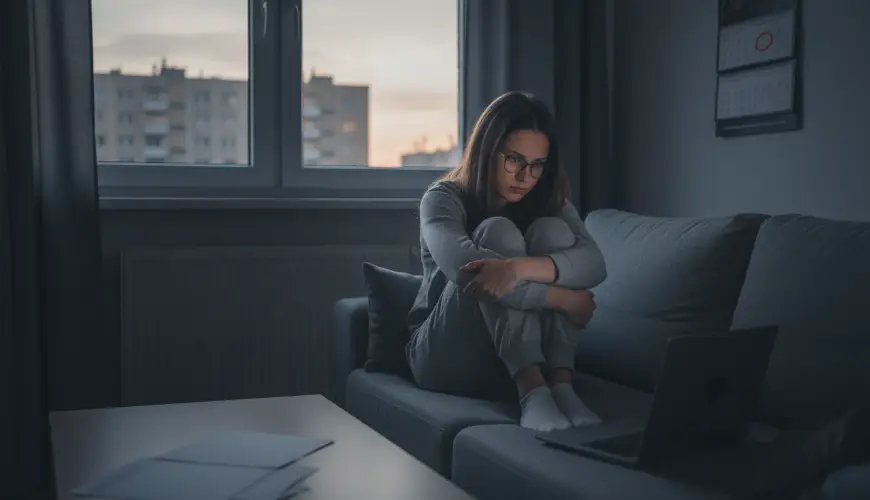
Sunday should be a day of rest, recovery, and a slow pace. Yet for a surprisingly large number of people, the final hours of the weekend turn into something entirely different – a quiet but exhausting battle with mounting anxiety. That peculiar feeling when, around five in the afternoon, a heaviness begins to settle in your stomach, thoughts turn toward the work week, and instead of calm comes nervousness. In English, this phenomenon is called "Sunday scaries," and although we don't have such a punchy term for it in Czech, a huge number of Czechs experience it. Sunday anxiety about Monday isn't just a trendy term from social media – it's a real psychological phenomenon that has its causes, consequences, and fortunately, solutions as well.
A 2018 LinkedIn survey showed that up to 80 percent of professionals experience some form of Sunday anxiety. More recent data from a 2022 American survey by the Headspace platform confirms this trend and shows that the problem deepened further after the COVID-19 pandemic. So this is neither a fringe issue nor a sign of weakness. It's a widespread phenomenon connected to how modern society functions, how we perceive work, and how we can – or can't – disconnect from professional obligations.
To understand why Sunday anxiety appears with such regularity, we need to look beneath the surface. Most people describe it as a mix of vague restlessness, irritability, difficulty falling asleep, and sometimes even physical symptoms like a tight stomach or tension in the shoulders. Interestingly, these feelings often have no specific trigger. It's not that someone has a presentation in front of management or an unpleasant conversation with their boss on Monday. The anxiety comes even when the work week ahead doesn't look particularly dramatic. And that's precisely where its insidiousness lies – it's anticipatory anxiety, meaning fear of what's yet to come, not a reaction to a current threat.
From a neuroscience perspective, this makes perfect sense. The human brain is evolutionarily programmed to anticipate potential dangers and prepare the body to react. The amygdala, the part of the brain responsible for processing emotions and especially fear, activates even at the mere expectation of an unpleasant situation. As the American Psychological Association (APA) explains, anticipatory anxiety triggers the same physiological responses as actual stress – elevated heart rate, increased cortisol levels, and muscle tension. The brain simply doesn't distinguish between real danger and danger we're merely imagining. On Sunday evening, the body reacts as if Monday morning were an actual threat, even though we rationally know it isn't.
Try our natural products




Why Sunday specifically, and what's behind it
There are several reasons why anxiety concentrates specifically on Sunday evening, and they intertwine with one another. The first and most obvious is the contrast between time off and work mode. During the weekend, a person sets a different rhythm – waking up later, having no fixed schedule, engaging in enjoyable activities. Sunday evening then represents a breaking point when this pleasant routine begins to crumble and the return to a structured, often demanding work life looms on the horizon. The greater the gap between how a person feels on the weekend and how they feel at work, the stronger Sunday anxiety tends to be.
The second factor is a lack of control. The weekend is a space where we have relative freedom to decide how we spend our time. The work week, on the other hand, brings meetings, deadlines, emails, and demands from others. The transition from autonomy to dependence on external structures triggers a sense of helplessness in many people, even if they don't consciously realize it. Psychologist Dr. Luana Marques of Harvard University compares this mechanism to a reaction to loss of freedom – the brain perceives the upcoming restrictions as a threat and responds with defensive stress.
The third cause is subtler but no less important: unfinished business and cognitive load. On Friday afternoon, many of us set aside unfinished tasks with the intention of returning to them on Monday. But the brain doesn't forget these unfinished matters – psychologists know this phenomenon as the Zeigarnik effect, named after Soviet psychologist Bluma Zeigarnik, who demonstrated in the 1920s that unfinished tasks remain more active in memory than completed ones. On Sunday evening, these "open loops" then demand attention and create mental noise that makes true rest impossible.
The role of technology cannot be overlooked either. Smartphones and constant access to work emails have blurred the boundary between work and personal time to such an extent that psychological detachment from work has become nearly impossible. One glance at your email inbox on Sunday afternoon and a calm mind is gone. Research published in the Journal of Occupational Health Psychology repeatedly confirms that employees who check work emails outside working hours exhibit higher stress levels and lower sleep quality. Sunday anxiety is therefore not just a matter of personal psychology – it's also a consequence of a culture that celebrates constant availability and productivity.
Let's imagine a specific situation. Markéta, a thirty-three-year-old project manager from Prague, describes her Sundays like this: "The whole morning is fine, we go on a trip with the family or out for lunch. But sometime around four in the afternoon, something changes. I start thinking about what awaits me on Monday, whether I've forgotten something, whether that client responded to my Friday email. Suddenly I'm irritable, I can't focus on a movie, and in the evening it takes me a long time to fall asleep." Markéta's story is not exceptional – it's typical. And it's precisely its ordinariness that shows how deeply Sunday anxiety is rooted in our way of life.
Interestingly, Sunday anxiety doesn't affect everyone equally. Research suggests that people with perfectionist tendencies are at higher risk, as are those who strongly tie their identity to work performance, and people who lack a sense of purpose or autonomy in their jobs. Conversely, people who perceive their work as meaningful and have sufficient decision-making space tend to be more resilient to Sunday anxiety. This brings us to an important insight: Sunday anxiety is often not a Sunday problem – it's a signal that something isn't working in the overall setup of one's work life.
As Austrian neurologist and psychiatrist Viktor Frankl aptly noted: "Between stimulus and response there is a space. In that space is our power to choose our response. In our response lies our growth and our freedom." It is precisely this space between the stimulus – the awareness of approaching Monday – and our response that is the key to working with Sunday anxiety.
How to reduce Sunday anxiety and reclaim your Sundays
The good news is that Sunday anxiety is not an inevitable fate. There are a number of approaches that can significantly reduce it, and most of them don't require any dramatic changes. Rather, they involve small adjustments to habits and ways of thinking that gradually add up.
One of the most effective tools is a Friday "closing ritual." Instead of leaving work on Friday afternoon with a head full of unfinished tasks, spend the last fifteen minutes of the work week writing down what's done, what remains, and what the priorities are for Monday. This simple act of externalization – transferring thoughts from your head onto paper or into an app – significantly reduces cognitive load over the weekend. The brain receives the signal that matters are "saved" and there's no need to constantly reassess them.
Another important step is consciously creating a transition ritual for Sunday evening. Instead of passively sinking into anxiety, you can create a pleasant routine that serves as a bridge between the weekend and the work week. It could be a walk, preparing a favorite meal, reading a book, or even light weekly planning – not in the sense of a stressful to-do list, but rather a calm glance at the calendar. The key is that this ritual should be associated with a sense of control and pleasure, not obligation.
Digital hygiene also plays a crucial role. Setting a rule that from Friday evening to Sunday evening you don't check work emails may sound radical, but for many people it means a fundamental difference in the quality of their rest. If your position doesn't allow this completely, try at least limiting checks to one brief moment per day and keeping notifications turned off the rest of the time. Apps like Freedom or simply setting your phone's "Do Not Disturb" mode can be unexpectedly powerful allies in this regard.
Exercise is another natural tool against anxiety, and not just the Sunday kind. Regular physical activity lowers cortisol levels and increases endorphin production, which are natural "remedies" against stress. A Sunday afternoon walk, yoga, or bike ride can significantly change how a person feels during the last hours of the weekend. According to the Mayo Clinic, regular exercise is one of the most effective non-pharmacological approaches to managing anxiety.
Also worth mentioning is a technique psychologists call cognitive restructuring. This involves consciously re-evaluating the thoughts that trigger anxiety. When the thought "Tomorrow is going to be terrible" appears on Sunday evening, it's helpful to stop and ask: Is that actually true? What evidence do I have for it? How have most Mondays gone in recent months? We usually find that our catastrophic predictions don't come true and that Mondays tend to be more manageable than how we perceive them on Sunday evening. This isn't naive positive thinking – it's training in a realistic view of the situation, which has strong support in cognitive-behavioral therapy research.
However, we can't get around the fact that for some people, Sunday anxiety is a symptom of a deeper problem. If the work environment is toxic, if a person is chronically experiencing overload, or if work completely lacks meaning, no Sunday ritual will fix the situation. In such cases, Sunday anxiety is actually a useful signal – a warning that it's time to change something. That might mean a conversation with a supervisor about workload, searching for a new position, or consulting with a psychologist or psychotherapist. Ignoring recurring Sunday anxiety for months and years isn't courage – it's a path to burnout.
In a broader context, the phenomenon of Sunday anxiety is also a mirror of how we as a society approach the balance between work and personal life. In a culture that values overwork and where "I have so much on my plate" is almost a status symbol, it's no wonder that rest becomes a source of stress. True rest actually requires courage – the courage to disconnect, to not be productive, and to accept that a person's worth doesn't lie in the number of completed tasks.
Sunday doesn't have to be a day full of worry about what Monday will bring. With a bit of conscious attention, a few small changes in habits, and above all honesty with ourselves, it's possible to transform Sunday evenings back into what they should be – a calm conclusion to the week and a pleasant interlude before a new beginning. And if a cup of herbal tea, a slow walk through the park, or simply the knowledge that you're not alone in this helps you along the way – all the better.