
Dry toilet is no longer just for cottage owners
There is a topic that most people don't want to talk about out loud, even though it affects them every day. The toilet. Specifically, how much water it uses – and what would happen if it didn't need any at all. The dry toilet is one of the most underestimated yet most promising solutions currently available in the fight against drinking water waste. And yet it remains a topic that is almost never discussed in everyday conversation. This article attempts to change that.
Try our natural products

Why the toilet is a problem nobody talks about
The average flush toilet uses approximately 6 to 9 litres of water with each use. Older models can manage up to 13 litres per flush. When we consider that the average person uses the toilet approximately six to eight times a day, we arrive at a number that surprises even those who actively care about sustainability. The toilet alone can account for up to thirty percent of total household water consumption. According to data from the Water Footprint Network, toilet flushing is one of the largest sources of drinking water consumption in households around the world.
And yet this is drinking water we're talking about. Water that has passed through treatment plants, been chemically processed, transported through pipes for kilometres – and we flush it literally down the drain. It is a paradox of modern civilisation that few people question, simply because we are used to it.
Meanwhile, the global water situation is far from optimistic. According to the UN World Water Development Report, more than two billion people already face drinking water shortages, and this number will only increase with growing population and climate change. While the Czech Republic is not among countries with an acute water shortage, in recent years we too have been experiencing drought, declining groundwater levels, and rising water and sewage costs. The question of water management is ceasing to be a matter for distant continents and is increasingly becoming our own reality.
It is in this context that the dry toilet enters the picture – a solution that has existed far longer than most people realise, but has only in recent years been gaining attention as a genuine alternative to the traditional flush toilet.
What a dry toilet actually is and how it works
A dry toilet, sometimes also referred to as a composting toilet or waterless toilet, operates on a simple principle: instead of flushing waste away with water, it undergoes natural biological transformation. Human waste decomposes in a sealed container or composting chamber with the help of microorganisms, air, and sometimes added material – most commonly sawdust, peat, or biochar. The result, after a certain period of time, is hygienically safe compost that can be used as fertiliser.
There are several types of dry toilets. The simplest versions are portable models suitable for cottages, gardens, or camping – compact containers with urine separation that minimise odour and make disposal easier. At the other end of the spectrum are full composting toilet systems designed for permanent residences, equipped with ventilation, heating, and automatic mixing of the composting material. These systems are designed to meet hygiene standards and can fully replace a conventional toilet.
One of the most common arguments from critics is odour. This concern is understandable, but largely mistaken. A properly designed and maintained dry toilet produces virtually no odour, thanks to natural ventilation and the separation of urine from solid waste. Urine is, in fact, the primary source of unpleasant odour in traditional toilets – and modern dry toilets divert it separately, elegantly solving this problem.
A practical example: a family from southern Bohemia who decided three years ago to convert their weekend cottage into year-round accommodation without a sewage connection describes the switch to a composting toilet as surprisingly trouble-free. "We expected it to be a compromise. Instead, we found that the toilet simply works, doesn't smell, and every year we save thousands of litres of drinking water," says Pavel, one member of the household. Today their system processes all waste directly on their property, and the resulting compost is used in their garden.
This story is not unique. Across Europe, the number of households, communities, and public institutions adopting dry toilets as part of a broader strategy for sustainable water and waste management is growing. Scandinavian countries are pioneers in this regard – in Sweden and Finland, entire eco-districts exist where composting toilets are a standard part of the infrastructure.
Why it remains a taboo and how that is changing
Resistance to dry toilets stems primarily from cultural conditioning. In modern society, the toilet is a symbol of civilisation, hygienic progress, and comfort. Flushing with water has become so self-evident that questioning it feels like a step backwards. Psychologists who study consumer behaviour in the field of sustainability speak of the so-called "disgust factor" – a natural aversion to anything that evokes contact with waste. And it is precisely this emotional barrier that, for many people, is stronger than any rational argument about water conservation.
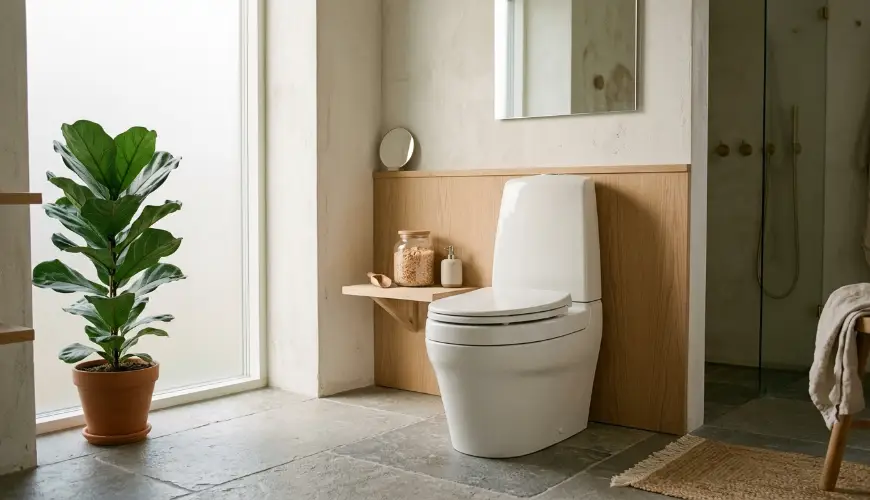
There is also the issue of a lack of information. Most people, when they hear the term "dry toilet," picture either a portable loo from a festival or a wooden outhouse at the edge of a forest – certainly not an elegant, functional device that would fit seamlessly into a modern bathroom. Yet the market has shifted considerably in recent years. Today's composting toilets are well-designed, quiet, easy to operate, and in many cases look exactly like their flush counterparts.
Change is coming where people are compelled to think differently about resources. Owners of cottages and country houses without sewage connections, people living in mobile homes or tiny houses, communities in areas with limited access to water – these are the groups that have embraced dry toilets as a practical solution rather than an ideological stance. And it is their experiences that are slowly dismantling prejudices among the wider population.
Legislative and regulatory changes also play an important role. In the Czech Republic, installing a composting toilet in a permanent dwelling is still associated with bureaucratic obstacles that complicate it in practice – building regulations and hygiene standards are set up primarily for flush systems. However, in many European countries, including Germany and the Netherlands, composting toilets in permanent residences are fully legal and normalised. It is only a matter of time before similar legislative relaxation arrives here as well.
The economic dimension is also not insignificant. The purchase cost of a quality composting toilet ranges from a few thousand crowns for simple models to tens of thousands for full systems intended for permanent residences. At first glance this may seem like a substantial investment, but when compared with the costs of building or repairing sewage connections, sewage charges, and water bills, the dry toilet proves very favourable over the long term. Additionally, the costs associated with servicing a septic tank or cesspit are eliminated.
The media and public discourse also bear a share of responsibility. Topics such as zero waste, sustainable fashion, and the eco-friendly home have earned a respectable place in mainstream discourse in recent years. Yet the toilet remains on the margins – as if society were embarrassed to acknowledge that even the most intimate part of the home can be part of a sustainable lifestyle. And yet this is precisely where one of the greatest untapped potentials lies.
As American environmentalist Bill Mollison, founder of the permaculture movement, once noted: "The problem is not a lack of resources. The problem is that we consider waste what is actually a resource." This thought perfectly captures the essence of the composting toilet – transforming something that modern civilisation perceives as waste to be disposed of into a valuable resource for the soil.
The dry toilet is thus ceasing to be a curiosity for enthusiasts and is becoming part of a broader conversation about how we manage the most precious resource we have – water. Every litre we don't have to use for flushing is a litre that stays where it belongs. And that is an argument that grows stronger with each passing day in an era of increasing drought and climate uncertainty.
For those who want to learn more about dry toilets or are looking for specific products suitable for a cottage, garden, or eco-conscious home, a good starting point is specialist shops focused on sustainable living – there you will find not only the products themselves, but also the information and guidance needed to get started. The path to a more sustainable home doesn't have to begin with solar panels on the roof. Sometimes it's enough to reconsider what we have, quite literally, beneath our feet.