

Breakfast in a jar saves you time when you're in a rush in the morning and want to eat better.
Mornings can be strangely relentless. The alarm rings, your head is still half asleep, and suddenly a small logistical feat takes place in the kitchen: getting dressed, preparing the kids, walking the dog, catching the tram, not forgetting the keys... and somewhere in between all of this, breakfast needs to fit in. No wonder many people end up with a "grab-and-go" roll or a coffee that is supposed to substitute both energy and mood. Yet, mornings often determine how the entire day will look—not just in terms of feelings, but also in terms of concentration, cravings for sweets, and overall resilience to stress.
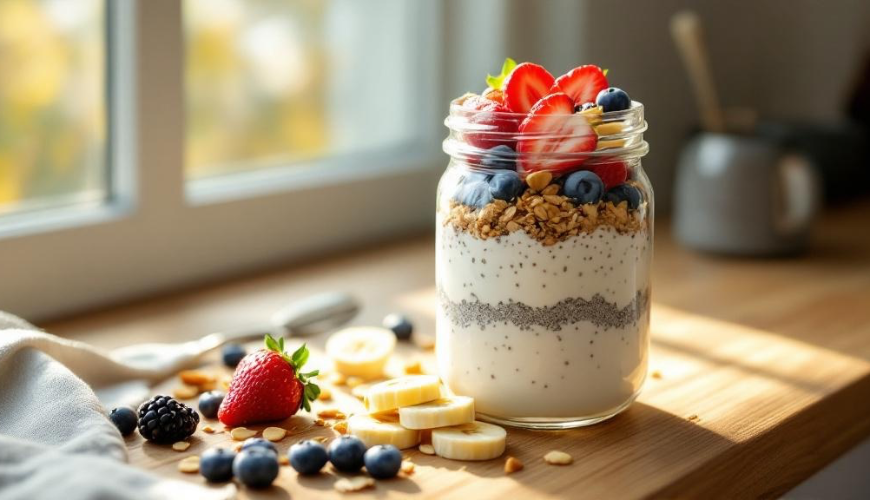
This is where the concept of breakfast in a jar comes in. A simple idea, but one that proves surprisingly liberating in practice: in the evening (or even in advance for several days), a portion is prepared in a sealable jar and is waiting in the fridge in the morning. This creates a nutritious and quick breakfast in a jar that can be eaten at home, at the office, or on the train. And importantly: it can be assembled to be truly filling, diverse, and taste "normal," not like a compromise.
Why breakfast in a jar works (and how it really saves time)
At first glance, it’s just a different container. In reality, however, the jar changes the game. Once breakfast is prepared in advance, the morning deliberation of "what now, quickly" is eliminated, which often leads to the simplest choice—and that is either too sweet or barely anything at all. How to save time in the morning isn't just about minutes spent at the stove. It's also about not having to make ten small decisions when your brain is still in sleep mode.
Jar breakfasts also support a simple principle: layering. This allows for a natural combination of protein, fiber, healthy fats, and fruit so that energy is released gradually. And this is exactly what most people need in the morning—not a quick sugar "kick" and subsequent crash.
They are also suitable for those trying to eat more consciously. When the portion is visible and prepared in advance, it is easier to stick to a rhythm and avoid overeating during the morning. And if reusable containers are used, there's an added bonus: less packaging and less waste. A jar is a small thing with a surprisingly big impact.
For a healthy breakfast in a jar to be truly functional, it's worth thinking about a simple composition. It’s not rocket science, more like a practical template that everyone can adjust according to taste and season. Usually, a base (oats, yogurt, chia, quark, or a plant-based alternative) is enough, along with fruit, something for flavor (cinnamon, cocoa, vanilla), and a "crunch" (nuts, seeds, granola). When more satiety is needed, adding protein helps—such as skyr, Greek yogurt, quark, or quality plant-based protein.
For inspiration, it's good to keep general nutritional recommendations in mind. For example, the Harvard T.H. Chan School of Public Health has long emphasized the importance of whole grains, quality proteins, and healthy fats as the backbone of a balanced diet (Healthy Eating Plate: https://www.hsph.harvard.edu/nutritionsource/healthy-eating-plate/). The jar aligns beautifully with this approach: just choose ingredients that offer more to the body than just quick calories.
How to assemble a healthy (and fit) breakfast in a jar that satisfies
The internet is full of pictures of perfect layers, but real life is often less polished. The good news is that a fit breakfast in a jar doesn’t have to be an aesthetic contest. It should be edible, practical, and something that won't leave you hungry in an hour. The key is balance—and small details that determine taste and consistency.
Starting with the basics. Oatmeal is a classic because it's accessible, cheap, and naturally contains fiber. For a change, you might opt for buckwheat flakes, millet, or a combination of flakes and seeds. Chia seeds are popular for creating a pudding-like texture and adding satiety, but they're not a necessity. More important is having protein in the jar: yogurt, skyr, quark, or their plant-based versions (ideally unsweetened). In practice, this is the difference between a breakfast that "just tastes good" and one that truly sustains you.
Fruit is a chapter of its own. Bananas are great for sweetening without sugar, berries add freshness and usually more fiber, and apples are available year-round. With dried fruit, it's good to watch the quantity—it’s concentrated and can quickly increase the energy value. Conversely, nuts and seeds are often worth adding, even in small handfuls: they enhance flavor, provide healthy fats, and extend the feeling of satiety.
Incidentally, the sweetness question is often the biggest hurdle. Not everyone wants a "dessert" in the morning, but at the same time, few crave bland porridge. Working with spices and aromas helps: cinnamon, vanilla, quality cocoa, lemon zest, or a pinch of salt can work wonders. And if sweetening is necessary, often a teaspoon of honey or maple syrup suffices—not half a jar.
A phrase often repeated in relation to breakfast is: "The best breakfast is the one you actually eat." And this might be the most practical rule. The jar should be tailored to what is realistically tasty, not what looks best in a photo.
And what does it look like on a typical day? Imagine a situation familiar to many: on Monday morning, the fridge is opened, and instead of improvisation, there are three jars prepared on Sunday evening. One with oats and apple, another with chia pudding and mango, the third with quark and cocoa. You just grab the one you fancy, toss a spoon in your bag, and go. On the way to work, the bakery on the corner or "today it somehow worked out again" is no longer an issue. It sounds trivial, but it’s in this triviality that lies the strength of a routine that saves nerves and the wallet.
Breakfast in a jar recipes that can be made repeatedly
Below are breakfast in a jar recipes designed to be easily modifiable. The quantities are approximate for 1 serving (a jar of about 300–500 ml) and can be adjusted according to hunger. It’s important to remember that some layers (especially oats and chia) will absorb liquid overnight, so the consistency will be thicker in the morning.
1) Overnight oats with apple, cinnamon, and nuts (a classic that never disappoints)
In a jar, add 50–70 g of oats, 150–200 ml of milk or plant-based drink, and 2–3 tablespoons of yogurt (or skyr for more protein). Mix in cinnamon, a pinch of salt, and grated apple (or apple chunks). Top with a handful of walnuts and optionally a teaspoon of honey if the apple isn't sweet enough. After a night in the fridge, it becomes a healthy breakfast in a jar tasting like apple pie but much more filling.
2) Chia pudding with berries (quick, light, but filling)
The base is simple: 2–3 tablespoons of chia seeds and 200 ml of milk or plant-based drink. Add vanilla (or vanilla extract) and optionally a teaspoon of maple syrup. Mix, let stand for 10 minutes, and mix again to prevent chia clumping. Then it goes into the fridge. In the morning, add a layer of yogurt and a handful of blueberries, raspberries, or mixed berries. For a more "fit" version, choose skyr; for a more dessert-like taste, add a teaspoon of quality cocoa to the yogurt.
3) Quark cream with banana and cocoa (when craving something sweet without a sugar bomb)
This variant is popular because it feels like dessert but is a solid breakfast. Add 200 g of quark (or a smoother variant) to a jar, add a mashed banana, a tablespoon of cocoa, and a bit of milk to smooth. Mix into a cream and top with a few banana slices and a handful of hazelnuts. The result is a nutritious and quick breakfast in a jar that is also suitable after a morning workout—proteins and carbohydrates in a natural combination.
4) Yogurt jar with homemade granola (crunchy and practical, if layers are done smartly)
With granola, the best trick is in the layering order. Add yogurt (or plant-based yogurt) to the bottom, then fruit (such as sliced pear or strawberries), and granola all the way on top—ideally added in the morning if you want it to stay crunchy. If added the night before, it often softens, which some don’t mind, but crunchiness is still crunchiness. This breakfast is great for kids because it’s colorful and can be customized. And if granola is homemade with oats, nuts, and a bit of honey, it’s easy to control the amount of sugar.
5) "Carrot cake" in a jar (unexpectedly good and perfect for autumn)
Carrot in breakfast sounds suspicious until you try it with cinnamon and nuts. Add a mixture of oats, yogurt, and milk to a jar, add finely grated carrot, cinnamon, a pinch of ginger, and a few raisins (or chopped dates). Top with walnuts or pecans. The taste resembles carrot cake, just without the heavy frosting. It’s a pleasant alternative when classic overnight oats are getting old.
6) Savory breakfast in a jar (when sweet mornings aren’t appealing)
A jar doesn’t have to be just sweet. Add cottage cheese or quark mixed with a bit of plain yogurt, salt, pepper, and herbs to the bottom layer. Add chopped tomatoes, cucumber, bell pepper, and top with pumpkin seeds. For more protein, add a hard-boiled egg (even separately in a container). This variant is practical for those whom a sweet breakfast triggers cravings. Plus, it’s a nice change—sometimes it takes little to make the morning routine less monotonous.
If there were to be only one "cheat sheet" that works across recipes, it’s a simple rule: if breakfast is too sweet, add protein and a bit of fat; if it’s bland, add spices and a pinch of salt. The jar then isn’t just a pretty idea but a genuinely usable tool for ordinary days.
And because sustainability is part of everyday choices today, it’s worth mentioning the practical aspect: jars can be reused over and over, they are easy to wash, and they seal well. Those who get used to preparing breakfast in the evening often find that their other meals throughout the day gradually simplify—and that "I don’t have time" begins to lose its strength as a universal excuse.
Mornings can then look a little calmer. Not because the obligations have disappeared, but because one thing is already solved in advance. And when you manage to start the day with something that is fit, tasty, and at the same time ordinarily human, it’s quite possible that even Monday will start to seem less stern.