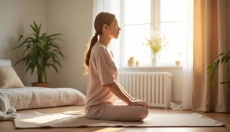

What does slow living mean, and why it can bring you focus, meaning, and relief from stress

Life today often resembles an endless to-do list that mysteriously grows longer with each completed task. Morning starts with a quick coffee, responding to messages on the way, switching between meetings at work, an "autopilot" shopping trip in the afternoon, and catching up on unfinished tasks in the evening. It's no wonder that in recent years, the question has increasingly arisen: what does slow living mean and why is it discussed by so many people who otherwise don't succumb to trends? Slow living isn't a competition of slowness or a romantic notion of living in solitude. It's more of a lifestyle that brings attention, meaning, and choice back into everyday life—and often brings relief as well.
Try our natural products




What slow living means and why it’s not just “living slowly”
The term slow living usually refers to a conscious decision to live at a pace that aligns with what is truly important. It doesn't mean giving up ambitions or stopping work. It's more about ceasing to automatically adapt to everything that screams "now" and "faster." In practice, it is a subtle but crucial slowing down: less fragmentation, more presence. Less "I should," more "I want" and "this makes sense to me."
Slow living is part of the broader "slow" movement, which first appeared in relation to food and dining culture. Today, it extends into living, work, wardrobe, and relaxation. And when it is discussed as a lifestyle, it's worth remembering that style isn't decoration—it's a way of making decisions. Even small ones, like whether to automatically start another episode of a series in the evening or spend ten minutes opening a window and letting silence into the home.
Sometimes a simple sentence helps, one that appears in various forms in psychology and mindfulness communities: "Attention is the most valuable currency we spend every day." And it is with attention that slow living works the most. It doesn’t ban technology, it just stops letting it dictate the day. It doesn’t condemn speed, it just uses it where it makes sense—and replaces it with calm elsewhere.
Interestingly, slow living often intersects with sustainability. As decision-making slows down, the quality of those decisions typically improves. Fewer impulsive purchases, less unnecessary waste, more repairs, reuse, and considerate choices. And this isn’t just personal well-being, but also an impact on the environment.
For broader context on how society's relationship to mental well-being and stress is changing, it’s useful to look into materials from the World Health Organization (WHO) on mental health. They don’t say “live slowly,” but clearly show how crucial the role of environment, habits, and the degree of long-term pressure is.
Slowing down in practice: small changes that make a big difference
When people hear “slowing down,” many imagine they need to change jobs, move out of the city, or have more time than others. However, slow living is often the exact opposite: it’s about finding space within the usual day, even when it’s full. It’s not about adding another obligation (“I must live more slowly”), but about reducing friction, noise, and unnecessary switching.
A typical real-life situation: after work, there's a “quick” trip to the supermarket. Things end up in the cart that seemed practical, but at home, no one returns to them. Dinner is eaten in a rush, the kitchen remains full of packaging, and one feels like they’ve just “survived” another day. Slow living here wouldn’t mean cooking a three-course meal. It might be a decision to have a few reliable ingredients at home that can be quickly combined, and shop with a shorter list but with more attention. Or take ten minutes to eat a meal at the table, not by the phone. The result? Less chaos, less waste, better digestion, and mood.
Slow living is also often about doing things “properly,” not “quickly.” In an eco-friendly home, this might mean switching to gentler products that don’t burden water or senses, while simplifying cleaning: fewer different bottles, more universal solutions. In sustainable fashion, slowing down means not buying a fifth “at-home” shirt, but instead choosing a quality piece that lasts and fits well. Fewer items often mean more peace, because the home stops being a warehouse of last week’s decisions.
An important detail: slow living isn’t about doing everything “right.” It’s more about gradually tuning what is sustainable in the long term. And sustainability is almost a revolutionary concept today. When the week is demanding, even a small slowdown can just mean leaving the phone in another room and prioritizing sleep. It seems trivial, but sleep is often the first casualty of fast living—yet it is the foundation of mental resilience, immunity, and the ability to make thoughtful decisions.
For support on how stress works and why long-term overload is a problem, one can also refer to overview information from the American Psychological Association on stress. It’s not about self-diagnosing, but rather understanding that “always on” isn’t a neutral state.
How to practice slow living: practical tips you can start doing right away
The question of how to practice slow living often sounds like there’s a universal guide. However, slow living is more a set of principles that everyone assembles according to their own life. Still, there are practical tips that repeatedly prove effective because they reduce daily friction and restore the feeling that the day belongs to the person, not the other way around.
It’s not about a long list that sounds like more tasks. Just a few points that can be tried and adjusted:
- Slow down the start of the day: first 10–15 minutes without news, social media, and emails. Instead, water, an open window, a short stretch, or a few calm breaths. The morning sets the tone for the entire day more than it seems.
- Do one thing at a time: multitasking seems efficient but often just increases fatigue. Try eating without a screen, or writing an email without other communications running simultaneously. Individual tasks paradoxically speed up when not done all at once.
- Simplify the home: fewer things in sight mean less stimulus for the brain. It helps to clear the kitchen counter, reduce “just in case” supplies, and prefer reusable solutions. In an eco-friendly home, it’s often a natural step: less packaging, less waste, less work.
- Establish small rituals instead of big plans: like tea after lunch, a short walk after work, regular airing, evening dimming of lights. A ritual isn’t an obligation, but an anchor.
- Shop more slowly: it doesn’t mean shopping less at all costs, but shopping more thoughtfully. For clothing, consider if it can be combined with at least three items from the wardrobe. For cosmetics and household products, consider if the product is gentle and will actually be used. Slowed-down shopping reduces later regret.
- Set boundaries for availability: like two time windows for emails, muted notifications, or “quiet” hours in the evening. Boundaries aren’t impolite; they’re guardrails for attention.
Notice that these tips aren’t about “adding wellness.” They’re about removing the unnecessary. Slow living often doesn’t arise from new activities but from stopping something that exhausts and brings nothing.
Also very practical is working with the environment. When the home is set up to support calm, the mind slows down too. Instead of five different scents and aggressive cleaners, gentler, more sustainable options that don’t overpower the space are enough. Instead of a crowded bathroom, a few proven products used long-term. And instead of a wardrobe full of compromises, a few favorite pieces worn repeatedly—which is incidentally one of the most practical principles of sustainable fashion.
Slow living doesn’t only take place at home. A big role is also played by how one spends time outside and with whom. Slowing down sometimes means saying “no” to more programs and “yes” to a simple walk. And other times it means stopping apologizing for needing to disconnect. It’s not running away from life; it’s returning to it.
A rhetorical question might arise: when everything is faster than ever, why are so many people tired? Slow living answers this quietly but persistently: because speed itself isn’t the problem—the problem is when it becomes the default setting for everything, including rest.
In this, slow living is surprisingly pragmatic. It doesn’t say that having ambitions is wrong. It just reminds us that a lifestyle isn’t just about what gets done, but also what is experienced. And that slowing down isn’t a luxury for the chosen few, but a skill that can be trained in small steps—perhaps already tonight by having a leisurely dinner, opening a window, and letting the world be, just for a moment.