
Animal flow returns the body to natural and healthy movement
Imagine a workout where you move like a crab, crawl like a snake, jump like a monkey, and exercise your entire body in a way that a traditional gym could never offer. That's exactly what animal flow is – a movement discipline that has been conquering fitness studios around the world in recent years, winning over more and more enthusiasts, including those who never thought of themselves as athletes. And it's not some passing trend that arrives and disappears within a few months. Animal flow has deep roots in the biomechanics of human movement, in movement patterns that our bodies have always known – we've just forgotten them a little.
The founder of the discipline, Mike Fitch, created animal flow in 2010 as a system of movements inspired by animal locomotion, but built on the principles of functional training, calisthenics, and movement acrobatics. His goal wasn't to create just another exercise programme – he wanted to give people back their natural movement, which the modern sedentary lifestyle systematically destroys. And the result? A system that develops strength, mobility, coordination, balance, and cardiovascular fitness all at once, without a single piece of equipment.
Try our natural products


Why move like an animal?
At first glance, the idea of moving around on all fours as an adult might seem a little absurd. But just look at how small children move, and you'll understand what animal flow is all about. Children naturally crawl, creep, jump, and roll around on the ground, building movement patterns that form the foundation of a healthy, functional body. Then comes school, sedentary work, and movement variety narrows down to walking from the car to the office and back. Animal flow reverses this journey.
The scientific basis is solid. Moving on all fours – so-called quadrupedal movement – activates muscle chains across the entire body in a way that isolated exercises simply cannot. Research in movement science repeatedly shows that training focused on movement patterns rather than isolated muscles leads to better transfer of strength into everyday activities and reduces the risk of injury. The portal Healthline, for example, has long pointed out that functional training involving bodyweight work and movement patterns is more effective for long-term musculoskeletal health than conventional machine-based strength training.
Animal flow works with six main components: transitioning into ground positions (wrist mobilizations), activations, animal movement patterns (animal forms), traveling forms, switches and transitions, and free-form sequences (flows). Each of these elements serves a specific function, but it is only their combination that creates the characteristic fluid movement that resembles improvisational dance more than conventional exercise.
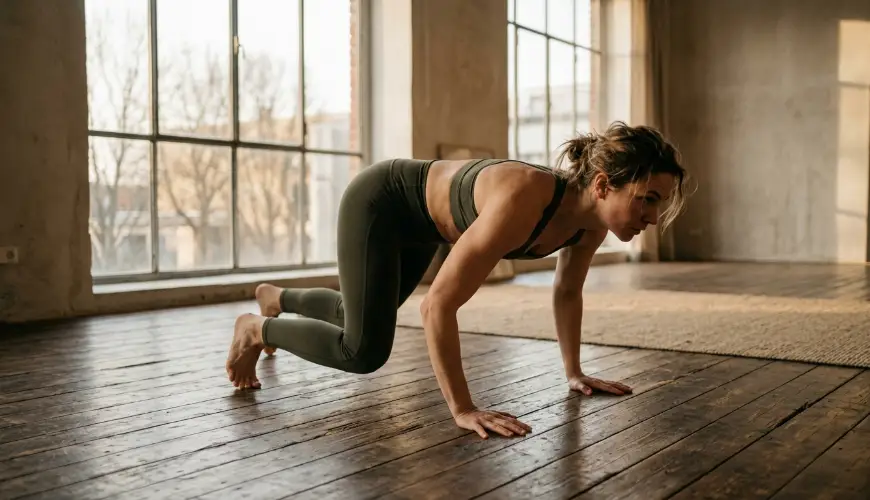
The basic animal forms from which the entire system originates include, for example, the crab walk, which intensively works the shoulder and spinal stabilisers, or the bear walk, which trains the coordination of opposite limbs and the deep stabilisation system. The lizard develops hip and thoracic spine mobility, while the gorilla builds explosive leg strength and coordination. Each form has dozens of variations ranging from basic to advanced, so animal flow works equally well for a complete beginner and an experienced athlete.
Take a specific example: Jana, a forty-something graphic designer, spent eight to ten hours a day at her computer. Back pain, tight hips, and general fatigue were her daily reality. Conventional strength training bored her, and yoga didn't satisfy her enough physically. Then she came across an animal flow class at a local studio. After three months of regular training three times a week, the back pain disappeared, her hips regained a range of motion they hadn't known since childhood, and Jana also admits that for the first time in her life she actually looks forward to training. Does it sound like an advertisement? Perhaps – but there are thousands of similar experiences, and their basis is logical: the body received the movement it truly needs.
A complete workout without a gym
One of animal flow's greatest strengths is its accessibility. All you need for training is a mat, or alternatively a carpet or grass, and your own body. No dumbbells, no weight machines, no expensive equipment. This makes animal flow an ideal workout for those who travel, work from home, or simply don't have time to visit a gym regularly.
But how can movement without weights provide sufficient strength stimulus? The answer lies in the mechanics of the movements. The crab walk in its advanced form places enormous demands on the shoulder stabilisers and scapular muscles in a way that few things can replicate. The lizard movement through its full range tests hip flexor mobility and strength to the extreme. And the so-called beast hold – the fundamental animal flow position where the body is held horizontal with knees just above the ground – activates the deep spinal stabilisation system more intensely than most conventional core exercises. As Mike Fitch himself said in one interview: "Movement is the best medicine you always have with you."
The cardiovascular component of the training comes naturally with the length and intensity of the sequence. A fluid sequence of animal movements without a break for twenty to thirty minutes represents a solid aerobic load, yet it is perceived subjectively in a completely different way than running on a treadmill. Attention is constantly focused on movement coordination, so fatigue arrives without the practitioner consciously registering it.
Mobility is perhaps animal flow's greatest asset. While in conventional strength training, mobility is typically treated as a bonus at the end of a session – a few stretching exercises that ultimately never get done – in animal flow, mobility is integrated directly into the movement. Every transition between forms works with the joints' end ranges, gradually expanding their range of motion. Research published in the Journal of Strength and Conditioning Research, for example, repeatedly confirms that dynamic mobility integrated into movement sequences is more effective for improving joint range of motion than static stretching.
For people with sedentary jobs, the work with the thoracic spine and hips is particularly valuable – two areas that suffer most from a sedentary lifestyle. Animal flow works these areas systematically in every session, in a way that feels natural and unforced to the body.
One of the things that makes animal flow exceptional is its neurological demand. The movements require connection between the right and left sides of the body, coordination of the upper and lower limbs, spatial orientation, and constant adaptation to weight shifts. All of this activates the brain in a way that monotonous repetition on weight machines cannot offer. Neuroplasticity – the brain's ability to form new neural connections – is developed, according to available research, precisely through learning new complex movement patterns. Animal flow is therefore not only training for the body, but to some extent training for the brain as well.
The community around animal flow is remarkably inclusive. Unlike many fitness trends that are implicitly aimed at young and already physically fit individuals, animal flow offers modifications for virtually every movement. Beginners work with simple forms and shorter sequences, while advanced practitioners add complex transitions, rotations, and aerial elements. The age range of active practitioners spans from children to seniors – and that in itself speaks to the universality of the approach.
Also interesting is animal flow's relationship with other movement disciplines. Many yoga practitioners find that animal flow helps them translate static poses into dynamic movement. Martial artists and athletes find in animal flow a tool for developing movement intelligence and preventing injuries. Dancers appreciate the fluidity and body awareness that the discipline develops. Animal flow thus becomes a kind of movement esperanto – a language understood by anyone willing to listen to their own body.
Practically speaking: how do you get started? The best path leads through a certified animal flow instructor, of whom there are a growing number in the Czech Republic. Alternatively, you can start with online materials directly from Mike Fitch on his official Animal Flow website, where video tutorials are available for various levels. The key at the beginning is not to underestimate wrist warm-up – the wrists bear an unusual load in animal flow and need time to adapt. It is equally important not to rush into advanced forms, and to spend sufficient time on the basic movement patterns until they become automatic.
Equipment is minimal, but still worth mentioning: a quality mat with adequate wrist and knee protection will significantly improve the training experience, especially at the beginning. Some practitioners prefer a barefoot approach on natural surfaces, while others appreciate light gloves for palm protection. With advancing practice, the body adapts and these aids become less important.
Animal flow is not a revolution in movement – it is more of a return to it. At a time when the average adult, according to data from the World Health Organization, spends more than nine hours a day sitting, a discipline that restores the body's natural movement variety offers something truly valuable. It is not just exercise – it is a reminder of what the human body was made for. And perhaps that is precisely why, when you first manage to smoothly connect three animal forms into a single sequence and the body moves exactly as it should, a feeling arrives that is otherwise hard to find: the feeling that movement is joy, not obligation.