

# Why Recycling Isn't Enough and What Works Better
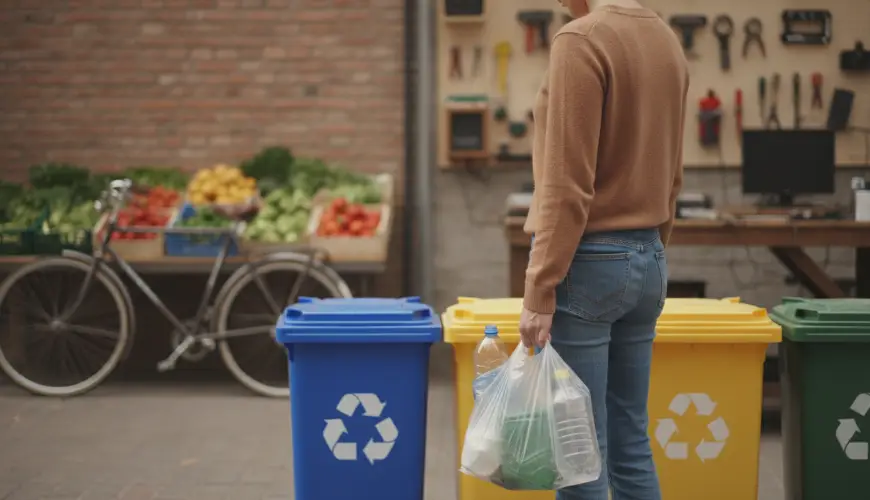
Every week, we dutifully sort paper, plastic, glass, and organic waste. We feel responsible, we're doing something for the planet, and with a clear conscience we carry our full bags to the recycling bins. But what if this everyday ritual, while not wrong, is far from sufficient? What if there are ways to significantly reduce our environmental impact that are simpler, cheaper, and more effective than sorting waste?
The answer may come as a surprise. Recycling is a great tool – but only when we treat it as a last safety net, not as the primary solution. Real change begins long before we ever reach for the bin.
Try our natural products

Recycling has its limits – and they are surprisingly tight
To understand why recycling alone is not enough, we need to look at the numbers. According to data from Eurostat, the European Union recycles approximately 47% of municipal waste – which sounds like a success. However, municipal waste represents only a fraction of all the waste human civilisation produces. Industrial waste, construction rubble, agricultural residues, and mining waste are many times greater in volume, and their recycling is considerably more complex.
Moreover, not everything we throw into a colour-coded bin actually gets recycled. Plastics are particularly problematic in this regard – most plastic materials can only be recycled once or twice before their quality deteriorates to the point where further processing makes no sense. Research published in the academic journal Science Advances showed that of the total amount of plastics produced up to 2015, only 9% was recycled. The rest ended up in landfills, incinerators, or in nature.
Furthermore, recycling itself consumes energy, water, and other resources. Melting glass, reprocessing paper, or chemically treating plastics are not carbon-neutral processes. Recycling therefore reduces impact, but does not eliminate it. And this is precisely where the key question arises: what actually works better?
The answer lies in a principle that environmentalists have been repeating for decades, but which society as a whole has still not sufficiently embraced – and that is the hierarchy of waste management. This hierarchy states simply: the best waste is the kind that never arises in the first place. Only then comes reuse, followed by repair, then recycling, and finally disposal. Recycling is therefore the fourth-best option out of five – yet it receives the most attention.
Buying less is revolutionary, but it works
If there is one change that demonstrably has a greater impact on the environment than sorting waste, it is reducing consumption itself. The savings are enormous, particularly in the areas of clothing, electronics, and food.
Let us take a concrete example from everyday life. Jana is a woman in her thirties from Brno who decided not to buy any new clothing for a year. Instead, she repaired what she could, swapped items with friends, and occasionally shopped at second-hand stores. At the end of the year, she calculated that she had bought only three new items of clothing – compared to the average of sixty items per year she had purchased before. The carbon footprint associated with the production of the clothing she did not buy was roughly equivalent to three years of daily waste sorting. And yet she made no special effort – she simply stopped automatically adding things to her shopping basket.
The fashion industry is one of the world's greatest polluters. According to the United Nations Environment Programme (UNEP), it accounts for 8–10% of global greenhouse gas emissions – more than international aviation and shipping combined. Every item of clothing we do not buy, every item we repair instead of discarding, and every item we buy second-hand has a direct and measurable impact on these figures.
The same logic applies to electronics. Manufacturing a new smartphone consumes approximately 70 kg of various raw materials, and the mining of rare metals is among the most ecologically destructive industrial processes. Using a phone for two years longer has a greater environmental benefit than recycling dozens of plastic bottles. The repairability of electronics is also becoming a political issue – the European Union has introduced the so-called right to repair, which obliges manufacturers to ensure the availability of spare parts and service documentation.
The area of food is equally significant. Approximately one third of all food produced in the world ends up as waste – and this is before it even reaches the consumer. Planning purchases, cooking from what is in the fridge, and shopping mindfully without impulse buying are steps whose impact surpasses any amount of waste sorting. Food waste does not burden the environment only at the point of disposal – it burdens it primarily during the production, transport, and storage of food that ultimately goes unused.
As writer and activist Paul Hawken aptly noted: "Sustainability is not about doing bad things less badly. It is about doing the right things." And the right thing in this context is to stop thinking about how best to dispose of what we have bought – and to start thinking about whether to buy it at all.
Systemic change vs. individual responsibility
It would be unfair to stop at individual decisions, because a large part of environmental impact lies beyond the reach of the individual. Systemic changes – in energy, transport, agriculture, and industry – have a potential that no waste-sorting campaign can ever achieve.
Nevertheless, individual behaviour matters, and for two reasons. First, a collective shift in consumer behaviour creates pressure on markets and policymakers. When millions of people stop buying single-use plastics, manufacturers are forced to seek alternatives – not because they want to, but because their revenues are falling. Second, conscious decision-making in everyday life changes our perception of our own role in the world. A person who once realises that their purchasing decisions have real consequences thinks differently about other issues too – about politics, about investments, about which companies they support.
There are specific areas where individual decisions have a demonstrably large impact. Research published in the journal Nature Food showed that switching to a plant-based or predominantly plant-based diet reduces an individual's food-related carbon footprint by 50–75%. This is a change that no amount of waste sorting can even remotely compensate for. Similarly, switching from a private car to public transport or cycling in an urban environment saves tonnes of emissions per year.
Another overlooked topic is household energy. Switching to renewable energy sources, insulating one's home, or replacing old appliances with more energy-efficient models are investments that pay off – both ecologically and financially. The Czech Republic still belongs among countries with a relatively high share of coal in its energy mix, which means that every kilowatt-hour saved at home has a direct impact on the amount of fossil fuel burned.
This does not mean we should stop sorting waste. Sorting makes sense and it is right to do it. But it must be seen as a minimum, as a foundation, not as the pinnacle of our efforts. If we are satisfied with conscientiously sorting our waste while buying dozens of items of clothing we do not need every year, replacing our phone every other year, and throwing away food leftovers every day – the balance still comes out negative.
A real shift will occur when we stop thinking about the environment as a problem solved at the recycling bin, and start seeing it as part of every decision – what we buy, where we shop, how we eat, how we travel. The waste management hierarchy gives us a clear guide: prevent, reuse, repair, recycle. In that order. And recycling – however important – comes third on that list.
A world in which we recycle less because we buy less and repair more is, from an environmental perspective, better than a world in which we recycle ever more because we produce and discard ever more. This simple logic is, however, in direct conflict with the logic of an economy of perpetual growth – and that is precisely why it is so rarely discussed, even though science confirms it repeatedly and convincingly.
Sorting waste is a good habit. But a good habit is not enough if it is surrounded by dozens of poor decisions. A greater impact than a bin full of sorted plastic comes from an empty basket in an online fashion store, a repaired jacket instead of a new one, a plant-based lunch instead of a beef steak, or a bicycle ride instead of a car journey. These are decisions that truly change the numbers – and they are available to each of us, every day.