
# What to Do About Cigarette Smoke from Neighbors Cigarette smoke from neighbors can be a serious p
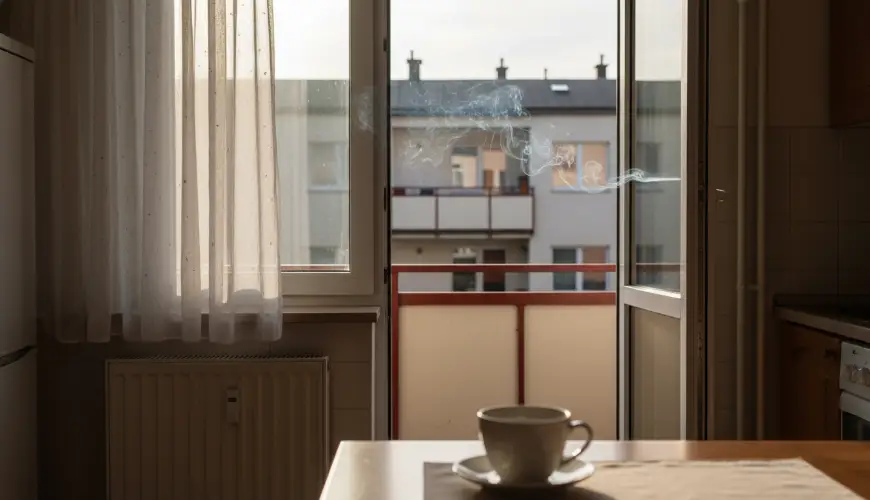
It happened again. In the morning you make yourself a coffee, open the window to let in some fresh air, and instead of fresh air you're greeted by the acrid cigarette smoke drifting up from your downstairs neighbour's balcony. Or you lie down in bed in the evening and notice the smell of tobacco creeping under the hallway door straight into your bedroom. This problem affects hundreds of thousands of people in Czech panel buildings, apartment complexes and older brick developments. It's not just a matter of comfort – passive smoking is demonstrably harmful to health, even when you never touch a cigarette yourself.
The situation is made more complicated by the fact that smoking in a private space – that is, in a flat or on one's own balcony – is legal in the Czech Republic. Your neighbour is therefore not breaking any law. Nevertheless, there are a whole range of steps that can help address the situation, whether through direct communication, technical measures, legal action or protecting your own health.
Try our natural products
Why the smell of cigarettes in a flat is such a problem
Before we get into solutions, it's important to understand why tobacco smoke penetrates walls, floors and ceilings so easily. Cigarette smoke contains over four thousand chemical substances, many of which are toxic or directly carcinogenic. These substances bind to dust particles and penetrate even very small gaps – around pipes, in floor joints, through ventilation shafts or electrical conduits. The World Health Organization (WHO) classifies passive smoking as a proven cause of lung cancer, heart disease and many other serious conditions. In other words, if smoke from neighbours regularly enters your flat, it's not just an unpleasant smell – it's a genuine health risk.
Moreover, tobacco smoke doesn't just stay in the air. It settles on furniture, curtains, carpets and walls, where it persists long after your neighbour has stubbed out their last cigarette. Scientists refer to this phenomenon as "thirdhand smoke." Research published in the journal Environmental Health Perspectives shows that tobacco smoke residues on surfaces can be particularly hazardous to children, pregnant women and the elderly. This is why the problem should not be treated as a trivial neighbourly nuisance, but as a serious matter of housing quality.
Imagine a family with a young child moving into a flat in a panel building. The baby sleeps in a room adjoining the stairwell where the building's smokers go to smoke. The parents soon discover that the smell penetrates even through closed doors, and the child starts waking up with a blocked nose. This situation is not made up – it is the everyday reality for many Czech families.
Talking to your neighbour – the first and most important step
Although it may seem like the most difficult part, a direct conversation with your neighbour is usually the most effective and quickest solution. Many smokers are completely unaware that their smoke is reaching their neighbours – and once they find out, they are often willing to adapt. The key is to approach the conversation calmly, without accusations, and with concrete suggestions.
How should you conduct such a conversation? Ideally, choose a neutral setting and a calm moment – not the instant you've just caught a whiff of smoke again and are feeling irritated. Explain the situation factually – say that smoke is entering your flat and causing you problems. Suggest specific solutions: for example, that your neighbour smokes by an open window on the opposite side of the flat, or outside in front of the building. If you have young children or someone with allergies in your household, mention it – people are generally more receptive when they understand the concrete impact.
If a direct conversation isn't possible or has failed, the next step is to contact the building manager or housing cooperative. While they cannot ban smoking in a private flat, they can prohibit smoking in common areas – in corridors, stairwells and lifts. A smoking ban in the common areas of a residential building is consistent with Czech law on the protection of health against the harmful effects of addictive substances (Act No. 65/2017 Coll.), and the building manager or homeowners' association can enshrine it in the house rules. This alone can significantly reduce the penetration of smoke into flats.
House rules are, in fact, a more powerful tool than many people realise. A homeowners' association or housing cooperative can use house rules to regulate the behaviour of residents in common areas and treat any violation as a misdemeanour or a breach of the tenancy agreement. If a neighbour smokes in the corridor or in the lift, you have the right to have the building manager prohibit and enforce against this.
Technical measures to protect your own flat
While waiting for the results of communication or legal steps, there are practical technical measures that can significantly reduce the penetration of smoke into your home. These are not definitive solutions, but effective protection that works immediately.
The first step is to identify where the smoke is getting in. The most common entry points are ventilation openings, gaps around pipes passing through ceilings or floors, spaces under entrance doors and electrical junction boxes in walls. These spots can be sealed with silicone sealant, expanding foam or specialist sealing tape. Pay particular attention to ventilation shafts – these are the most common route by which smoke travels between flats. Installing a non-return valve in a ventilation shaft will prevent air (and with it, odour) from entering from a neighbouring flat.
Another highly effective aid is an air purifier with a HEPA filter and activated carbon. HEPA filters capture fine dust particles to which the chemical substances in tobacco smoke bind, while activated carbon absorbs the gaseous components of the odour. A good-quality air purifier can clean the air in a room several times per hour and significantly reduce the concentration of harmful substances. When choosing one, it's important to look at the CADR (Clean Air Delivery Rate) parameter – the higher the value, the more effective the device for a given room size.
Ventilating your flat is a tricky issue in this situation. Opening a window can be counterproductive if your neighbour happens to be smoking outside at that moment. A solution may be a heat recovery ventilation unit with controlled airflow, which brings fresh air in from outside through a filter while eliminating draughts and uncontrolled air intake from the corridor or shafts. These units do represent an investment of several thousand crowns, but for allergy sufferers or families with young children they can pay for themselves quickly.
Don't forget indoor plants either – although their ability to clean the air tends to be overstated in popular media, certain species such as the peace lily or pothos (epipremnum) can absorb some volatile organic compounds. It's not a miracle solution, but as a supplement to other measures it has its place.
The legal route and when to take it
If communication fails and technical measures are not enough, legal options come into play. It is important to bear in mind that the right to peaceful enjoyment of one's flat is enshrined in the Civil Code. Section 1013 of the Civil Code stipulates that the owner of a property must refrain from anything that causes immissions – that is, the intrusion of smoke, odour or other disturbing influences onto a neighbouring property beyond a level proportionate to local conditions. Tobacco smoke can be legally classified as an immission, and if it exceeds the "proportionate level", you have the right to seek redress.
How does this work in practice? The first step is to document the problem. Keep a diary recording when and how intensely smoke enters your flat. Take photographs or videos where possible. Have a doctor confirm any health problems the smoke is causing you or members of your household. This documentation will be crucial if you decide to file a complaint or bring a claim.
Filing a complaint with the regional public health authority is another possible step. Regional hygiene stations have the authority to investigate complaints relating to disturbance by immissions and can look into the situation. Their decision cannot directly stop the smoker, but it creates an official record and can strengthen your position in any subsequent legal dispute.
Going to court is a last resort, and you should be prepared for it to be lengthy and costly. Nevertheless, there are precedents in which Czech courts have awarded claimants the right to compensation or ordered a neighbour to restrict smoking in a manner that disturbs others. As legal practice has it: "One person's freedom ends where another's begins." This principle applies in housing law too.
How to protect your health while the situation is being resolved
Regardless of which route you decide to take, it is important to actively protect your own health and that of your loved ones in the meantime. Regular ventilation at times when your neighbour is not smoking, combined with an air purifier, forms the basic line of defence. If you have an allergy sufferer, asthmatic or young child in your household, consult a doctor about appropriate supplementary measures.
It is also worth investing in quality bed linen and curtains made from materials that absorb odours less readily, and washing them regularly. Tobacco residue settles on textiles and can linger for weeks. Natural materials such as cotton or linen wash more easily and hold odours less than synthetic fibres. Similarly, regularly wiping surfaces with a damp cloth helps remove settled particles.
How long a person is prepared to put up with the smell of cigarettes in their own home is an entirely personal matter. For some it is a minor inconvenience; for others – particularly parents of young children or people with respiratory conditions – it is a serious problem with an impact on everyday quality of life. What matters is knowing that you are not powerless and that there are concrete steps that can improve the situation – from a calm conversation, through technical solutions, to legal instruments. A combination of these approaches tends to be most effective, and patience along with good documentation are in this case the best investment you can make.