

# Co se stane s oblečením z kontejneru na textil Oblečení vhozené do kontejneru na textil prochází
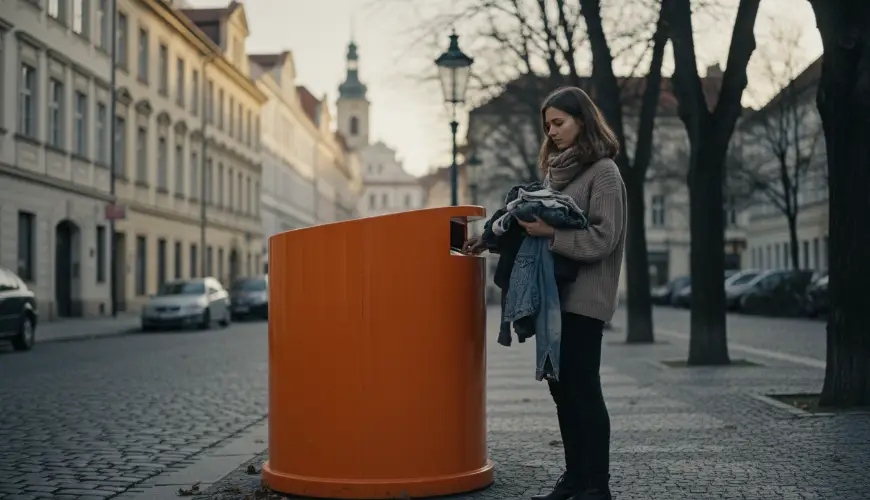
Every one of us knows the feeling – spring cleaning or moving day arrives, and we find ourselves staring at a pile of clothes we haven't worn in years, wondering what to do with them. Orange or yellow textile collection bins, scattered throughout the Czech Republic, have become a familiar fixture in our housing estates and streets. We toss in old jeans, a torn sweater, or children's clothes from last season and walk away feeling like we've done something good for the planet. But what actually happens to that clothing? The journey of textiles from the collection bin to their final destination is surprisingly complex and not always as eco-friendly as we might hope.
According to data from the Czech Statistical Office, the average Czech person generates several kilograms of textile waste per year. Globally, approximately 85% of all clothing ends up in landfills or incinerators, with only a fraction undergoing genuine recycling. Textile collection bins therefore represent an important first step – but certainly not the end of the story.
Try our natural products




Sorting and initial selection – where the real fate of your clothing begins
Once a collection company empties a bin, its contents are transported to a sorting facility. In the Czech Republic, textile collection is operated primarily by charitable organisations such as Diakonie ČCE, the Red Cross, and Charita Česká republika, as well as commercial companies specialising in the processing of used clothing. It is in these sorting facilities that the fate of each individual garment is decided.
Sorting facility workers manually go through each item and divide it into categories. Clothing that is still in good condition – clean, undamaged, and functional – is sent to second-hand shops or humanitarian warehouses. Some of it is sold directly in the Czech Republic through charity shops, while some is shipped abroad. Clothing with minor defects, such as missing buttons or small tears, can be repaired before being sold. Roughly 50–60% of all collected textiles are still of sufficient quality to be reused as clothing – that's good news.
However, the remaining 40–50% tell a rather different story. Clothing that is too worn, damaged, or soiled to be worn again goes on to further processing. And this is where things get complicated.
Textiles that cannot be directly resold as clothing are used as so-called industrial rags – cleaning materials for industry, car repair shops, or cleaning companies. Some clothing is mechanically shredded and converted into filling material for mattresses, insulation layers, or building materials. Woollen jumpers can be recycled back into yarn, and a cotton T-shirt can be transformed into a cleaning cloth or paper. True chemical recycling of textiles – capable of fully restoring fibres to the level of new ones – remains largely the domain of research laboratories and pilot projects rather than common practice.
Where discarded Czech clothing ends up – the global dimension of the story
This is where a part of the story that rarely gets told comes in. A large proportion of used clothing that passes through sorting facilities in Europe doesn't end up in charity shops around the corner, but on markets in Africa, Asia, or Latin America. This trade in used clothing has an enormous global scale – according to a report by the organisation WRAP, it is a billion-dollar industry that moves hundreds of thousands of tonnes of textiles across continents every year.
The largest recipients of used clothing from Europe include Ghana, Tanzania, Uganda, and India. Local markets for used clothing – in Ghana they are called obroni wawu, literally meaning "dead white man's clothing" – are a vital source of affordable clothing for many families. At first glance, this sounds like an ideal solution: clothing gets a second life and helps people with lower incomes. But the reality is more complex.
As numerous investigative reports and academic studies have pointed out, some of the imported clothing is so poor in quality or so damaged that local traders cannot even sell it. The result is enormous piles of textile waste in developing countries that lack the capacity or infrastructure to process them in an environmentally sound way. Beaches in Ghana or Chile are today literally covered in layers of used clothing from around the world – this phenomenon has been documented by, among others, reports in The Guardian. This is a paradox worth reflecting on: efforts to behave in an environmentally responsible way in Europe can indirectly cause an ecological disaster on the other side of the world.
Renowned fashion designer and activist Orsola de Castro summed it up aptly: "The most sustainable garment is the one you already own." This sentence contains more wisdom than it might appear at first glance.
This doesn't mean, of course, that textile collection bins are a bad idea or that we shouldn't put anything in them. But it is important to understand how the whole system works and to adjust our behaviour accordingly.
There are things that will significantly influence whether your clothing genuinely helps or ends up as someone else's problem elsewhere. Clothing should be clean and dry – damp or dirty textiles deteriorate in collection bins and spoil other items as well. It should be in the kind of condition you would be happy to give to a friend or family member. If an item is truly worn out, torn, or contaminated with paint or chemicals, it is better to take it directly to a materials recycling facility or to enquire about local textile waste processing programmes.
Many towns and municipalities in the Czech Republic also operate so-called re-use centres or clothes swaps, where people can take clothing for free or exchange it. These initiatives have the advantage of keeping clothing within the local community, without it having to travel halfway around the world.
It is also worth noting that not all textile collection bins are the same. While bins operated by charitable organisations generally ensure that the proceeds from selling clothing go to good causes, commercial operators may use the income purely for business purposes. If you care about your donated clothing actually supporting a good cause, it is worth finding out who operates a particular bin.
Thinking about clothing before it ends up in a collection bin
The whole story of textile collection bins actually reveals a deeper problem – namely, the way we buy clothing today and how we treat it. Fast fashion has flooded the market with cheap items designed to last only a few seasons. The quality of materials is declining, clothing wears out more quickly, and as a result the volume of textiles that cannot be meaningfully reused is also growing.
Take a specific example: Jana, a woman in her thirties from Brno, buys an average of twenty new items of clothing each year. Some of them are cheap pieces from fast fashion chains that lose their shape or fall apart after two seasons. The rest are higher-quality items she wears for years. When Jana occasionally sorts through her wardrobe, it is precisely those cheap items that make up the bulk of what ends up in the collection bin – and they are also the least valuable to sorting facilities and potential recipients alike.
This example is not the exception but the rule. A study by the Ellen MacArthur Foundation, which focuses on the circular economy, found that the average garment today is worn approximately 36% less than it was fifteen years ago. We buy more, wear things less, and discard them faster.
Changing this pattern of behaviour doesn't have to mean a radical life overhaul. It's enough to start with a few simple steps – buying less but better-quality clothing that lasts longer and retains its value as a second-hand item. Repairing clothing instead of immediately discarding it. Seeking out sustainable brands that use eco-friendly materials and transparent production processes. Or simply visiting a second-hand shop before heading to a shopping centre.
Sustainable fashion is not just a trend – it is a way of thinking that takes the entire lifecycle of clothing into account: from production through wearing to its eventual end. And it is precisely this way of thinking that makes us more responsible consumers who don't need to wait until clothing ends up in a collection bin before considering its impact.
Textile collection bins remain an important part of the system for managing used clothing and they certainly serve a purpose. But the real benefit to the environment begins long before we arrive at one with a bag full of old T-shirts. It begins at the moment when we pick up a new item of clothing in a shop and ask ourselves: do I really need this? How long will it last? And what will happen to it when I stop wearing it? These are the questions that form the foundation of a truly sustainable approach to fashion – and answering them has far greater impact than any collection bin on a street corner.