

# Why We Get Used to Pain and What to Do About It Pain is one of the most complex phenomena the hum

Pain is a natural part of life – our parents, doctors, and life experiences all tell us so. Yet there is a fine line between pain serving as the body's protective signal and pain ceasing to be perceived as a problem, simply becoming part of everyday existence. This transition is gradual, subtle, and for many people quite literally a life trap. Chronic back pain in the morning, constant fatigue, tension in the neck, digestive issues – these are all conditions that millions of people describe as "normal," even though they are not normal at all.
The question is simple: how does it actually happen that we become so accustomed to pain that we stop perceiving it as a problem that needs to be addressed?
The answer lies deep in the biology of the human brain, in the psychology of adaptation, and in cultural patterns that teach us from childhood to "not sweat the small stuff" and to "just endure it." The result is a society in which being tired, having back pain, or experiencing constant stress is considered the standard of adult life. And it is precisely this normalisation of pain that is one of the greatest health risks of the modern age.
Try our natural products






A brain that adapts – and stops warning
The human brain is a master of adaptation. This ability once helped us survive in harsh conditions, but today it can betray us in ways we don't even realise. Neurologists call this phenomenon habituation – a process in which the brain stops actively responding to repeated stimuli because it evaluates them as "safe" or "irrelevant." The exact same thing happens with chronic pain.
Imagine Martina, a thirty-four-year-old accountant who sits at a computer for eight to ten hours a day. Two years ago she began to feel mild pain in her lower back. At first she perceived it as an unpleasant signal – she would stretch, go for walks. Gradually, however, the pain intensified and became a daily occurrence. The brain categorised it as a "standard sensation of this body" and stopped evaluating it as an urgent message. Today Martina says her back "aches a little," but that it's just normal. She stopped looking for the cause and began tolerating the pain as a given. Yet specialists in musculoskeletal medicine repeatedly point out that chronic back pain is often a symptom of specific structural problems that worsen without intervention.
Habituation itself is not a system error – it is a system function. The problem arises when the brain "turns down the volume" of a warning signal before the cause of the pain has been removed. The body then continues to bear the burden of damage, inflammation, or faulty movement patterns, but the conscious mind stops receiving a clear message. Pain becomes the background, not the foreground.
Research in neuroscience shows that chronic pain causes changes in the very structure of the brain – specifically in the areas responsible for processing pain and emotions. Studies published in the journal Nature Neuroscience confirm that long-term pain alters the density of grey matter in the prefrontal cortex, affecting not only pain perception but also decision-making, mood, and the ability to concentrate. In other words, the normalisation of pain is not merely a psychological attitude – it is a physiological reality with profound effects on a person's overall functioning.
Alongside habituation, a key role is also played by the phenomenon of central sensitisation, in which the nervous system, after prolonged exposure to pain, paradoxically heightens its sensitivity to other stimuli while "getting used to" the original source of pain. The result can be a person who does not respond to joint pain but reacts hypersensitively to stress, light, or sound. The body redistributes attention, but the problem has not gone away.
A culture of endurance and the silent acceptance of fear
Biology is only one part of the story. The second, equally important part plays out in the realm of culture and social pressure. From an early age we are exposed to messages that glorify pain as proof of courage or industriousness. "No pain, no gain." "Where there's a will, there's a way." "Don't make excuses about pain." These beliefs are deeply ingrained and shape the way adults interpret their own bodily signals.
As Bessel van der Kolk, leading psychiatrist and author of The Body Keeps the Score, aptly noted: "The body keeps the score of everything the mind refuses to see." This sentence captures the essence of what happens when we normalise pain – the conscious mind accepts it as the standard, but the body continues its silent struggle, which sooner or later manifests in another way: illness, exhaustion, psychological difficulties.
A performance culture is a direct catalyst for the normalisation of pain. People in demanding professions – nurses, teachers, paramedics, managers – are particularly vulnerable. Their working environment not only offers no space for acknowledging their own pain, but actively rewards ignoring it. Being "strong," "not stopping," "being there for others" are values that implicitly say: your pain can wait. And it will wait – but with interest.
A similar mechanism operates in the family environment. Parents who themselves suffer from chronic pain and never address it unconsciously pass on a pattern to their children: pain is normal, dealt with at most by a tablet, not by searching for the cause. Research by the World Health Organization shows that chronic pain affects approximately 20% of the adult population worldwide, with a large proportion of these people never having sought professional help – not because help was unavailable, but because they did not consider it necessary.
There is also a specific type of pain normalisation that concerns women. Menstrual pain, pain during childbirth, pain associated with endometriosis – these conditions have historically been minimised both by doctors and by the women themselves, who are led to believe that "it's just the way it is." Studies published in The Lancet repeatedly highlight the fact that women's pain is believed less and treated less than men's pain, which contributes to women internalising it as an inevitable part of their sex.
When pain stops being normal and what to do about it
Distinguishing between natural bodily fatigue and a genuine warning signal is not always easy, especially when we have become so accustomed to pain that we have lost our reference point for how we are actually supposed to feel "normally." Nevertheless, there are certain indicators that are worth paying attention to.
Pain that lasts longer than three months is professionally classified as chronic and deserves professional examination. The same applies to pain that affects sleep, mood, social life, or work performance – even if it seems "mild." A key signal is also the gradual restriction of activities that a person previously carried out without difficulty. If someone has stopped going for walks because "their knees hurt," stopped cooking because "their back hurts," or avoids social situations because they are too tired – this is not normal adaptation to ageing or to a heavy workload. It is a warning signal.
The first step towards change is naming the problem. Stopping saying "my back aches a bit" and starting to say "I have chronic back pain that limits my life" is a seemingly small but fundamental shift in thinking. The language we use to describe our own condition directly influences how we deal with it.
The next step is to look for the cause, not just relief. Modern medicine offers a wide range of options – from physiotherapy and osteopathy to pain-focused psychotherapy and lifestyle changes. Exercise, quality sleep, an anti-inflammatory diet, and reducing chronic stress are factors that have a demonstrable effect on the perception and intensity of pain. These are not miracle recipes, but systematic care for a body that is giving us signals we have learned to ignore.
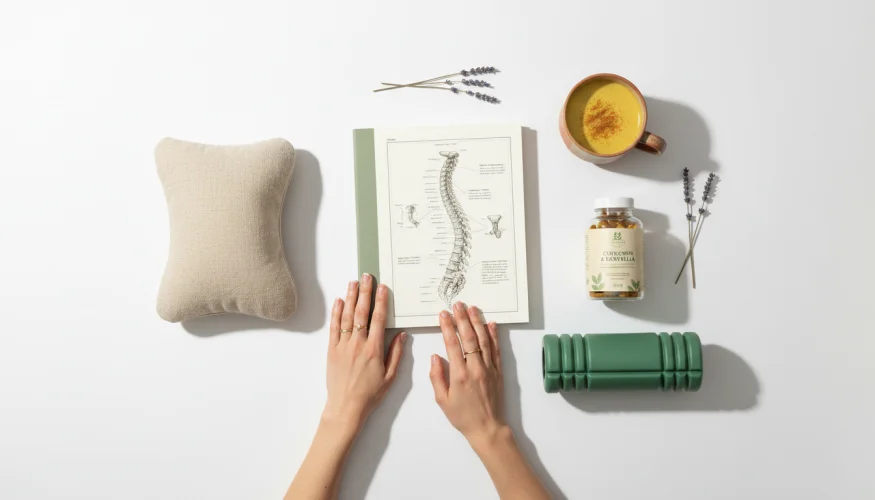
In this context, the choice of everyday products also plays a role – from ergonomic aids and high-quality natural dietary supplements to materials that do not burden the body with unnecessary chemical substances. A mindful approach to what we eat, what we surround ourselves with, and how we treat our bodies is part of a broader framework in which pain ceases to be the standard and becomes what it always was – information that must be acted upon.
The normalisation of pain is a silent epidemic that does not act dramatically but systematically undermines the quality of life of millions of people. The brain adapts, culture approves, those around us confirm it – and a person finds themselves in a situation where pain seems as natural as their morning coffee. That is precisely why it is important to stop from time to time and ask honestly: is this really normal, or have I simply got used to it?