
# How to Teach Children to Value Things Without Lecturing
Every parent knows it. A child gets a mountain of gifts for their birthday, and three days later half of them are forgotten under the bed while they complain again that there's nothing to do. Or they come home from school and toss their backpack into the corner without thinking, leave their lunchbox open on the table, and kick their new shoes — which cost a fair amount of money — into the hallway. It's not about bad parenting, nor about children being naturally ungrateful. It's about something deeper — the fact that in today's world, saturated with things, fast fashion, and one-day trends, we have all, children and adults alike, lost some of our ability to truly appreciate things.
And this is where one of the greatest parenting paradoxes lies: the more things we give children, the less they value them. Yet lecturing them about how grateful they should be, or long speeches about the value of money, rarely work. Children don't need moralising — they need experience. They need to feel what it means to lose something, to wait for something, to make something with their own hands, or to take care of something. And it is precisely at this point that raising children to be grateful naturally intersects with the topic of sustainability.
Try our natural products



Sustainability as a way of life, not an ecological slogan
The word sustainability has been on everyone's lips in recent years, but in the context of raising children it has a very concrete and practical dimension. It's not just about sorting waste or buying organic food. It's about how we relate to the world around us — how we handle the things we own, how we think about their origins, and what we do with them when they've served their purpose. If a child understands that every object has its own story — from where it was made, through the hands that crafted it, to the moment they hold it — they will approach things in an entirely different way.
Research in developmental psychology shows that children who actively participate in caring for things in their environment display higher levels of empathy and responsibility. A study published in the journal Developmental Psychology confirms that children who have specific responsibilities at home and can see the direct consequences of their actions develop a better relationship with material things and with people. This is not a moral appeal — it is a natural consequence of how children are involved in everyday life.
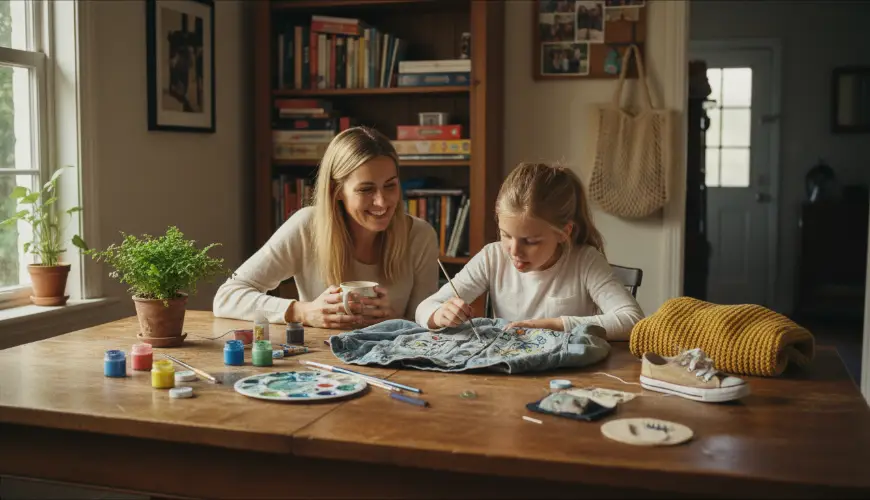
Take, for example, a family that decided to stop buying clothes from fast fashion chains and instead started going to flea markets and second-hand shops. At first, their ten-year-old daughter rebelled — she wanted the same things as her classmates. But then something unexpected happened. On one of their trips to a second-hand shop, she chose an old denim jacket herself, decorated it at home with hand-painted motifs, and began wearing it with enormous pride. Suddenly she had a piece of clothing that was truly hers — unique, with a story she had helped to create. From that moment on, her relationship with things changed. She stopped asking for new things just for the sake of it and began to appreciate more what she already had.
This story is not an exception. It is the natural result of giving children the space to have their own experiences, rather than adults telling them how they should feel.
Practical approaches that work better than lecturing
One of the most effective methods is surprisingly simple: letting children experience scarcity or waiting. In an age when almost anything is available instantly, the experience of delayed gratification is rare and enormously valuable. Psychologist Walter Mischel, whose famous marshmallow experiment became the foundation for understanding self-control in children, showed that the ability to wait is closely linked to overall life satisfaction and responsibility. If a child wants a new toy or piece of clothing, it can be very beneficial to say: "All right, but let's wait a month. If you still want it, we'll talk about it." Surprisingly often, after a month the interest has faded — and that in itself is a valuable lesson.
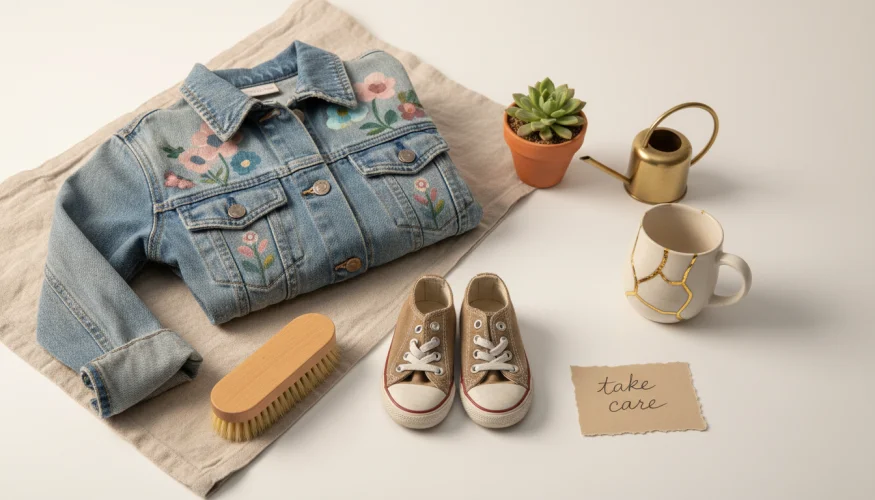
Another approach is to involve children in the process of choosing and caring for things. When a child knows how to look after something, they value it more. This might mean regularly cleaning shoes, repairing a broken toy, or watering a plant. Care creates a bond. It is no coincidence that children who have a pet they look after themselves value that animal in a completely different way from those who simply "have" one. The same principle applies to objects.
A very powerful tool is also sharing stories about where things come from. Where did that hoodie come from? Who made it? What is it made of? How much work went into it? These questions don't feel like an interrogation, but like natural conversations that broaden a child's view of the world. The organisation Fashion Revolution, for example, reminds us every year of the conditions under which fast fashion clothing is produced, and offers educational materials suitable for children as well. Once a child understands that behind a cheap T-shirt there may be the story of an overworked worker on the other side of the world, they will approach the shopping basket with greater thought — not because someone told them to, but because they understood it themselves.
A very concrete and effective way to teach children to value things is also the "one in, one out" system. If a child wants a new toy, they must decide which old one to give away or sell. This simple mechanism encourages thinking about the true value of things and whether a new item will genuinely fill a gap or simply add to the pile. At the same time, it teaches that things can have a second life — and that is the foundation of sustainable thinking.
There are also approaches that connect the cultivation of gratitude with creativity. Repairing things rather than throwing them away is particularly powerful in this regard. The Japanese concept of kintsugi — repairing cracked ceramics with gold, so that the breaks are highlighted rather than hidden — carries a profound message: things that have been repaired have their own story and are all the more precious for it. This approach can be applied to parenting too: when a favourite toy breaks, it is not the end, but an opportunity for repair and for understanding that things deserve care.
But how can all of this be achieved without becoming parents who constantly moralise and preach? The answer is simple, even if not always easy: lead by example. Children don't listen to what we say — they watch what we do. If we as adults shop impulsively, throw away things that could be repaired, and complain that nothing lasts, the child will naturally adopt this behaviour. On the other hand, if they see parents who repair things, shop thoughtfully, and speak about objects with respect, they absorb these values without a single lecture.
As the educator and philosopher John Dewey said: "Education is not preparation for life — education is life itself." Teaching children to value things therefore does not mean organising lectures on sustainability or forcing them to read articles about ecology. It means creating an everyday environment in which these values are present naturally and as a matter of course.
When to start and how to adapt to the child's age
Raising children to be grateful and sustainable has no fixed starting point — it begins far earlier than most parents realise. Even small children around the age of two to three are capable of grasping basic principles of caring for things, provided they are presented in a playful way. Putting toys away in their place, watering a little plant, helping to fold laundry — these are not just household chores, they are the first lessons in responsibility and care.
With school-age children, it is possible to go deeper. They can take part in decisions about family purchases, compare prices and quality, and discuss whether it is better to buy something cheap that will last a year, or something of higher quality that will last ten years. This kind of financial literacy is naturally connected to ecological thinking — something that lasts longer is not only more economical, but also kinder to the planet.
Teenagers can then be involved in more complex topics: they can research the origins of the products they use, follow brands that are committed to ethical production, or try selling things they no longer need through online platforms. This experience of running their own little "shop" is often enormously formative for young people — they suddenly understand what it means for something to have or lack value, and why the way they looked after it matters.
Sustainability and gratitude are not abstract concepts — they are concrete attitudes that manifest in everyday decisions. How we shop, how we care for things, how we handle them when they've served their purpose. And if children grow up in an environment where these attitudes are a natural part of life, there is no need to preach them. It is enough to live the way we hope they will one day live.
It's not about perfection. It's about the awareness that every thing has value — and that this value can only be seen if one learns to slow down and look.