
# How to Remove Stains Naturally ## Basic Natural Remedies for Stain Removal ### Baking Soda - Exc
Everyone knows it. An evening with friends, a glass of red wine tips over, and in seconds a light tablecloth turns into a disaster. Or morning coffee on the way to work leaves a mark on a favourite t-shirt. And anyone with children knows that grass stains on the knees of kids' trousers are an almost inevitable part of every trip into nature. Stains are part of life – but the way we fight them can have a significant impact on our health and the state of the planet.
Most people reach for the first available chemical from the drugstore. Aggressive degreasers, bleaching agents full of chlorine, or synthetic enzymatic products often work, but at a price that may not be immediately apparent. Irritating the skin, causing allergies, polluting wastewater, and damaging textile fibres – these are the side effects that rarely get mentioned on packaging. Fortunately, there is another way, one that is equally effective yet gentler on both people and the environment.
Try our natural products
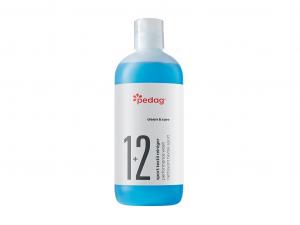

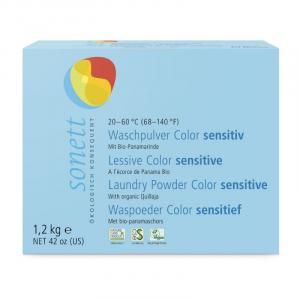
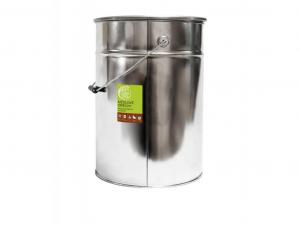
Why are some stains so stubborn?
To truly remove a stain, you first need to understand what is actually happening at the microscopic level. Red wine contains anthocyanins – natural pigments that bind very quickly to fabric fibres. Once the stain dries and the pigment oxidises, it becomes considerably harder to remove. A similar principle applies to coffee: it contains tannins and melanoidins that literally anchor themselves into the fabric. Grass, meanwhile, brings chlorophyll and other organic compounds that have an affinity for both natural and synthetic fibres.
The key to success is therefore speed and the right choice of product. The sooner a stain is treated, the greater the chance of complete removal. This rule applies without exception, and no natural method, however good, can get around it. Experienced textile cleaners confirm that a stain older than 24 hours requires far more intensive treatment than a fresh one. The ideal approach is always to start gently and only move on to stronger methods if necessary.
It is also important to know what to avoid. Hot water is the enemy in the first stage of stain treatment – heat causes proteins and pigments to literally bake into the fibre. Similarly, vigorous rubbing will not remove the stain but will instead spread it over a larger area and push it deeper into the fabric. The correct approach is always to gently dab and work from the edges of the stain towards the centre, to prevent it from spreading.
Natural helpers that work better than you might expect
Nature offers a surprisingly rich arsenal of products that can tackle most stains without a single drop of synthetic chemicals. Their advantage lies not only in their gentleness towards textiles and skin, but also in their availability – most of them can be found right in the home.
Mineral water or sparkling water are the first choice for a fresh red wine stain. Carbon dioxide helps mechanically loosen the pigment from the fibres before it has a chance to penetrate deeper. Simply pour it over the stain immediately and let it work, while carefully blotting up the excess liquid with a clean cloth. This method is particularly effective on carpets or tablecloths where the fabric cannot be washed straight away.
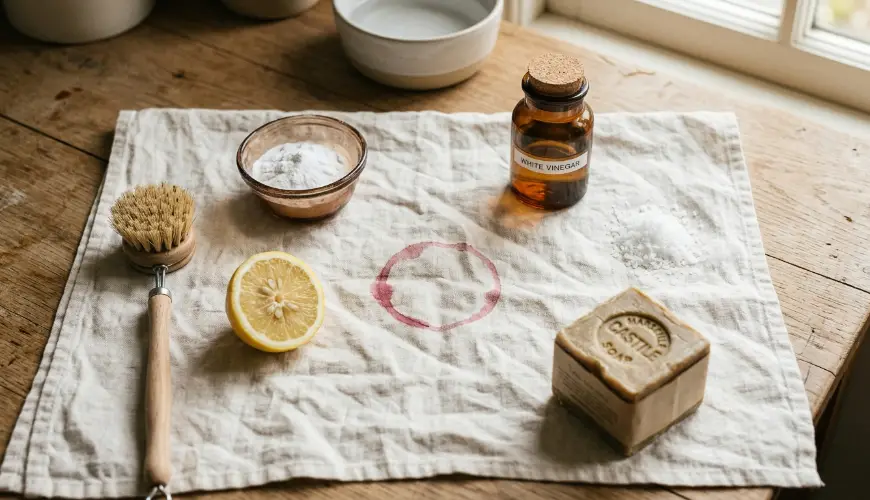
Salt is another classic helper that works on the principle of osmosis. Coarse table salt sprinkled on a fresh wine stain absorbs the liquid before it has a chance to anchor itself in the fabric. Once absorbed, the salt is brushed off and the stain is treated by another method. Baking soda works similarly, with the added benefit of mildly alkaline properties that help break down organic compounds. A paste of baking soda and a little water applied to a coffee or grass stain and left to work for 15 to 20 minutes can work wonders.
White vinegar is a true all-rounder in home cleaning. Its acidity helps break down the structure of stains while also acting as a natural deodorant that eliminates any accompanying odours. For coffee stains, a solution of white vinegar and cold water in a 1:2 ratio has proven effective, either as a soak or applied directly to the affected area. Vinegar is also gentle on most fabrics, including cotton, linen, and viscose, though with delicate materials such as silk or wool it is always advisable to test on an inconspicuous area first.
Lemon juice works on a similar principle to vinegar, but adds a natural bleaching ability thanks to its citric acid content. It is particularly effective on grass stains, where it helps break down chlorophyll. The combination of lemon juice and direct sunlight acts as a gentle natural bleach that has none of the aggressive effects on fabric that chlorine-based products have.
Bile soap, although its name sounds somewhat exotic, is a traditional European stain-removal method with a long history. It is made from animal bile and natural fats, and its enzymatic composition is remarkably effective on organic stains of all kinds – including wine, coffee, and grass. Today it is readily available in eco-friendly shops, and its composition is fully biodegradable. It is applied directly to the stain, worked in while damp, and left to act before washing.
Marseille soap or olive-based Castile soap are further natural alternatives with gentle cleansing properties that do not disrupt the natural structure of the fabric. As the French proverb goes: "Le savon de Marseille nettoie tout" – Marseille soap cleans everything. And while that is not literally true, for everyday stains this traditional soap really does suffice.
Special mention should also go to enzyme-based cleaning products of natural origin, which are now available from a range of eco-friendly manufacturers. Enzymes are biological molecules that break down specific types of soiling – proteases tackle proteins, amylases handle starches, and lipases deal with fats. Unlike synthetic enzymatic products, natural ones are produced by fermentation and contain no petrochemical carriers or synthetic stabilisers. Studies published in the Journal of Cleaner Production have repeatedly confirmed that biodegradable cleaning products are comparably effective to conventional ones, with significantly lower impact on aquatic ecosystems.
A practical guide for the most common stains
Imagine a scene that plays out in thousands of households every weekend: a family celebration, children running around the garden and returning with green stains on the knees of new trousers, while the adults at the table deal with a spilled glass of red wine and coffee on the tablecloth. Here is how to handle it.
For a red wine stain, speed is the priority. Immediately apply a clean cloth or paper towel and gently blot up as much liquid as possible. Then comes the mineral water or sparkling water, or a sprinkling of salt. If the stain persists, make a paste from baking soda and a drop of liquid Castile soap, apply it to the stain, and after 20 minutes wash in cold water. For dried wine stains, the most effective natural solution is to soak in a solution of white vinegar and cold water overnight, followed by washing with the addition of bile soap.
A coffee stain on clothing is best treated by immediately rinsing with cold water from the back of the fabric – the water pressure helps push the pigment out of the fibres. If the fabric is light-coloured, a solution of white vinegar or lemon juice can be applied after rinsing and left to work for 10 minutes. For older coffee stains, a natural enzyme-based product or bile soap with a longer working time works well.
Grass stains require a little more patience. Chlorophyll is a tough opponent, but a combination of lemon juice and baking soda creates a mildly fizzing reaction that helps loosen the stain from the fibres. Alternatively, diluted white vinegar or glycerin can be used – glycerin softens the stain and makes it easier to wash out afterwards. Glycerin is a natural substance derived from vegetable oils and is completely safe for both textiles and skin. After application and a working time of around 30 minutes, a standard wash at a lower temperature is sufficient.
When choosing eco-friendly cleaning products, it is worth looking for certifications such as Ecocert, EU Ecolabel, or Nordic Swan. These labels guarantee that the product has undergone independent assessment in terms of its composition, biodegradability, and impact on ecosystems. The European Environment Agency has long highlighted that common household cleaning products are a significant source of indoor air pollution and surface water contamination, and considers switching to eco-friendly alternatives one of the most accessible steps towards a more sustainable household.
It is also worth noting that the care of clothing and textiles has a direct impact on their longevity. Aggressive chemical products gradually damage textile fibres, causing premature wear and colour fading. Gentle natural methods, on the other hand, help keep textiles in good condition for longer, which from a sustainability perspective may be even more important than the composition of the cleaning product itself. Clothing that lasts longer does not need to be replaced as soon – and that is the greenest choice of all.
Switching from aggressive chemicals to natural cleaning methods requires no major investment or complex preparation. Salt, baking soda, white vinegar, lemon juice, and bile soap – these are the cornerstones of a natural home cleaning kit that can handle most everyday stains just as well as conventional products. And in those cases where a ready-made product is needed, simply look for certified eco-friendly alternatives, of which there are now more than enough on the market.