
# How to Read and Understand Food Labels
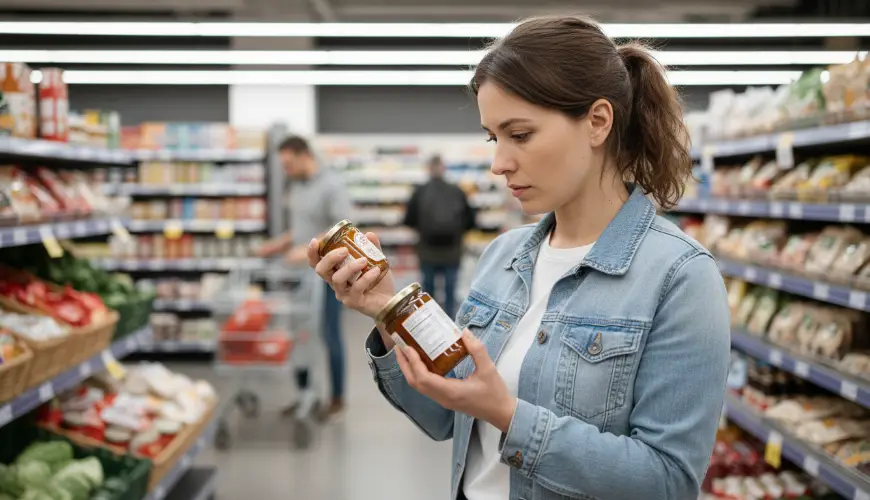
Most of us do it every day – we grab a product from the shelf, toss it into the cart, and move on. Maybe we glance at the packaging, read the name, and possibly check the price. But how many people actually read the label? And an even more important question – how many of those who do read it truly understand it? Reading food labels is a skill that seems trivial at first glance, but in reality, it can fundamentally influence how we eat, how we feel, and how healthily we live. And some of the things hidden on labels can be truly surprising.
Food labels aren't just mandatory decoration on packaging. They're essentially small information leaflets that manufacturers are legally required to include so consumers know what they're buying. But the problem is that the food industry has its tricks for presenting information in a way that makes a product look as appealing as possible – while still formally meeting all legislative requirements. That's why it's good to know where to look, what to search for, and what to avoid.
Let's start with the very basics. Every label in the European Union must, according to EU Regulation No. 1169/2011, contain several mandatory pieces of information: the name of the food, the list of ingredients, allergens, net weight, the best-before date or use-by date, storage conditions, manufacturer details, and of course nutritional values. All this information must be there – but that doesn't mean it's always easy to read or understand. That's precisely why it's important to learn how to navigate it.
What to focus on when reading ingredients
The product's composition is probably the most important part of the entire label. The rule is simple – ingredients are listed in order of quantity, from the one present in the greatest amount to the one present in the least. This means that if you're buying, for example, a fruit yogurt and you see sugar or glucose-fructose syrup listed first in the ingredients, it should give you pause. It means there's more sugar in that yogurt than actual fruit, and possibly even more than milk.
It's precisely the order of ingredients that many people overlook. Imagine you're standing in a shop in front of a shelf of muesli bars. The packaging features a beautiful image of whole nuts, honey, and golden grain. But when you flip the package over and read the ingredients, you discover that glucose syrup is listed first, palm fat is second, and nuts are somewhere around fifth place with a share of just six percent. That beautiful image suddenly tells a completely different story than the reality inside the packaging.
Another important aspect is E-numbers, meaning food additives. Many people are automatically afraid of them, but the truth is a bit more complex. Some E-numbers are completely harmless – for example, E300 is nothing other than ascorbic acid, which is vitamin C, and E330 is citric acid. On the other hand, there are additives where caution is warranted. Artificial colorings such as E102 (tartrazine) or E110 (sunset yellow) have been repeatedly examined by the European Food Safety Authority (EFSA) in connection with hyperactivity in children. The key, then, is not to panic at every letter E, but to develop the ability to distinguish between them.
A separate chapter entirely is sugar and its many forms. The food industry is exceptionally creative in this regard. Sugar can hide on labels under dozens of different names – sucrose, fructose, dextrose, maltose, glucose syrup, high-fructose corn syrup, maple syrup, agave syrup, cane juice, molasses, malt extract, and many others. According to some estimates, there are more than sixty different names for sugar that can appear on a label. And why do manufacturers do this? Because when they split sugar into several different forms, none of them appears in first place in the ingredients list – and the product then looks healthier than it actually is.
It's worth mentioning a real-life example here. The Czech consumer organization dTest some time ago tested children's breakfast cereals and found that some products contained up to thirty percent sugar. That means in every bowl of cereal a child ate, nearly a third was pure sugar. Yet the packaging enticed with "whole grain" and "vitamins and minerals." Formally, this was true – the cereals did indeed contain whole grain and added vitamins. But the sugar was there too; the packaging just preferred not to talk about it too much.
What might surprise you on labels
One of the biggest surprises for many consumers is the serving size from which nutritional values are calculated. Manufacturers often list values per single serving, not per entire package. And that serving can be unrealistically small. Buy a packet of crisps weighing 150 grams and look at the nutrition table – the values may be listed per 30-gram serving. Hand on heart, who among us opens a packet of crisps and eats exactly one-fifth? Most people eat significantly more, if not the entire packet. The result is that the actual intake of calories, fat, and salt is many times higher than what the label appears to show at first glance.
Another surprise is hidden in the marketing claims on the front of the packaging. Labels like "light," "fit," "natural," "no added sugar," or "whole grain" sound great, but they don't always mean what we imagine. The designation "light," for example, means the product contains thirty percent less fat or sugar than its standard version – but if the standard version contained an enormous amount of fat, even the "light" variant can still have quite a lot. And "no added sugar" doesn't mean the product contains no sugar at all – it may contain naturally occurring sugars or artificial sweeteners, which have their own pitfalls.
It's also interesting how manufacturers work with the term "natural flavoring." Most consumers imagine that this designation means the flavoring comes directly from the given fruit or spice. In reality, however, "natural flavoring" only means that the starting material was of natural origin – but it may have undergone complex chemical processing and may have almost nothing in common with the original raw material anymore. Strawberry natural flavoring may not come from strawberries at all, but perhaps from mold or yeasts that have been genetically modified to produce a strawberry taste. It's still "natural" because the source organism is natural – but the image we form of it is entirely different.
Few people also know that salt can be hidden on labels under the designation "sodium." If you want to find out the actual salt content, you need to multiply the sodium value by 2.5. So when you see 0.8 grams of sodium per 100 grams on a label, the actual salt content is 2 grams – which is already quite a lot, especially if you eat a larger portion. The World Health Organization recommends not exceeding 5 grams of salt per day, and many people routinely exceed this limit without even knowing it.
The fat content in products that present themselves as healthy can also be surprising. Granola, which is marketed as a healthy breakfast, can contain more fat and sugar than an ordinary chocolate biscuit. A store-bought smoothie can have more calories than cola. And a salad dressing labeled as "light" can be full of sugar that replaced the fat to help the product maintain its taste. As American journalist and food writer Michael Pollan once aptly remarked: "Don't eat anything your great-grandmother wouldn't recognize as food." It's a simplification, of course, but at the core of that thought lies an important truth – the shorter and more comprehensible the ingredient list, the better.
Special attention also deserves the distinction between best-before date versus use-by date. Many people confuse these two, and consequently throw away food that is still perfectly fine. "Best before" (marked with the words "best before") means that up to the stated date, the manufacturer guarantees the product's optimal quality – but after this date, the food may still be safe to consume. In contrast, the "use-by date" (marked with the words "use by") applies to highly perishable foods, and after this date, the product genuinely should not be consumed. According to European Commission estimates, approximately 59 million tons of food are thrown away in the EU each year, and a significant portion of this waste is related precisely to the misunderstanding of the difference between these two dates.
For those who want to navigate labels better, there are several practical tips. First and foremost, it's good to get into the habit of always flipping the package over and reading the back – the front is advertising, the back is reality. It also pays to always compare nutritional values per 100 grams, not per serving, because that's the only way to fairly compare two similar products. And finally – if you find an ingredient in the composition that you can't pronounce or can't picture, it's worth considering whether you really want to eat it.
It's also good to know that organic and ecological certifications have their strict rules. If a product bears the EU organic farming logo (the green leaf with stars), it must meet the conditions set by European legislation – at least 95 percent of agricultural ingredients must come from organic farming. That's a fairly strong guarantee, but even an organic product isn't automatically "healthy" – organic sugar is still sugar, and organic crisps are still crisps.
Reading food labels isn't about becoming a paranoid consumer who spends hours in the shop examining every product. It's more about building a habit and gradually learning to recognize what's important. It's enough to start with small steps – next time you're standing in a shop, try reading the ingredients of your favorite product. You might be pleasantly surprised. And you might discover it's time to try something different. In either case, you'll be one step closer to knowing what you're actually eating – and that's something that's definitely worth those few extra minutes.