
French potatoes will be tender and not dry when you choose the right type of potatoes and dressing.
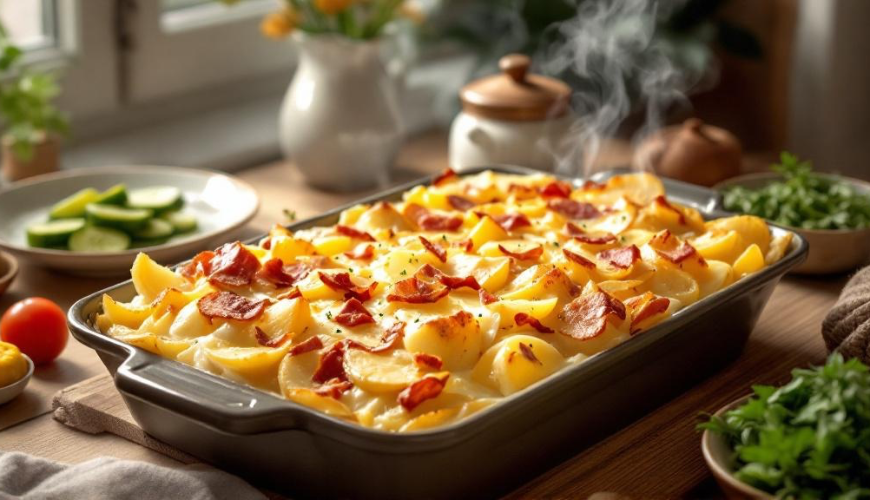
French potatoes are one of those dishes that are passed down in Czech kitchens almost like family stories. In some places, they are made "properly" with cream, elsewhere they swear by milk, some add smoked meat, while in others the main stars remain eggs and potatoes. And although the name evokes French gastronomy, it's mainly about a home classic: hearty, fragrant, ideal for weekdays and weekends when you want to save time and dishes. It's no wonder people keep asking, how to make French potatoes so they're juicy, not dry, and to create a beautiful golden crust on top. Also, why are some baked French potatoes so tender that they almost fall apart, while others hold their shape like from a textbook.
In recent years, classic recipes have met with new habits: some are looking for a lighter version, others want to use up leftovers from the fridge completely, and some try to choose ingredients more sustainably – like locally sourced potatoes, better-farmed eggs, or dairy products without unnecessary additives. French potatoes are grateful in this respect: with a few simple rules, the result can be not only tasty but also quite "sustainable" in the most practical sense – using up what is already at home while creating a meal that feeds the whole family.
Why French Potatoes Are So Popular (and What Determines the Outcome)
The charm of French potatoes lies in the contrast: soft layers of potatoes and eggs inside, something more pronounced in between (onion, pickle, smoked meat, or just pepper and nutmeg) and a baked surface on top that tempts as soon as the oven is opened. Yet it's a recipe that allows for improvisation. But improvisation is often the reason why sometimes they turn out great and other times mediocre. It often hinges on three details: the right type of potatoes, the ratio of liquid, and the baking temperature.
Potatoes should ideally be of the cooking type B (or C if you want a softer result). Type A tends to be firm and holds its shape, but in a baked dish, it can feel drier. Type B is a compromise – it softens nicely but doesn't fall apart into mash. Preparation is also important: some use potatoes cooked in their skins the day before, others cook them peeled. In practice, it proves useful to cook them in advance, as they are easier to slice evenly and just "finish" in the sauce in the oven.
Liquid is the second key. If there's too little, the casserole will be dry, looking nice but eating like over-dried potatoes with eggs. If there's too much, the dish will steam rather than bake, and the crust will form late. The most common solution is a mixture of milk and cream (or just cream diluted with milk) in which eggs are mixed. Here, it's worth considering quality: real cream without thickeners behaves differently in the oven than a "creamy" substitute – the taste is fuller and the consistency more natural.
And the temperature? French potatoes need time for the flavors to meld, but not so much that the sauce separates and the potatoes harden. They're usually baked at around 180–200 °C depending on the oven and the height of the layer. Sometimes it's useful to bake them covered for the first 20–30 minutes (or in a deeper baking dish) so that the contents heat evenly, and then finish uncovered for the crust. In households, it's solved simply: let it "work" for a while and then monitor the surface color.
When someone says "recipe for French potatoes," most people also think of the traditional accompaniment – pickles, salad, or just a spoonful of mustard on the side of the plate. It's no coincidence: the acidity and crunch balance the creamy, hearty base. That's also why this dish works across generations. As an old culinary rule aptly sums up: "Simple food is only as good as its ingredients."
For reliable information on food composition and nutritional values, you can look into databases like the Czech SZÚ (National Institute of Public Health) or European food and safety materials on the EFSA (European Food Safety Authority) website. It's not about turning French potatoes into a dietary project, but rather knowing that even with a simple dish, you can make smarter choices.
How to Make French Potatoes: A Method That Works in Everyday Household Use
When people ask, how to make French potatoes, they often mean one specific thing: that they should be "just right" – neither mushy nor dry, and yet easy to cut into neat portions. And this is where sticking to simple logic helps: prepare the potatoes first, then layer, and finally pour and bake.
Potatoes are usually cooked in advance. It's ideal to cook them with their skins on, let them cool, and peel them afterward. This way, they maintain their structure and don't crumble as much when sliced. The slices should be roughly the same thickness – neither paper-thin nor one-centimeter chunks. If they're uneven, some will overcook while others remain firm.
Then comes the layering. In a greased baking dish, you start with a layer of potatoes, season with salt and pepper, and add other ingredients – traditionally hard-boiled eggs in slices, sometimes also onions, or a bit of smoked meat, ham, or a quality plant-based alternative if making a lighter or vegetarian version. Seasoning is crucial: salt and pepper are basic, but a pinch of nutmeg or marjoram works well too. Those who like a stronger flavor can add a bit of garlic, but carefully, so as not to overpower the rest.
Finally, everything is poured over with a mixture of eggs and a dairy base. Here, the question often arises: how many eggs in the sauce when there are already eggs inside? The answer is: it depends on how "creamy" it should be. Some add just one or two eggs to the sauce, while others make it almost like a savory custard. What's certain is that the sauce should seep down but not drown everything. A gentle shake of the dish or pressing the potatoes slightly helps the liquid get between the layers.
Baked French potatoes are then baked until the surface is golden and the sauce is set. You'll know by the smell too – when the typical "baking" aroma starts and the edges of the dish slightly pull away. If the surface browns too quickly, just lower the temperature or cover temporarily. Conversely, if the surface is pale and the dish is already heated through, a few minutes under the grill (if the oven has one) helps, but keep an eye on it because the difference between a golden and a burnt crust can be just a moment.
And now an example from everyday life that sums it all up: in many families, French potatoes are made on Sundays because on Saturday there are a few boiled potatoes left from lunch and an opened pack of ham or a piece of smoked meat in the fridge. Instead of "finishing off" the leftovers bit by bit, everything is combined into one dish, a few eggs and some cream are added, and it becomes a dinner that tastes as if it were planned. Plus, it reheats well the next day – and sometimes it's even better because the flavors meld even more overnight.
Recipe for Classic French Potatoes (Without Unnecessary Complications)
This recipe for French potatoes is based on what's most often at home, yet leaves room for small adjustments. The quantity adapts to the size of the baking dish and the number of diners, but as a guideline, about a kilogram of potatoes is suitable for four servings.
The only list really needed is the one with the ingredients:
- potatoes (ideally cooking type B), about 1 kg
- hard-boiled eggs, 4–6 pcs (according to taste)
- eggs for the sauce, 2 pcs
- milk and/or cream (e.g., 200 ml milk + 200 ml cream)
- onion (optional, but often works wonders), 1 pc
- smoked meat or ham (optional), about 150–250 g
- salt, pepper, a pinch of nutmeg
- fat for greasing the dish (butter or oil)
The method can be described simply: boiled and cooled potatoes are peeled and sliced, hard-boiled eggs are also sliced, onions can be used raw in thin strips or briefly sautéed. In the dish, layer potatoes, eggs, and possibly smoked meat, seasoning each layer lightly. The sauce is made by whisking eggs with milk and cream, seasoned with salt and pepper, and poured over the dish's contents. Bake for about 35–50 minutes, depending on the layer's height, at 180–190 °C until the surface is golden and the center is firm.
Those who want to take the flavor a step further can place a few small pieces of butter on top or lightly sprinkle with cheese. It's not necessary, as the sauce itself can create a crust, but in some households, it's a favorite trick for a "more festive" version.
Baked French Potatoes a Bit Differently: Lighter Ingredients, Fuller Flavor, and Less Waste
French potatoes are often considered a hearty dish, but even here, the composition can be sensitively adjusted to retain flavor while making the dish easier to eat even during the week. It often suffices to replace part of the cream with milk or plain yogurt (ideally thicker to prevent curdling), add more onions and herbs, and reduce the smoked meat. The result will still be creamy, just a bit lighter. Those avoiding meat altogether can opt for sautéed mushrooms, tempeh, or smoked tofu – the important thing is to add that "smoky" or umami note that smoked meat typically provides.
From a sustainability perspective, this dish has another advantage: it can be built excellently on seasonal and local ingredients. Locally sourced potatoes often have a shorter journey to the plate, often better flavor, and when combined with eggs from a verified farm, it's a change that even someone not focused on labels can notice. And if dairy products are commonly used at home, it's worth monitoring the composition – the shorter, the generally better. It's not a rule, more of a practical guide: when cream is supposed to contain cream, it's nice when it actually does.
French potatoes also teach a useful skill: seasoning layer by layer. Many people make the mistake of only salting the sauce. But then the salt doesn't distribute evenly, and some bites are bland. When the potatoes are lightly seasoned while layering and the sauce is just adjusted, the flavor is more balanced, and there's no need to "chase" it on the plate.
Perhaps it's worth asking a simple question the next time baking: is it really necessary for everything to be exactly the same as always? French potatoes are exactly the type of dish that can take small changes without losing identity. Sometimes it takes just a few thyme leaves, other times replacing part of the smoked meat with vegetables, allowing the pepper and nutmeg to shine. And when the right sauce and good potatoes are achieved, it creates a dish that smells like home even on a completely ordinary day.
The next time the oven is opened and a golden crust is bubbling on the surface, there's a good chance that even those who originally "weren't hungry" will gather at the table. French potatoes have a peculiar ability: they seem inconspicuous but taste so good that even someone who generally doesn't seek out baked dishes will request them. And that's perhaps the most pleasant thing about a home classic.