

# Heat Treatment of Vegetables and Its Effect on Nutrients
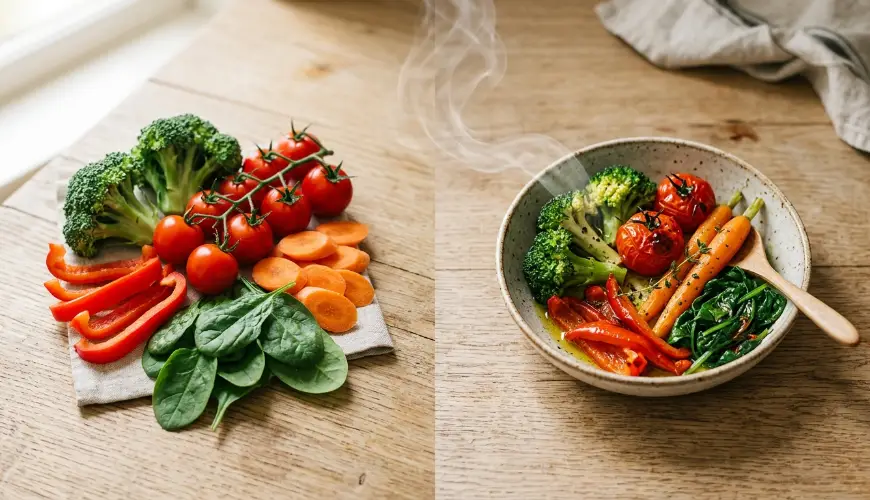
Vegetables are one of the fundamental pillars of a healthy diet – almost everyone knows that. But what exactly happens to their nutrients the moment we start boiling, steaming or roasting them? The answer is not as straightforward as it might seem. While some vitamins and antioxidants are indeed lost through heat treatment, other substances actually become more available and beneficial. Understanding this paradox can fundamentally transform the way we prepare vegetables – and therefore what our bodies actually absorb from them.
This debate has been going on for decades between advocates of raw food diets and supporters of traditional cooking. The truth, as is often the case, lies somewhere in the middle – and depends on the specific vegetable, the cooking method and the duration of cooking. It is therefore not enough to say that cooked vegetables are worse or better than raw ones. We need to look at the matter in more detail.
Try our natural products



What happens to nutrients when heated
Vegetables contain a wide range of biologically active substances – vitamins, minerals, fibre, antioxidants and phytochemicals. Each of these groups reacts to heat differently. Vitamin C and B-group vitamins are so-called water-soluble vitamins, and these are the most sensitive to heat. Vitamin C breaks down relatively quickly during cooking – a study published in the journal Food Chemistry showed that boiling vegetables in water can cause them to lose up to 50% of their vitamin C, with some of it passing directly into the water. Folic acid is similarly affected, playing a key role during pregnancy or in the production of red blood cells, for example.
On the other side are fat-soluble vitamins – A, D, E and K. These are considerably more resistant to heat and their availability to the body often increases with heat treatment, especially when we prepare vegetables with a little quality fat. Carrots braised in butter or olive oil will therefore provide the body with significantly more beta-carotene than raw carrots without fat – because beta-carotene is a lipophilic substance, meaning one that is absorbed in the presence of fats.
Mineral substances such as potassium, magnesium or iron are a special case. These are generally resistant to heat, but when boiled in a large amount of water they pass into the cooking liquid. It therefore makes sense to use the water from cooking vegetables – for example as a base for soup or sauce. Those who pour this water down the drain are discarding a considerable amount of nutrients without even realising it.
One of the most interesting examples of how heat can increase the nutritional value of vegetables is the tomato. Raw tomatoes contain lycopene – a powerful antioxidant associated with a reduced risk of cardiovascular disease and certain types of cancer. However, lycopene is released from the cell walls of tomatoes through heat treatment and becomes much more easily absorbed by the body. Cooked or roasted tomatoes, tomato sauce or tomato paste therefore surpass fresh tomatoes in terms of their content of usable lycopene. This fact is also confirmed by research from the Harvard T.H. Chan School of Public Health, which has long focused on the relationship between diet and disease prevention.
A similar effect occurs with spinach, broccoli or asparagus. Spinach contains oxalic acid, which in its raw state binds minerals such as calcium and iron and prevents their absorption. Brief boiling or blanching largely breaks down the oxalic acid, which paradoxically increases the availability of minerals to the body. Broccoli, when briefly steamed or boiled, also releases more sulforaphane – a substance with powerful anti-inflammatory and anti-cancer effects – than raw broccoli. Research published in the Journal of Agricultural and Food Chemistry suggests that the key here is precisely the degree and method of heat treatment: brief and gentle cooking helps, while prolonged cooking is counterproductive.
The cooking method matters more than we think
The method of heat treatment plays a crucial role in what we ultimately obtain from vegetables. Boiling in a large amount of water is the least gentle method in terms of preserving vitamins – nutrients simply pass into the water, which is then often discarded. Steaming, gentle simmering or oven roasting are far better choices. These methods minimise the vegetable's contact with water and reduce the duration of exposure to high temperatures.
A concrete example is easy to imagine: a mother cooking broccoli for the whole family throws it into a pot of boiling water and leaves it there for twenty minutes. The result? The vegetable is soft, but most of the nutrients have ended up in the water or been broken down by heat. If instead she briefly steamed the broccoli – for around ten minutes – she would preserve significantly more vitamin C and other beneficial substances, and the vegetable would also retain a pleasant texture and colour.
Oven roasting produces a different effect. At higher temperatures, the Maillard reaction and caramelisation of sugars occur, giving vegetables their characteristic sweet and complex flavour. From a nutritional standpoint, fibre and minerals are well preserved during roasting, while some vitamin C is lost. Nevertheless, roasted vegetables can be an excellent choice, especially when prepared with a little olive oil – which aids in the absorption of lipophilic nutrients while also providing healthy unsaturated fatty acids.
The microwave, which many people consider an inferior cooking method, is actually one of the most gentle methods in terms of preserving nutrients. The short preparation time and minimal amount of water mean that vitamins have neither the time nor the environment to break down or pass into water. This is confirmed by the World Health Organization, which states that microwave cooking poses no health risks and can actually be advantageous in terms of preserving the nutritional value of food.
Deep-frying vegetables in oil is, by contrast, the most problematic from a nutritional standpoint. The high temperature of the oil destroys heat-sensitive vitamins, the vegetables absorb large amounts of fat, and harmful substances can form when oil is repeatedly overheated. Brief sautéing in a pan with a little oil is, however, an entirely different matter – it is a quick method that preserves both texture and some nutrients without burdening the dish with unnecessary amounts of fat.
Raw or cooked? The right question is different
As nutritional consultant and author of a book on functional foods Jo Robinson says: "The way we prepare vegetables can be just as important as which vegetables we choose." And this thought captures the essence of the whole topic. There is no clear-cut answer to the question of whether it is better to eat vegetables raw or cooked. It depends on the type of vegetable, the specific nutrients we are interested in, and the method of preparation.
Carrots, tomatoes, asparagus, spinach or kale – these are all vegetables that benefit from heat treatment, provided we prepare them correctly and for an appropriate length of time. Conversely, peppers, radishes or cucumbers retain their nutritional potential better in their raw state. Vitamin C, of which red pepper is an exceptionally rich source, breaks down quickly with heat – raw pepper sliced into a salad will therefore always be a better choice than braised pepper.
A healthy approach therefore lies in variety. Combining raw vegetables with cooked, steamed or roasted ones is a natural way to ensure the body receives the broadest possible spectrum of nutrients. A salad of fresh vegetables at lunch and steamed broccoli with roasted tomatoes at dinner – this combination covers far more nutritional needs than any extreme approach.
Fermentation also deserves special attention – while it is not strictly a heat treatment, as a method of processing vegetables it significantly increases the bioavailability of nutrients and enriches the diet with probiotics. Fermented cabbage, kimchi or pickled vegetables are examples of how traditional food processing methods naturally increase their nutritional value – and without a single degree of heat.
The overall message for everyday cooking is actually an encouraging one. We need not be afraid to boil, steam or roast vegetables – as long as we do so sensibly, gently and with variety. Brief heat treatment in the right medium – whether steam, a small amount of water or a little oil – can not only preserve nutrients but in many cases also increase their usability for the body. And that is good news for everyone who loves warm food and does not want to give up the pleasure of a bowl of steamed vegetables or a homemade tomato sauce in the name of health.