

Nokedli, halušky, gnocchi and their kinship
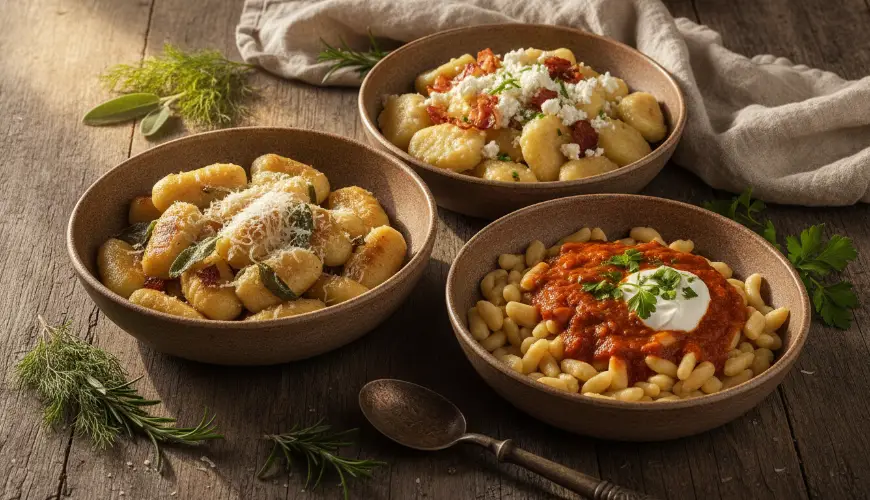
There are dishes that cross the borders of nations and centuries without their creators even knowing it. Small, soft dumplings made from dough belong among the most universal creations of human cuisine – and yet every nation proudly claims its own recipe as something entirely unique. Nokedli, halušky and gnocchi are three examples of how the same basic idea – boiled pieces of dough – can blossom into completely different forms, flavours and traditions across different cultures. They are distant relatives who have never met, and yet they are strikingly similar.
Let's take a look at what these three dishes have in common, how they differ, and why they deserve a place not only in the history of gastronomy, but also on the modern plate.
Try our natural products





From Alpine Villages to Balkan Mountains
The story of gnocchi begins in northern Italy, probably somewhere between Veneto and Friuli, where poor peasants were looking for ways to create a filling meal from basic ingredients. The word gnocchi comes from an old Italian term for a lump or knot – and indeed, these small potato dumplings have a distinctive shape created by pressing them over a fork or a special wooden board. The basic recipe for potato gnocchi is surprisingly simple: boiled potatoes, flour, egg and a pinch of salt. But therein lies the difficulty – the ratio of ingredients must be precise, otherwise the dough will either fall apart or turn rubbery.
Italians most commonly eat gnocchi with tomato sauce, pesto alla genovese, or simply drizzled with clarified butter and sage. In Rome, there is even a tradition called giovedì gnocchi – gnocchi is eaten every Thursday. The origin of this custom dates back to the time when Thursday was a carnival day and people treated themselves to a more substantial meal before Friday's fast. Today it is more of a cultural ritual than a religious obligation, but Roman restaurants still observe it with an almost sacred solemnity.
Yet gnocchi are far from just potato-based. In various Italian regions, versions made from spinach, pumpkin, beetroot or even chestnut flour exist. In northern Italy, you will encounter canederli – large dumplings made from stale bread, which are actually direct relatives of Czech bread dumplings. Italian cuisine is in this sense much more diverse than it might appear at first glance.
Halušky, on the other hand, are at the heart of Central European cuisine, and in two very different national interpretations at that. Slovak halušky are small, irregular pieces of dough boiled in water, most often served with bryndza and bacon – in the form of the iconic dish called bryndzové halušky, which is today considered Slovakia's national dish. Bryndzové halušky received protected geographical indication status in 2008, which is testament to how seriously Slovaks take their culinary heritage.
The Czech Republic also has a close relationship with halušky – after all, Slovak and Czech cuisine share much common heritage from the days of their shared state as well as from the older Central European tradition. Halušky are prepared in Czechia in a similar way, though less systematically than in Slovakia, where they are truly an everyday dish. Bryndza – a salty sheep's cheese with a distinctive flavour – is the key ingredient that cannot simply be replaced with another cheese without the dish losing its soul.
Nokedli: Hungary's Contribution to the Central European Story
And then there are nokedli, which are perhaps the least well-known of this trio beyond their homeland, but in Hungary they hold an absolutely irreplaceable position. Hungarian nokedli are small, yellow dumplings made from simple dough – flour, egg, water and salt – formed by pressing the dough through a special grater or colander directly into boiling water. The result is irregular, slightly chewy pieces with a characteristic texture different from smooth Italian gnocchi.
Nokedli are served with almost everything in Hungary. They are the classic accompaniment to pörkölt – Hungarian goulash, which is thicker and more aromatic than its Czech or Slovak variant. They are part of paprikás made from chicken, floating in a velvety paprika sauce with sour cream. And sometimes they are eaten simply pan-fried in butter with a little parsley. Simple perfection that needs no adornment.
Interestingly, nokedli have a direct relative in German and Austrian cuisine – Spätzle or Nockerl. These dishes are so similar that some historians argue about who influenced whom. The answer is probably that no nation invented dumplings – they arose spontaneously everywhere that people had flour, eggs and a pot of boiling water. The Central European space was connected for centuries by trade routes, migrations and political alliances to such a degree that culinary influences flowed in both directions regardless of linguistic or national boundaries.
Imagine, for example, a family from the area of present-day Slovakia in the 19th century, living in the Kingdom of Hungary. The grandmother made halušky according to her recipe, the neighbour from the Hungarian village next door made nokedli – and both women would probably have understood each other at the stove, because the process was almost the same. The difference lay in the details: in the thickness of the dough, in the size of the holes in the colander, in what the dumplings were served with. But the basic logic of the dish was shared.
As the Hungarian writer and gourmet Zsolt Harsányi once remarked: "Cuisine is the only language that needs no translation." And indeed – a plate of nokedli or halušky will speak to a hungry person regardless of where they come from.
What They Have in Common and Why It Matters
From a nutritional standpoint, all three dishes are primarily sources of carbohydrates, with potato gnocchi additionally providing potassium and vitamin C from the potatoes. Halušky and nokedli are somewhat richer in protein than purely flour-based pasta due to their egg content. None of these dishes is a dietary affair in the modern sense – they are foods that were created to fill working people, and in this regard they fulfil their purpose admirably.
For those interested in nutrition or trying to eat more mindfully, it is worth knowing that all three dishes can be prepared in various versions. Gnocchi made from wholegrain flour or sweet potatoes offer interesting nutritional alternatives. Halušky can be made from buckwheat flour, which gives them a nutty flavour and lowers the glycaemic index. And nokedli made from spelt flour are a popular choice for those seeking a compromise between tradition and healthier eating. If you are interested in ingredients for healthier cooking, you will find a whole range of quality alternative flours and other ingredients for mindful cooking at Ferwer's website.
The method of preparation and serving is also important. Gnocchi topped with a light tomato sauce made from fresh tomatoes are nutritionally quite different from gnocchi doused in a cream sauce with bacon. Bryndzové halušky are relatively substantial, but bryndza – as a fermented dairy product – brings beneficial bacteria and is more easily digestible than many other cheeses. Research on the benefits of fermented foods shows that fermentation increases the bioavailability of nutrients and supports the gut microbiome.
Equally important as the composition of the dish is the origin and quality of the ingredients. Potatoes for gnocchi from a local farm, free-range eggs, flour from a regional mill – these are choices that have an impact not only on flavour, but also on the ecological footprint of the meal. Mindful purchasing of ingredients is today part of a broader conversation about sustainable living, and it is precisely in this regard that even seemingly modest dishes like halušky or nokedli can serve as an example of how to eat well while being considerate of the environment.
There is yet another dimension that connects these three dishes, and that is their role in family memory. Few people remember the first restaurant where they ate gnocchi – but almost everyone remembers how their grandmother made them, or how the kitchen smelled when halušky were bubbling on the stove. Food is a carrier of identity and stories that survive generations. And that is precisely why nokedli, halušky and gnocchi deserve more than just a place in a cookbook – they deserve attention as part of a living cultural tradition that connects people across borders and through time.
Whether you decide to try the Italian recipe with sage butter, the Slovak classic with bryndza, or Hungarian nokedli with paprikás, one thing is certain: you will be part of a story that began long before you and will continue long after you. And that is the most beautiful thing about cooking.