

# Children's Microbiome and Antibiotics in the First Years of Life
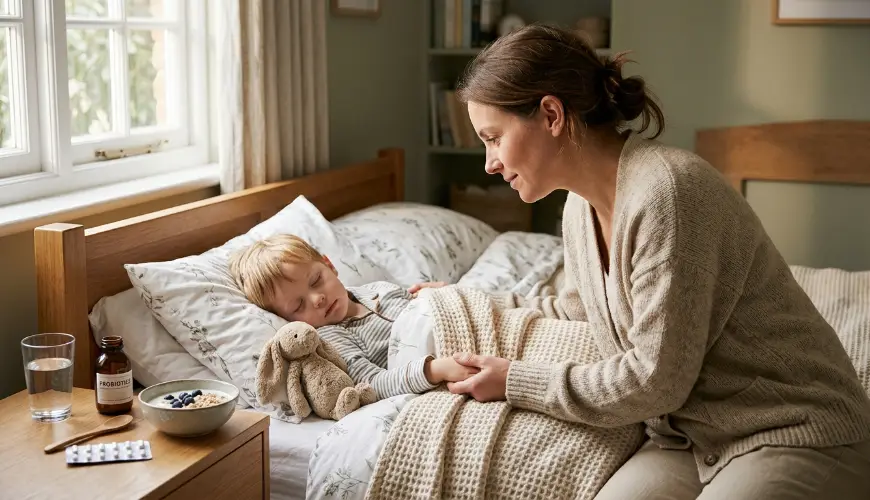
Every parent knows it. The child comes home with a runny nose, fever, or sore throat, and a few days later you're sitting in the paediatrician's office hoping for a prescription for antibiotics that will "finally sort it out." But the situation is more complex than it seems – and the choice of whether to give antibiotics or wait may affect not only the current illness, but also the child's health over years, perhaps an entire lifetime.
Over the past two decades, science has revealed something fascinating: a child's gut microbiome is not merely a passive component of the digestive system, but a living ecosystem that profoundly influences immunity, mood, metabolism, and resistance to disease. And antibiotics intervene in this ecosystem in ways that most parents and doctors don't fully appreciate.
Try our natural products

What is the childhood microbiome and why does it matter
The human gut is home to approximately 38 trillion microorganisms – bacteria, viruses, fungi, and other microbial inhabitants, whose total number approaches the number of cells in the entire human body. This microbiome begins to form at birth, when the newborn passes through the birth canal and receives its first bacteria from the mother. Breastfeeding further develops this process – breast milk contains special oligosaccharides that serve as food specifically for the beneficial bacteria in the infant's gut.
The first thousand days of life – the period from conception to a child's second birthday – are absolutely critical for microbiome development. During this time, the microbial community is still forming, is unstable, and is extraordinarily sensitive to external influences. Mode of delivery, diet, environment, contact with animals, and use of medications – all of these leave traces in the microbiome that can persist for years. Research by the World Health Organization and numerous independent studies confirm that disruption of the microbiome in early childhood is associated with an increased risk of developing allergies, asthma, obesity, type 2 diabetes, and certain autoimmune diseases.
Think of the microbiome as a dense rainforest – each species of bacteria plays its role, maintains balance, and prevents the invasion of unwanted guests. When antibiotics enter this rainforest, it isn't just one tree that falls. A widespread catastrophe can occur, from which the landscape takes a long time to recover – and doesn't always return to its original state.
How antibiotics affect a child's microbiome
Antibiotics are life-saving medicines. That is a fact that must be emphasised from the outset. Bacterial meningitis, severe pneumonia, sepsis – these are conditions where antibiotics should not only be used, but absolutely must be. The problem arises, however, when they are prescribed unnecessarily, preventively, or for viral illnesses where they have no therapeutic effect.
Antibiotics do not distinguish between "good" and "bad" bacteria. They act broadly and in doing so eliminate even those microorganisms that are essential to a child's health. A study published in the journal Nature showed that after a single course of antibiotics, a child's microbiome can take several months to restore itself to its pre-treatment state – and in some cases, full restoration never occurs. With repeated antibiotic use in early childhood, the risk of permanent changes in microbiome composition increases significantly.
The first three years of life are particularly vulnerable. This is precisely when the gut microbiome is being built and diversified – and precisely when children are most frequently ill and antibiotics are most frequently prescribed. According to data from the Czech Vaccinology Society and European studies, the average child receives three to four courses of antibiotics by the age of six. Some children receive considerably more. Each intervention can leave its mark.
It is important to know which specific situations call for caution:
- Viral upper respiratory tract infections – runny nose, the common cold, and most sore throats are caused by viruses, against which antibiotics have no effect whatsoever
- Middle ear infections in older children – international paediatric associations recommend waiting 48 to 72 hours and monitoring progress in uncomplicated cases
- Diarrhoeal illnesses – the majority are of viral or dietary origin, and antibiotic treatment is not only unnecessary but can worsen the condition
- Recurrent bronchitis – unless accompanied by bacterial complications, antibiotics do not address the situation and may contribute to the development of resistance
When to give antibiotics without hesitation
On the other hand, there are conditions where prescribing antibiotics is entirely justified and delaying treatment would be gambling with the child's health. Bacterial tonsillitis caused by group A streptococcus is a classic example – correctly diagnosed and treated with antibiotics, it protects the child from complications such as rheumatic fever or kidney damage. Likewise, bacterial pneumonia, urinary tract infections, Lyme disease, and severe skin infections are situations where antibiotics not only help but are essential.
The key is correct diagnosis. And here we encounter one of the greatest challenges in contemporary paediatrics: distinguishing a bacterial infection from a viral one is not always straightforward. Fever, fatigue, sore throat – these can be symptoms of either. This is precisely why rapid diagnostic tests exist, such as the strep test or a CRP test from a drop of blood, which help doctors decide whether to actually prescribe antibiotics. Parents should not hesitate to ask about such a test if the doctor is issuing a prescription based solely on the clinical picture.
As paediatric gastroenterologist and microbiome expert Martin Blaser aptly summarises in his book Missing Microbes: "Antibiotics are like a nuclear weapon in the fight against infection – sometimes necessary, but always with collateral damage."
How to protect the childhood microbiome during necessary antibiotic treatment
If you do need to use antibiotics – and sometimes you simply must – there are ways to reduce their impact on the microbiome. The most frequently discussed topic is probiotics. The scientific evidence for their benefit during antibiotic treatment is growing: a Cochrane review of studies from 2019 confirmed that administering probiotics alongside antibiotics reduces the risk of antibiotic-associated diarrhoea in children by more than 50 percent.
It is important to choose probiotics with proven strains – ideally Lactobacillus rhamnosus GG or Saccharomyces boulardii, whose efficacy is supported by studies. Probiotics should be taken at least two hours apart from the antibiotic to prevent their immediate destruction.
Diet is equally important. Fermented foods such as natural yoghurt, kefir, or sauerkraut naturally support microbiome restoration – even in young children. Fibre from fruit, vegetables, and whole grains serves as food for beneficial bacteria and helps them multiply more quickly after antibiotic treatment. Conversely, sugar and highly processed foods weaken the microbiome and slow its recovery.
Time in nature, contact with soil and animals, and plenty of outdoor physical activity may seem unrelated to antibiotics, but research shows that natural exposure to diverse microorganisms from the environment helps enrich and strengthen a child's microbiome. Children who grow up on farms or have pets at home statistically have a richer and more resilient microbiome than their peers in urban apartments – and also a lower incidence of allergies and autoimmune diseases, as demonstrated, for example, by research from Finnish scientists at the University of Helsinki.
Parents sometimes face a dilemma they know from personal experience: the child has been ill for three days, isn't sleeping, is crying, and the pressure to find a quick solution is immense. Petra, a mother from Brno, describes how she waited at the doctor's with her daughter, convinced that she "had to get antibiotics." However, the doctor reassured her, performed a rapid test, and explained that it was a viral infection. He prescribed nasal drops, ibuprofen, and rest. Four days later the child was well – without antibiotics, without any intervention in the microbiome. "That was the first time I understood that not every fever calls for antibiotics," says Petra.
This story is not exceptional. It is precisely the scenario towards which modern paediatrics and microbiome research are jointly moving: fewer unnecessary antibiotics, more attention to natural immunity and microbial balance, and more trust in the fact that a child's body can handle many infections on its own – if we give it time and the right support.
A healthy microbiome is not a given, but it is an investment. Every decision that parents and doctors make in a child's early years – what the child eats, how they live, what medicines they receive – is recorded in this ecosystem. And the better the microbiome is established in childhood, the stronger the foundation of health the child carries into later life. Antibiotics play their part in this – but only when they are truly needed.