

Vegan recipes for beginners explain what to watch out for so you don't miss important nutrients
Transitioning to a plant-based diet is often accompanied by a mix of curiosity and uncertainty. On one hand, the idea of lighter meals, new flavors, and a more planet-friendly approach is appealing, but on the other hand, questions immediately arise: What should I cook to make it filling? Where do I get proteins? And won't it be expensive and complicated? That's why vegan recipes for beginners make sense—not as culinary acrobatics, but as a practical bridge between what one knows and what they are just discovering. The good news is that simple vegan recipes often rely on common ingredients already in the pantry.
Veganism in the kitchen isn't about "forbidding something," but more about learning a few new habits. Once the basics of vegan cuisine are grasped, cooking starts to make surprisingly smooth sense: instead of cream, use oat or coconut; instead of meat, legumes; instead of eggs, sometimes a flax "egg"—and suddenly it's not a compromise, but a variant with its own character. For those who want to start without stress, it pays to approach it like any other change: gradually, with enthusiasm, and with good vegan meal tips in hand. And also to know what to watch out for so that enthusiasm doesn't turn into fatigue.
Basics of Vegan Cuisine: A Few Building Blocks That Make the Biggest Difference
Beginners often seek the "perfect recipe," but it's much more important to have a few certainties at home that can elevate almost any dish. In practice, it's a combination of ingredients that satiate, add flavor, and provide nutrition.
The first building block is legumes: lentils, chickpeas, beans, and peas. Canned are quick and reliable, while dry are cheaper and more flavorful when cooked in advance. The second block consists of grains and sides—rice, bulgur, couscous, oatmeal, quinoa, potatoes, or whole grain pasta. The third, often underestimated element, is fats and "flavor shortcuts": olive oil, tahini (sesame paste), nuts, seeds, quality soy sauce, mustard, lemon, balsamic vinegar. And then spices—cumin, smoked paprika, curry, turmeric, dried garlic. Spices make legumes more than just a "healthy obligation."
Try our natural products



Plant-based dairy alternatives also play a significant role. It's not about having ten products in the fridge but knowing what suits what: oat milk for porridge, soy milk for cooking (holds structure well), coconut milk for curry. And if nutrition is also a goal, it's good to check if the drinks are fortified with calcium and possibly vitamin D.
And now, a sentence worth remembering more often than recipes in the beginning: "The simplest vegan meal is one that builds on what already works—just swap one or two ingredients." This means: instead of chicken, chickpeas; instead of cream, oat milk; instead of cheese, nutritional yeast or cashew cream. It's not necessary to change everything at once.
A Real Example: When a "Quick Dinner" Becomes a New Habit
A typical workweek situation: late afternoon, hunger grows, and cooking energy declines. Many reach for a cheese sandwich or something "quick" from delivery. One household solved it differently—on Sunday, they cooked a pot of brown lentils, put a box of rice in the fridge, and stocked the pantry with canned chickpeas. On Tuesday evening, it was enough to sauté onions with garlic, add lentils, some tomatoes, a pinch of smoked paprika, and serve it with rice and a pickle on the plate. Dinner ready in fifteen minutes, filling and cheap. This is exactly the type of routine that makes vegan recipes for beginners a reality, not just inspiration on social media.
Simple Vegan Recipes for Beginners That Can Be Varied
The following ideas aren't complex "Instagram projects." They are meals that can be cooked repeatedly, just changing the spices, vegetables, or sides. And that's the biggest advantage in the beginning: less thinking, more certainty.
1) Creamy Red Lentil Soup (15–20 minutes)
Red lentils are grateful because they don't need soaking and soften quickly. Sauté onions in oil, add carrots, garlic, a teaspoon of curry or cumin, rinsed lentils, pour in broth, and blend after cooking. Creaminess can be enhanced with a bit of coconut milk or oat cream. Lemon and pepper complete the taste. This is a textbook example of how the basics of vegan cuisine work: legumes as a base, spices as character, acidity as the final "spark."
2) Chickpea "Tuna" Spread Without Tuna
Mashed chickpeas, a teaspoon of mustard, lemon juice, chopped onion, cucumber, capers (or just cucumber), pepper, salt. For a creamier version, add a spoonful of vegan mayo or white soy yogurt. On bread, it tastes surprisingly familiar and fresh at the same time. It's the perfect answer to making vegan meal tips truly practical—the spread is suitable for work and travel.
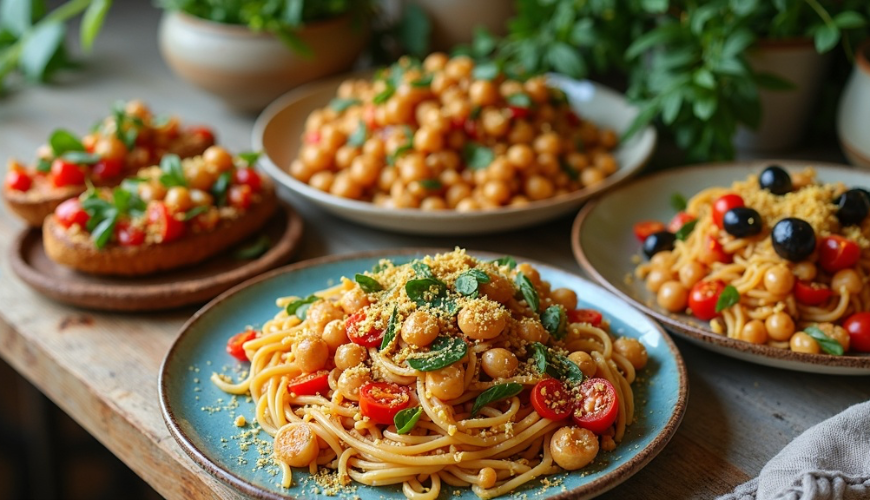
3) Pasta with Tomatoes, Olives, and "Parmesan" from Yeast
On olive oil, garlic, add tomatoes (fresh or canned), olives, oregano, chili. On the plate, sprinkle with nutritional yeast, which adds a cheesy tone. Nutritional yeast isn't "magic," it's just a handy ingredient: flavorful and often fortified. For many beginners, it's a small discovery that eases the transition from cheesy dishes.
4) Quick Vegetable Stir-Fry with Tofu
Cut tofu into cubes, briefly fry, add vegetables from the fridge (broccoli, bell pepper, carrot, zucchini), season with soy sauce, ginger, and a bit of sesame oil. Serve with rice or noodles. If tofu "says nothing" to someone, often it's just because it wasn't well seasoned. Tofu itself isn't a star but absorbs flavors excellently.
5) Baked Potatoes and a Sheet of Vegetables with Chickpeas
One oven, one sheet, minimal work. Potatoes, carrots, onions, bell pepper, chickpeas, oil, salt, pepper, smoked paprika, thyme. After baking, just add a simple dip of tahini, lemon, and water. Sheet meals are exactly the type of recipe that saves days when you don't want to be at the stove, yet you don't want to resort to empty calories.
To make these meals a long-term habit, it's worth sticking to a simple rule: have a source of protein in each main meal (legumes, tofu, tempeh, seitan, soy yogurt), along with a side and vegetables. Not for charts, but for satiety and stable energy.
The Only List That Really Helps at the Start: A Small Vegan Pantry
- Legumes (lentils, chickpeas, beans—ideally some canned for speed)
- Grains and Sides (rice, oats, couscous/pasta)
- Basic Seasonings (soy sauce, mustard, lemon, vinegar)
- Spices for "Depth" (cumin, curry, smoked paprika)
- Fats and Creaminess (olive oil, tahini, nuts/seeds)
- Plant-Based Alternatives (soy/oat milk, or plant cream)
What to Watch Out For: Nutrition, Labels, and Expectations
The enthusiasm for new recipes is great, but it's also fair to say that veganism isn't just about "cutting out meat." It's a change in the composition of the diet, so it's good to know where people most often hit snags.
The most talked-about is vitamin B12—and rightly so. B12 is not commonly found in sufficient amounts in a vegan diet, so it's usually recommended to supplement it through a supplement or B12-fortified foods. In the Czech Republic, there are also professional materials on this; a useful overview is provided by the British NHS (National Health Service) on vegan diets or information from https://www.bda.uk.com/resource/vegetarian-vegan-plant-based-diet.html, which has long stated that a well-planned plant-based diet can be suitable for all life stages. For general dietary implications and prevention, WHO is also a good guide (especially on topics of healthy eating and chronic diseases).
Besides B12, vitamin D (especially in winter), iodine (often managed with iodized salt or seaweed, but caution is needed with seaweed due to very variable iodine content), calcium (from fortified drinks, calcium-set tofu, leafy greens), and omega-3 fatty acids (flaxseed, chia, walnuts; or algae supplements) are also worth attention. It's not about scaremongering, but about practical what to watch out for so one feels good even after several months, not just the first week.
The second surprise is labels. "Vegan" doesn't automatically mean "nutritious." Even plant-based cookies, chips, or sugary cereals are still ultra-processed foods. Conversely, simple combinations like beans, rice, vegetables, and quality oil tend to be a more solid nutritional foundation. With plant-based alternatives, it's worth noticing salt content, saturated fats, and whether products are fortified with calcium or B12. Often, this is the difference between "just a substitute" and a truly useful food.
The third point is expectations regarding taste. Some foods will taste different—and that's okay. Those expecting vegan cheese to be identical to dairy cheese might be disappointed. Those who approach it as a new category of flavors usually quickly find their favorites. It helps to focus on foods that are "naturally vegan" or close to it: curry, dhal, hummus, ratatouille, minestrone, roasted vegetables, pasta with tomatoes. Only then does it make sense to try exact replicas.
Finally, there's one small thing with a big impact: planning. Not in terms of charts and exact grams, but in terms of "having something at home that can be quickly cooked." Once basic building blocks are missing from the fridge, even the best vegan recipes for beginners lose to hunger and time. That's why cooking legumes in advance, having frozen vegetables, and keeping a couple of cans in the pantry as a backup works so well.
Plant-based cooking has one pleasant trait: the more one learns, the less one needs recipes. It's enough to understand the logic of combinations, have a few favorite seasonings, and not fear variations. And when the question arises whether it all makes sense, just return to a simple meal that always works—like lentil soup, a roasted vegetable sheet, or chickpea spread. It's in these small, repeatable certainties that veganism most often transforms from an experiment into a natural part of daily life.