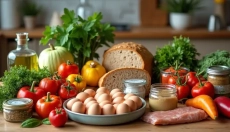

Oyster mushrooms are suitable for soups and pasta because they are quick to prepare and filling.
Oyster mushroom has recently transitioned from being a "curious mushroom" to a staple ingredient that can enhance both the menu and household budget. It is accessible, quick to prepare, and surprisingly versatile. Some know it mainly from Asian cuisine, others buy it for its reputed immune benefits. Then there's a large group of people who simply love it because it tastes great—mild, slightly "meaty," and light. But what exactly is oyster mushroom, where does it grow, what does it contain, and what is it good for? And how can you serve it on a plate without it becoming boring?
What is oyster mushroom and why is it worth attention
When someone asks, "what is oyster mushroom," the simplest answer is: an edible wood-decaying fungus (Pleurotus ostreatus) that forms typical fan-shaped caps and grows in clusters. It resembles a shell in appearance—hence "oyster." In the kitchen, it behaves friendly: it softens quickly, absorbs the flavor of spices well, and its fibrous structure can partially replace meat in dishes where texture is important.
From a sustainability perspective, it's also appealing that oyster mushrooms are often grown on substrates from agricultural by-products (such as straw), making its production relatively eco-friendly. Moreover, it's available year-round—unlike purely seasonal forest mushrooms—and doesn’t require waiting for the "right" weather.
Perhaps that's why oyster mushrooms have become a typical ingredient in households aiming to cook simply, healthier, and with less impact. Despite numerous claims surrounding it, it’s important to stick to the facts: oyster mushrooms are primarily nutritious food. Not a miracle in a pan, but a smart piece of the puzzle.
Try our natural products


Where oyster mushrooms grow and what they contain
The question "where do oyster mushrooms grow" has two answers—one for the forest and one for the store. In nature, oyster mushrooms appear mainly on dead or weakened hardwoods, often on beeches, poplars, or willows. They typically grow in clusters, where several caps emerge from one spot. In our conditions, they are most often harvested in autumn and in mild winters, as they tolerate cold well.
In the common market, however, we predominantly encounter cultivated oyster mushrooms, which offer stable quality and availability. This is advantageous for home cooking: there’s no need to worry about confusing them with inedible species or waiting for them to "grow."
And what do oyster mushrooms contain? Practically, people are most interested in whether they are "special" in some way. Nutritionally, they are interesting because they offer fiber, a reasonable amount of protein for a plant source, and various micronutrients. They naturally contain, for example, B vitamins and minerals, often potassium, phosphorus, or iron (specific values vary depending on cultivation and freshness). Oyster mushrooms are also known for their content of beta-glucans, which are generally studied in relation to immunity—similar to oats or certain medicinal mushrooms.
For a trustworthy framework, it’s good to rely on authoritative sources: databases like USDA FoodData Central consistently summarize information on the nutritional values of mushrooms and their composition, while institutions like Harvard T.H. Chan School of Public Health explain the broader context of the role of fiber or beta-glucans in the diet. It’s not about finding "one magical ingredient" in mushrooms, but seeing them as practical food that pairs well with legumes, grains, and vegetables.
Interestingly, for many, oyster mushrooms serve as a "springboard" to eating more mushrooms in general. They have a mild flavor and are not as distinctly "foresty" as some other types. And when prepared correctly, they can be surprisingly addictive.
What are oyster mushrooms good for and how to cleverly incorporate them into your diet
"What are oyster mushrooms good for?" This question often simplifies to immunity. Yet in the kitchen and everyday life, the benefits tend to be more mundane—and thus more sustainable. Oyster mushrooms are great for helping to cook lighter meals that satisfy without being heavy. Thanks to their fiber and structure, they fit into dishes where one might otherwise automatically reach for meat and yet not end up with a "salad that leaves you hungry in an hour."
They also work well as an ingredient for days when you need to cook quickly: oyster mushrooms don’t require long stewing, just a few minutes in the pan. And because of their mild flavor, they can handle bold spices, garlic, thyme, smoked paprika, or soy sauce. This is their strength—they are mushrooms that can adapt.
In real life, it often looks like this: on a weekday, you open the fridge, there’s half an onion, some garlic, pasta in the basket, and leftover spinach in the vegetable drawer. Plus a pack of oyster mushrooms. From that, you can make a dish in twenty minutes that feels "like from a bistro," but costs a fraction of the price. And it’s precisely the kind of dinner that doesn’t leave you feeling overstuffed.
When buying fresh oyster mushrooms, it's worth keeping a few things in mind: they should be firm, without a slimy surface, and have a pleasant mushroom aroma. The best storage is in a paper bag or an open container in the fridge to prevent them from getting damp. Before preparation, usually just a knife cleaning or a light wipe with a damp cloth is enough; long soaking in water tends to detract from their flavor.
And one more thing that people sometimes underestimate: oyster mushrooms need space in the pan. If they’re crammed into a small pan, they start stewing in their own juice. If sautéed in a layer that can catch color, they reward you with a more pronounced flavor. As they say, "Color makes taste." And with oyster mushrooms, this is doubly true.
"The best meals are often those made from a few good ingredients and the right heat."
Oyster mushroom recipes: what always works
In the kitchen, people most often search for oyster mushroom recipes that are simple and repeatable. Oyster mushrooms fit excellently into soups, sauces, skillet dishes, risottos, spreads, and even “ragú” on toast. And because they’re accessible, they can be part of family cooking without the stress of "this was an expensive mushroom, and it mustn’t go wrong."
A basic flavor profile can be built on onion, garlic, and herbs. Those who love creaminess can add a bit of plant cream or traditional cream, while those wanting a lighter version might opt for broth and lemon juice. In both cases, oyster mushrooms work well.
To ensure the mushrooms stand out in the dish, it’s worth cutting them into larger pieces. Small cubes easily "disappear," while larger slices create a pleasant texture. In soups, it’s also practical to sauté some mushrooms separately and add them at the end—they remain more pronounced, adding another flavor layer to the soup.
Oyster mushroom soup that warms and doesn't take half a day
Oyster mushroom soup is often one of the most grateful ways to fall in love with oyster mushrooms. It’s a dish you can cook "with confidence": when the broth base is made well and the mushrooms are briefly sautéed, the result is a full flavor without complex procedures.
It’s usually prepared as something between a kulajda and a creamy mushroom soup, with the difference being that oyster mushrooms are milder than a mix of forest mushrooms. The combination of onion, garlic, marjoram, and caraway, possibly a bit of thyme, works well. Thickening can be done with a potato, a bit of roux, or by blending part of the vegetables—and for a naturally lighter version, you can skip thickening altogether, relying on the mushrooms and vegetables to add body themselves.
A practical tip that often decides the outcome: it’s good to first sauté the mushrooms in a bit of fat until golden edges form, then combine them with the broth. The soup won’t taste "boiled," but more like it’s from a good restaurant that respects mushrooms.
If cooking the soup for more people, it’s easy to adapt: for children, it can be made milder; for adults, you can add pepper, a pinch of chili, or a drop of quality soy sauce for an umami effect. And if there are leftovers, it’s often even better the next day, as the flavors meld.
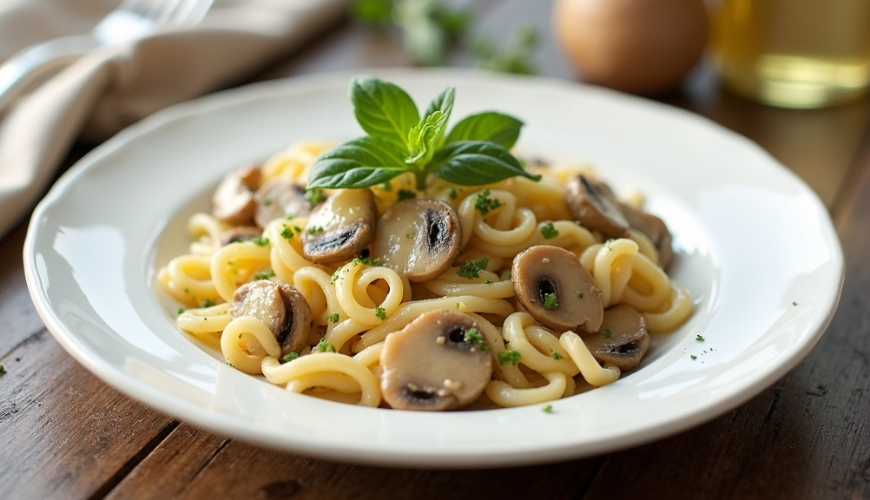
Pasta with oyster mushrooms: a quick dinner that feels festive
Those looking for a specific idea like pasta with oyster mushrooms usually want something quick and not just "pasta with vegetables." Oyster mushrooms can create the impression of a hearty sauce even without using meat.
The base is simple: let onions soften in the pan, add garlic and oyster mushrooms torn into larger pieces. Once the mushrooms are golden, add a bit of pasta water (the starch will create creaminess), possibly a spoonful of cream or an alternative. A combination with leafy spinach, capers, or sun-dried tomatoes works well—according to what’s at hand. Finish with lemon juice or zest to "brighten" the sauce, and some herbs.
Here’s a single list worth having on hand as a quick guide for what to add to such pasta to make it taste slightly different each time:
- For a stronger flavor: smoked paprika, thyme, soy sauce
- For creaminess: cream (even plant-based), oat "cuisine," blended white bean base
- For freshness: lemon, parsley, chives
- For substance: peas, spinach, lentils, nuts, or seeds
A crucial detail: it’s better to leave the pasta slightly "al dente" and finish it in the pan with the sauce. The mushrooms meld with the sauce, making the whole dish feel cohesive, not like two separate things.
When a typical household faces dinner after a long day, such a meal is a small triumph: it’s quick but doesn’t feel slapped together. Moreover, it’s the type of recipe that can easily be steered towards more sustainable cooking—by choosing quality pasta, seasonal vegetables, and limiting animal products without feeling like "something’s missing."
Thus, oyster mushrooms emerge as an ingredient that is both comprehensible and yet fresh. In the forest, they remind us of nature’s clever work with wood and nutrient cycles, while in the kitchen, they show that even an ordinary dinner can have flair. And the next time the question arises about what to cook when the meal should be quick, tasty, and a bit lighter, oyster mushrooms are a surprisingly reliable answer.