

How to Talk to Your Family About Sustainability Without Conflict
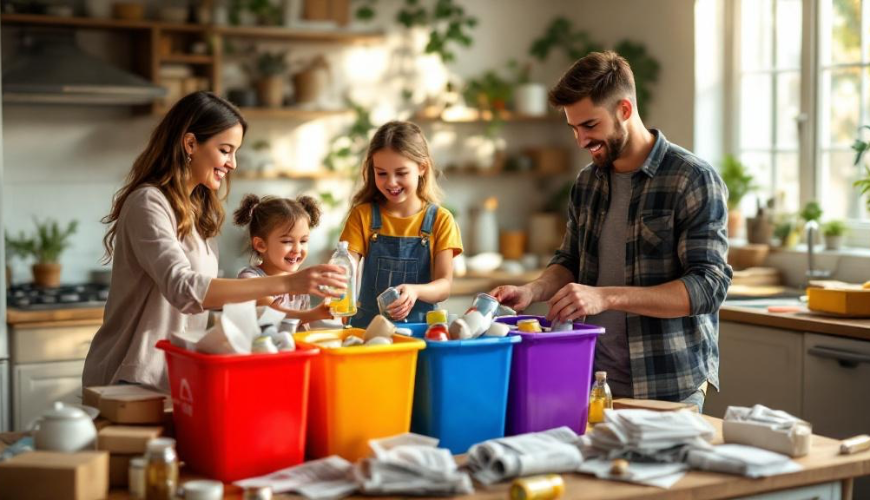
Sustainability is a buzzword today at school, work, and in advertisements, but the most sensitive ground is often at home. It is there that the eco household and family meet in completely ordinary situations: who buys the laundry detergent, how waste is sorted, whether the dishwasher really needs to be run half-empty, or why someone insists on shopping with their own bag. And even though these are "just" small things, they can evoke surprisingly strong emotions. Sometimes because changes disrupt established habits, other times because they harbor a sense of judgment: am I doing it wrong?
Those looking for how to talk to the family about sustainability without conflicts often encounter one important truth: it’s not just about facts and figures. At home, it’s not an academic debate but a conversation between people who know each other all too well, have a shared history, and sometimes even unspoken grievances. Sustainability can then be just a trigger. Yet, it can be done differently – calmly, humanly, and with respect for everyone’s different pace and options.
Try our natural products


Why sustainability at home easily sparks
In a family, sustainability is rarely addressed as an abstract concept. It is addressed as a specific change in behavior that costs someone extra energy: taking out the bio-waste, repairing instead of buying new, thinking about what to cook, or remembering not to buy bottled water. And as soon as the change is tinged with "rightness," defensive reactions appear. Not because people are against nature, but because they feel cornered.
It helps to realize that resistance is often not against sustainability itself. It is against the feeling that someone is questioning the current way of life. In psychology, this phenomenon is sometimes called reactance – when a person feels that someone is taking away their freedom of choice, they start defending it, even if they originally had no problem. In the family, it manifests simply: "Don’t tell me what to do." And at that moment, it’s no longer about the yogurt cup, but about the relationship.
Generations come into play. Older family members may feel they are being made out as culprits, even though they have lived rather thriftily all their lives. Younger ones may be frustrated that things aren’t moving fast enough. Yet both sides often share similar values – they just use different language and arguments. Someone talks about the planet, another about money, another about health. All three motivations, however, can lead to the same thing: for a sustainable household not to be a project "for someone," but a natural way of functioning.
A solid framework for understanding why household habits are so important can also be provided by the overview material from the UN Environment Programme (UNEP) on sustainable consumption – it reminds us that change is not just about big politics, but also about everyday decisions. At home, the "big world" meets what is currently in the fridge.
How to talk about sustainability with family without it ending in a fight
The biggest difference often comes from how the conversation is opened. Sustainability can be presented as a judgment ("we mustn’t do this anymore"), or as an invitation ("let’s try something that might help us"). The second option leaves room for participation. And participation is key in a family – no one wants to be just the executor of someone else’s ideas.
It works well to start from a common goal, not criticism. Instead of "Why are you buying those disposable things again?" you can try a sentence that doesn’t sound like a reproach: "Let’s try to have less waste at home so that we’re all not so bothered by it." It’s a subtle shift but often crucial. It doesn’t say "you’re making a mistake," it says "we have a common problem."
Similarly, it’s useful to stick to specific situations and not move to general judgments. When you say "you never sort," the other party hears "you’re a bad person." When you say "can you please show me where you put the packaging? I'm sometimes confused," it opens space for dialogue, not defense. It sounds paradoxical, but even if a person knows how to sort things, admitting uncertainty sometimes takes the conversation off the battlefield to cooperation.
It is also important to choose the right moment. A debate on how to do laundry properly is hard to conduct when someone has come home tired from work and is dealing with five other things. Family changes are best introduced in "neutral time" – perhaps over weekend coffee, when planning shopping, or during a joint cleanup. Not when someone is under pressure.
Then there’s the tone. If there is a universal recommendation for how to talk to the family about sustainability without conflicts, it is: less preaching, more curiosity. Instead of an argumentative shootout, a question helps: “What would bother you about it?” or “What would make it easier?” It often turns out that the problem is not in the value (sustainability), but in the logistics (where will the extra bin go, who will take out the bio-waste, what will be bought when the dish soap runs out).
Bringing a human dimension to conversations is worthwhile. One sentence that can lighten the atmosphere sounds something like this: "It's not about perfection, it's about direction." It's not just a nice phrase; it's a practical safeguard against sustainability at home causing feelings of guilt. And guilt is surprisingly poor fuel for long-term change – a person either burns out or starts to resist.
Real-life example: when change is not "sold" but makes the day easier
In one ordinary household, it took a long time to agree on sorting. Not that anyone was fundamentally against it, it just "delayed" things, and the bin for plastics was far away. The result was that packaging piled up on the counter, someone angrily threw it into the mixed waste, and then a fight ensued. The turning point came when it stopped being about who was right and started being about what was practical: a small bin for plastic was added right at the place where groceries are unpacked, and a specific time was set once a week when the waste would be taken out on the way out. Suddenly it wasn’t "sorting as a moral lesson," but sorting as a clutter saver.
This small story shows that a family often doesn’t need more arguments. It needs the change to be easy to do. Sustainability is not enforced at home by being "right" but by being usable.
Sustainable household as a joint project, not a correctness test
When communication is set, the second part comes: what to do specifically so that it doesn’t become an endless list of obligations. The greatest service to the family will be the approach of "less, but stable." That is, choose one or two areas where change will quickly make sense, and only then add others. Eco household and family are not a competition where the strictest one wins.
Very often, three motivations work that can be seamlessly connected:
- health and well-being at home (fewer irritating scents, simpler compositions, more pleasant environment),
- saving money and time (fewer impulsive purchases, longer lifespan of things),
- less clutter and waste (a practical benefit almost everyone appreciates).
And now more specifically – without turning the article into a manual. In a household, the kitchen and cleaning often come first because they are seen every day. For example, when single-use towels are replaced with washable ones, or when instead of several aggressively scented products, a few universal ones are chosen, the family usually quickly notices the difference: fewer items in the cupboard, fewer plastics, less "chemical" smell. It doesn’t have to be a revolution – more of a return to simplicity.
For packaging and shopping, setting a realistic rule helps: not "never anything in plastic again," but for example "when possible, we’ll take larger packaging or no packaging." Black-and-white promises easily break at home and then cause frustration. Conversely, a flexible rule can be followed long-term. And longevity in sustainability is more than a one-time heroic performance.
With clothing, which naturally belongs to the topic of sustainability, family communication is sometimes even more sensitive. Clothing is identity, style, sometimes even reward. Instead of comments like "you bought something fast fashion again," it’s more effective to talk about quality and comfort: "When we buy something, let it last and be comfortable to wear." That’s a sentence that can be agreed upon without anyone feeling attacked. And then it naturally opens space to try second-hand, repair, exchange among acquaintances, or choose brands that describe production more transparently.
A strong ally is also "invisible" sustainability – things that happen in the background and don’t require constant attention from all family members. For example, when the household switches to a more eco-friendly laundry detergent that works and doesn’t unnecessarily burden the water, it’s not a daily topic. It just works. And such changes usually have the least friction.
Those who want to have credible arguments in hand can rely on sources that are not "just from the internet." For example, the European Environment Agency (EEA) has long published overviews of the impacts of consumption and waste in Europe and reminds that it’s not a minor fashion wave but a topic of public health and economy. When sustainability is talked about as something that impacts the quality of life, the debate often calms down.
Finally, it’s good to anticipate that the family will not hold a unified line. Some will be enthusiastic, some lukewarm, some skeptical. And that’s okay. A household is not a team in uniform but a community of different people. Instead of trying to "re-educate" everyone, it’s worthwhile to watch what works and give it space. Once it is shown that the new thing saves time, money, or nerves, it starts to spread on its own.
And so sustainability can become something that doesn’t feel like pressure at home but like relief. Less unnecessary stuff, fewer overcrowded cabinets, less waste to deal with, and more of the feeling that the household is not a factory for consumption, but a place where life happens. When a bit of patience and willingness to speak the language of others is added, the most important thing often happens: that how to talk about sustainability with the family stops being a tactical question and becomes a normal part of household conversation – just like planning the weekend or what will be for dinner.