
# How to Make Homemade Bouillon Cubes Without Additives Homemade bouillon cubes are a great alterna
Anyone who has at least once looked at the ingredients list on store-bought bouillon cubes has probably experienced a similar feeling. A long list of ingredients full of abbreviations, numbers and names that resemble a chemistry laboratory rather than a kitchen. Monosodium glutamate, hydrolyzed vegetable proteins, palm oil, colorings and a whole range of preservatives – all of this is hidden behind an apparently innocent little cube that is supposed to give soup or sauce depth of flavor. And yet there is a way to prepare such a base at home, from clean ingredients, without a single additive, and the result is incomparably better in taste.
Homemade bouillon cubes are nothing new. Generations of cooks before us naturally knew how to use vegetables, herbs and bones to create a nutritious base for soups, sauces and stews. It was only the industrial revolution and the pursuit of convenience that led us to instant substitutes. Today, however, we are slowly returning – and this return has good reason.
Try our natural products


Why it pays to avoid industrial bouillon cubes
This is not just a fashionable trend or the snobbery of a healthy lifestyle. Research repeatedly shows that excessive intake of sodium and glutamates associated with industrially processed foods can contribute to high blood pressure, headaches and kidney overload. The World Health Organization recommends a daily sodium intake of under 2 grams, while a single store-bought bouillon cube can contain more than 1 gram of sodium per serving. If a person cooks soup, sauce and a rice base, the daily dose can easily climb to a dangerous level without them even noticing.
But the problem is not just salt. Monosodium glutamate, labeled as E621, is a substance that enhances umami flavor and makes food taste more intense than it actually is. In more sensitive individuals, it can trigger the so-called Chinese restaurant syndrome – a feeling of pressure in the head, heart palpitations or excessive sweating. Although the scientific community continues to debate the extent of its harmfulness, one thing is certain: if you prepare bouillon at home, you don't need any glutamate. The natural flavor of vegetables, herbs and possibly meat is in itself so complex that no chemical flavor enhancers are needed.
As British chef and clean eating advocate Jamie Oliver once remarked: "Good food starts with good ingredients – not bottles and powders." And that is precisely the philosophy behind homemade bouillon.
Another aspect that is often overlooked is the economic side of things. Homemade bouillon cubes are prepared from so-called waste ingredients – vegetable peelings, parsley tops, herb stems or mushroom bases that would otherwise end up in the bin. This approach is not only ecological but also kind to the wallet. From things that would otherwise cost nothing, a valuable and nutritious product is created that can keep in the freezer for several months.
Basic recipe for homemade bouillon cubes
Before we get into the actual process, it is important to understand what actually makes bouillon into bouillon. It is a concentrated stock – a liquid from which most of the water evaporates, leaving behind a thick, intensely flavored paste or solid mass. It is precisely this concentration that is the key to a small amount being able to replace an entire pot of stock.
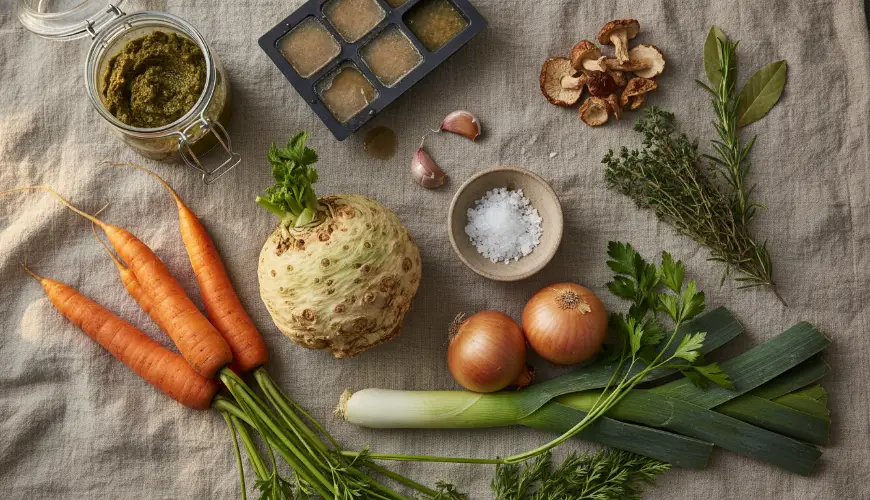
Basic ingredients for approximately 20 homemade cubes:
- 500 g carrots
- 300 g celery (bulb or stalk)
- 200 g leek
- 150 g onion
- 100 g parsley (root and leaves)
- 4–5 cloves of garlic
- a handful of dried mushrooms (such as porcini)
- fresh herbs – thyme, rosemary, bay leaf, chives
- 150 g coarse sea salt
- 2 tablespoons of olive oil
The whole process is surprisingly simple. All the vegetables need to be thoroughly washed and roughly chopped – there is no need to peel them or cut them too carefully, as everything will eventually be blended. The vegetables are then either processed directly raw, or first briefly sautéed in olive oil, which gives the resulting bouillon a deeper, caramelized flavor. Sautéing is optional, but definitely recommended – it is precisely this step that makes the difference between an average and an exceptional result.
After sautéing or direct processing, everything is placed in a blender and blended into a smooth paste. Dried mushrooms can be soaked in advance and added along with their soaking liquid, which is full of natural umami flavor. Then comes the salt – and here it is important to understand its role. Salt in this recipe does not function merely as a seasoning, but also as a natural preservative that prevents bacterial growth and extends shelf life. This is why the quantity is relatively higher than one might expect – and when actually cooking, the bouillon is added sparingly, without any additional seasoning of the dish.
The finished paste is poured into ice cube trays or small silicone molds and frozen. Once frozen, the cubes can be transferred to a resealable bag or container and stored in the freezer. Alternatively, the paste can be kept in a preserving jar in the refrigerator, where with the right amount of salt it will keep for 3 to 4 months.
Take as an example a typical household – say a family with two children who cook every day. Such a family uses an average of 2 to 3 bouillon cubes per week. If once a month they spend an hour and a half preparing homemade cubes, they have a supply for the whole month, know exactly what they are eating, and save not only money but also unnecessary packaging from industrial products. Moreover, they have the assurance that their children are not consuming any hidden allergens or artificial additives.
Variations and tips for an even better result
The basic recipe is just the beginning. Once a person understands the principle, they can adapt it to their own taste preferences or the seasonal availability of ingredients. In summer, tomatoes, peppers or courgette are ideal, giving the bouillon a sweeter and lighter character. In autumn, pumpkin, parsnip or root vegetables work wonderfully, bringing an earthy depth. In winter, dried herbs, garlic and onion create a warming and intense base.
For those who do not eat vegetarian or vegan food, there is a version with chicken bones or beef oxtail. The bones are first roasted in the oven at high temperature until browned, then slowly simmered with water and vegetables for several hours. The resulting stock is then thickened and concentrated in the same way as the vegetable version. The result is cubes full of collagen, minerals and natural flavor, which are literally the polar opposite of an industrial product.
A very interesting variation is also the addition of miso paste or tamari sauce to the basic vegetable mixture. Both of these ingredients are fermented and naturally rich in umami flavor, so they can partially replace or reduce the amount of salt. Miso paste also brings probiotic benefits, although it is true that during cooking some of the probiotics are destroyed – nevertheless, valuable amino acids and enzymes remain.
An important practical tip concerns the consistency of the resulting paste. If it is too runny, it can be thickened before freezing by drying in the oven at a low temperature (around 60–70 °C) for one to two hours. If, on the other hand, it is too thick and difficult to blend, simply adding a little water or olive oil is sufficient. The ideal consistency resembles thick hummus – the paste holds its shape but can easily be scooped with a spoon.
As for use, one homemade cube or teaspoon of paste generally replaces one industrial cube. It is added to boiling water for stock, to a soup base, to sauces, risotto, braised meat or even to a pasta base. The flavor is significantly more complex and natural – without that artificial intensity which is so characteristic of industrial products and at the same time so unmistakably recognizable.
It is fascinating how a small change in the kitchen can influence the overall approach to cooking. Once a person has prepared their own bouillon, they begin to think similarly about other basic ingredients – about mustard, ketchup, mayonnaise or even bread. This shift in thinking is precisely what lies behind the growing interest in the so-called "real food" movement, which is documented for example by the Weston A. Price Foundation or Czech advocates of traditional eating.
Homemade bouillon without additives is not just a recipe – it is an attitude towards food. It is a decision to know what we eat, where it comes from and how it was prepared. It is a way of returning to something that our grandmothers considered completely natural, and which we have lost in the pursuit of convenience. And all it takes is one free afternoon a month, a few vegetables and the desire to try something differently.
The world of industrial food has convinced us that cooking from scratch is complicated, time-consuming and unnecessary. Homemade bouillon cubes are precisely the type of recipe that shatters this illusion – and once a person feels the difference, it is very hard to go back to those little foil-wrapped cubes.