
When children ask about war and disasters
News about war, natural disasters, or terrorist attacks are now part of the everyday media landscape. Adults try to cope with them in their own way – some follow the news constantly, others deliberately avoid it. But children are a different case. They are curious, sensitive, and have far fewer tools to process information that may frighten or confuse them. And although many parents would like to shield their children from all the evil in the world, the reality is that children do hear bad news – from classmates, on social media, from the car radio, or from the television in the living room.
The question, then, is not whether to talk to children about these topics, but how to do it sensitively, truthfully, and in a way that doesn't cause them unnecessary fear. This is precisely one of the most challenging parenting tasks of our time.
Try our natural products



Why talking about difficult topics is so important
Many parents instinctively react protectively – they skirt the topic, change the channel, give an evasive answer. This approach is understandable, but in the long run it can actually harm the child. When a child senses that adults are nervous or refuse to talk about something the child has already noticed, they start filling in the gaps themselves. And a child's imagination can be far more terrifying in such moments than reality itself.
Psychologists from the Child Mind Institute point out that children who don't have the space to ask questions and receive understandable answers are more prone to developing anxiety and nightmares. Conversely, children whose parents communicate openly but age-appropriately about difficult topics build greater psychological resilience. The point is not to lay out all the horrors of the world in full detail – the point is to make sure the child doesn't feel alone and confused.
Natural conversation about the world, including its dark sides, strengthens mutual trust between parent and child. The child learns that they can ask about anything and will receive an answer that helps them understand the situation – not an answer that pushes them away or scares them off.
How to adapt the conversation to the child's age
One of the most common mistakes is that parents approach all children the same way, regardless of their age and developmental stage. A three-year-old and a twelve-year-old need completely different approaches – not only in terms of content but also in the form of communication.
Young children up to the age of six live predominantly in the present moment, and their understanding of the world is concrete and physical. If they hear about an earthquake in another country, their first question won't be political or geographical – it will be: "Will that happen to us too? Are we safe?" This question needs to be answered clearly and calmly. The safety of their own family is a small child's number one priority. Lengthy explanations about geopolitics or climate change are counterproductive at this age. Simple, reassuring sentences are enough: "That happened far away from here. We are safe at home."
School-age children, roughly from seven to twelve, can already think more abstractly and are interested in causes and consequences. They want to know why. Why do people go to war? Why does someone attack other people? Why does nature destroy entire cities? Here there is room for a more open but still age-appropriate conversation. Parents should answer the specific questions the child asks – not preemptively lay out everything they themselves know. Less is often more. At the same time, it's good to involve the child in finding answers: "What do you think about it? How would you like to solve it?"
Teenagers are in an entirely different situation. They have access to the internet, social media, and their peers are often a more important source of information for them than their parents. It would be naive to think that access to information can be completely cut off from them – and it would be wrong to try. With adolescents, you need to speak as partners in conversation. Share your own feelings, ask questions, listen to their opinions. Adolescents primarily need space to express themselves, not to be lectured.
The American Academy of Pediatrics (American Academy of Pediatrics) recommends limiting news viewing in the presence of young children and dedicating time to conversation after every news viewing – regardless of whether the child asks questions on their own or not.
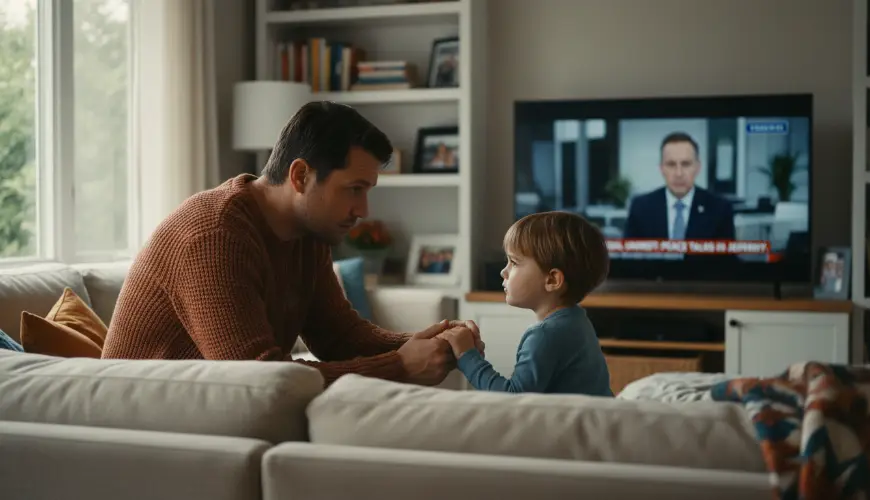
Let's take a concrete example: an eight-year-old comes home from school and says that a classmate was talking about a war in some country and that children are dying there. A parent who dismisses the topic with "that's far away, don't worry" may calm the immediate unease but doesn't answer the real question behind it – why is this happening and what does it mean for the world the child lives in. A much better response is to sit down with the child, ask what exactly they heard, and talk about it together. Even acknowledging that not everything has a simple answer.
Emotions are not weakness – how to work with children's feelings
One of the most important aspects of the entire conversation is the emotional dimension. Children need to know that their feelings – fear, sadness, anger, confusion – are completely natural and okay. Parents who say "don't be afraid, it's nothing" or "it's just on TV" unintentionally send the message that the child has no right to feel what they feel. And that is harmful.
Psychologist and author of books on child development Mister Rogers (Fred Rogers) expressed it in words that have become classic: "When I can talk about my feelings, I can cope with them. When I can work with them, I can move forward." Even though these words referred to emotions in general, they apply doubly in the context of traumatizing news.
Parents should lead by example and acknowledge their own feelings – in an age-appropriate way. Saying "I feel sad about it too" or "it scares me a little too, but I believe people are working to help" is more honest and healthier than pretending everything is fine. At the same time, it's important that the parent doesn't pour their own anxiety onto the child – the goal is to share feelings, not to transfer the burden.
If a child shows prolonged symptoms of anxiety – sleep problems, refusal to go to school, repetitive questions about safety, physical symptoms like stomach aches – it's time to seek professional help. A child psychologist or school counselor can offer tools that go beyond what a family conversation can provide.
A very effective technique is also redirecting energy into concrete action. Children feel less helpless when they can do something. It can be symbolic – drawing a picture for people affected by a disaster, contributing to a toy drive, or participating in a school charity event. The feeling that even a small person can contribute something is immensely empowering for children.
An important part of caring for children's mental health is also regulating access to media. News loops that repeatedly replay footage from disasters or war zones are psychologically exhausting for children (and adults too). It is neither necessary nor healthy to watch the news continuously. Research shows that excessive viewing of traumatizing news increases anxiety even in people who are not direct victims of the events – this phenomenon is called secondary traumatization.
Parents can establish a simple household rule: news is watched once a day, not in the background all day long. A television in the child's room or unrestricted access to online news without parental supervision is not appropriate for younger children. And if a serious event occurs, it's better to talk about it proactively than to wait until the child finds out on their own – and perhaps in a distorted form.
The world is not only a place of disasters and conflicts – and this is precisely the perspective that needs to be repeatedly reinforced for children. Alongside news about war, there are stories about the courage of rescuers, about neighborly solidarity, about people who travel from the other side of the world to help. Showing children these stories is not naive optimism – it is an important counterbalance that helps them maintain faith in humanity.
As experts from UNICEF say: looking for "helpers" – people who help in difficult moments – is one of the most effective ways to help children process fear. Instead of focusing on destruction and chaos, attention can be turned to those who build, rescue, and comfort.
Talking to children about war, natural disasters, and bad news is not a pleasant duty. But it is part of raising children to become people capable of facing reality – with open eyes, a strong heart, and the confidence that even in the most difficult moments, no one is alone. And that is a gift that no amount of shielding from the world can give them.