

Counting calories may not be necessary when you know how to assemble a balanced plate.
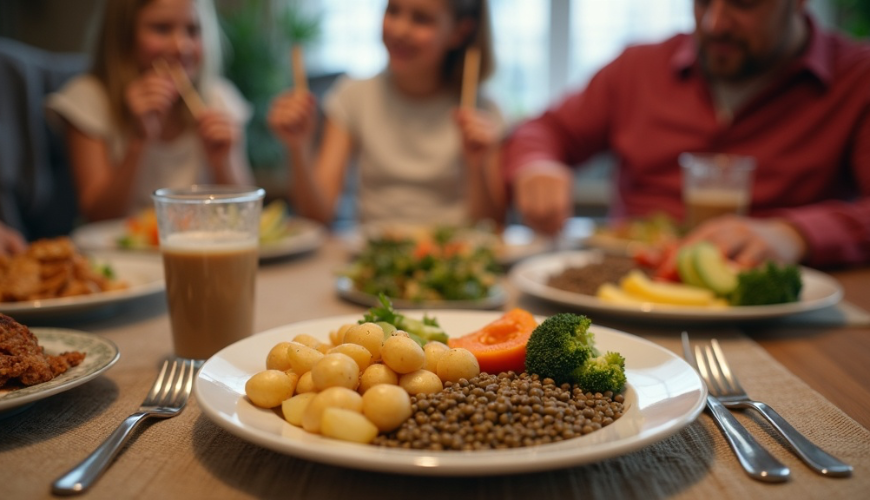
Eating “right” today can be surprisingly exhausting. On one side, calorie counting apps tempt us, while on the other side, social media is filled with “perfect” bowls and plates. However, healthy eating in practice rarely happens under laboratory conditions. It takes place amidst morning rushes, work lunches, family dinners, and occasional desserts “because it’s Sunday.” That’s why so many people are looking for an easier path: how to eat healthily without counting calories, yet balanced and sustainable – for the body, mind, and planet.
The good news is that it’s possible. It doesn’t mean giving up on nutrition or “eating by feeling” without any guidance. Rather, it’s about shifting focus from numbers to quality, variety, and regularity. A balanced meal isn’t just the sum of calories; it’s a combination of nutrients that satisfy, provide energy, and support health in the long run. And it can be entirely ordinary: potatoes, lentils, vegetables, cottage cheese, eggs, good bread, seasonal fruit. Without guilt, without a calculator.
Try our natural products






What is a balanced meal and why it can do without calories
When you say “balanced plate,” many people imagine a strict rule that must be followed to the gram. In reality, balance is more of a practical framework that helps the body get what it needs while allowing room for life’s realities. A balanced meal usually stands on four pillars: protein, complex carbohydrates, healthy fats, and fiber (most often from vegetables, legumes, fruits, and whole grains). This also includes water and reasonable portions of salt and sugar—not as forbidden substances, but as things worth monitoring “from a distance.”
Why can it be managed without counting calories? Because calories are just a unit of energy. They say nothing about how long the food will satisfy, how it will affect blood sugar levels, how it will support muscles, microbiome, or mood. Two meals with the same energy value can have a completely different impact on the body and the desire for the next meal. When a plate is composed of common, minimally processed foods and contains enough protein and fiber, the body often naturally “aligns”—hunger and satiety become more readable, and extreme fluctuations diminish.
Useful context is also offered by recommendations from public health institutions, such as an overview of healthy diet principles and working with food groups within WHO – Healthy diet or the long-cited approach Harvard Healthy Eating Plate, which is based on a simple “plate” principle instead of counting.
And then there's another thing that’s talked about less: sustainability. Not just ecological, but also psychological and temporal. Food that is “perfect” but unsustainable to live with usually ends in a yo-yo effect—and that applies to overly strict calorie tracking as well. Healthy eating that works is surprisingly boring in the best sense of the word: regular, varied, repeatable.
“The best diet is the one that can be followed even in an ordinary week.”
How to compose a balanced plate without counting calories (and not lose the joy of eating)
Those seeking an answer to how to compose a balanced plate without counting calories often also seek a simple process that works at home, in the canteen, and in restaurants. And that’s exactly what the “plate” method offers: instead of numbers, it monitors the ratio of components. It’s not dogma, but a guideline that can be adjusted depending on whether it’s breakfast, post-sport lunch, or a lighter dinner.
The basic idea is simple: roughly half the plate is for vegetables (even thermally processed), a quarter for proteins, and a quarter for a side of quality carbohydrates. Fats are not added as “a quarter of the plate” but as a reasonable amount—a spoonful of olive oil, a handful of nuts, a piece of seeds, a slice of avocado, a bit of butter. Fats are important for hormones, vitamin absorption, and taste, it’s just easy to “accumulate them invisibly.”
Balance is surprisingly practical: after eating, one feels good, has energy, isn’t sleepy or “bloated,” and can last several hours without a ravenous hunger. If a craving for sweets comes within an hour after lunch, it’s often due to a lack of protein or fiber—or the lunch was too small.
Proteins: the anchor of satiety and regeneration
Proteins are often the most lacking in regular meals—especially in breakfasts and quick lunches. Yet they help with satiety and stable energy. It doesn’t have to be just meat. Eggs, fish, dairy products, tofu, tempeh, legumes, or a combination of legumes and grains work great too.
A practical rule without weighing: the protein component should be “visible” in the main meal and at least as big, so as not to look like decoration. If there’s only a bit of cheese sprinkled on pasta, it’s usually not enough. When there’s a portion of lentils, chickpeas, or fish next to the side dish, the body can tell.
Carbohydrates: not an enemy, but context
Another common mistake: those who don’t want to count calories try to “just in case” cut out sides. It might work for a while, but often ends in fatigue, cravings, or evening “binge eating.” Complex carbohydrates are fuel, especially for the brain and active days. The difference is made by quality: potatoes with skin, brown rice, buckwheat, oats, whole grain pasta, quality sourdough bread. And also the amount—the portion of the side dish can change according to movement, stress, sleep, and the season.
A simple guideline: if the day is very active, the side dish can be larger. If it’s a “computer day,” the portion naturally shrinks, and vegetables and proteins take on a bigger role. Still without counting, just with a little attention.
Vegetables and fiber: the silent hero
Vegetables often appear in advice, but few say why practically, so it makes sense in everyday life. Fiber improves satiety, supports digestion, and helps maintain a more stable energy flow throughout the day. Moreover, it’s the easiest way to bring variety into the diet.
It doesn’t have to be just salad. In winter, soups, roasted root vegetables, sauerkraut, stewed cabbage, and frozen vegetables on the pan work well. And when there’s no time, even a simple cucumber, tomato, or carrot “on hand” makes a surprisingly big difference. A balanced meal often doesn’t look “Instagrammable” but works.
Fats: taste, vitamins, and long-term satisfaction
Fats have a bad reputation mainly because they are energy-rich. Yet without them, food often doesn’t taste good, and satiety is shortened. It’s better to think of fats as a quality finish: olive oil, cold-pressed canola oil, nuts, seeds, fatty fish. And also notice “hidden” fats in ultra-processed foods, where they can easily accumulate without a feeling of real food.
How to not count calories and eat healthily, balanced, and sustainably in a regular week
Theory is nice, but the real question is: how to not count calories and eat healthily, balanced, and sustainably when juggling work, kids, commuting, shopping, and occasional fatigue? The answer usually isn’t in perfect planning, but in a few simple habits that reduce friction.
Imagine a common situation: a work lunch in a restaurant. The menu offers pasta carbonara, fried cheese, and chicken breast with potatoes and vegetables. A person counting calories might spend ten minutes recalculating and still be unsure. A person composing a balanced plate looks differently: where is the protein, where is the vegetable, what does the side look like, and what’s the chance of post-meal fatigue. The choice then isn’t “right vs. wrong,” but “what will support energy today.” Chicken with potatoes and vegetables is, in this sense, a simple, functional choice. And when carbonara is what you crave, a salad or vegetable soup can be added, and the portion is eaten “to pleasant satisfaction,” not to oblivion. No numbers, but with reason.
Sustainability also has an ecological aspect. A balanced diet can be designed to be more considerate: more legumes, more seasonal vegetables, less waste, a reasonable amount of animal products. It’s not about everyone eating the same, but about composing a plate with foods that make sense long-term—health-wise and planet-wise. Those who wish can also be inspired by the general principles of the “planetary” diet, which works with a higher share of plant foods and moderation in meat (as an orientation framework, the work of EAT-Lancet is often mentioned, neatly summarized for example in The Lancet).
To make it less abstract, here’s a simple real-life example familiar to many households: dinner after a long day when energy for cooking is almost zero. The fridge contains leftover roasted vegetables from yesterday, cooked rice, eggs, and some plain yogurt. A balanced plate without counting calories might look like this: quickly reheat the vegetables on a pan, add the egg (perhaps as an omelet or scrambled), heat the rice, and top it with a spoonful of yogurt with lemon and herbs. It’s quick, filling, varied, and also utilizes leftovers—thus sustainable and economical. And most importantly: there’s no need to weigh or record anything.
If a simple “check” is still sought, body signals work too: eating in peace, noticing when pleasant satiety arrives, and not waiting for the state of “not another bite.” Regularity also helps—not as a strict regime, but as a safety net, so hunger isn’t so big that one reaches for the first thing at hand.
If the approach without calories is to have firmer outlines, just keep an eye on a few things that can be done almost automatically:
- Have a source of protein in every main meal (eggs, legumes, fish, tofu, cottage cheese…)
- Add vegetables either on the plate or as a soup or side
- Choose sides that satisfy (potatoes, whole grains, legumes) and adjust the portion according to activity
- Don’t skimp on taste, but choose fats wisely (oil, nuts, seeds) instead of “hidden” fats in industrial foods
Such a guideline can be maintained even on days when there’s no time to deal with nutrition in detail. And importantly: it leaves room for joy. Because sustainable eating isn’t just about what’s “right,” but also about what’s long-term pleasant. When a cake appears at a celebration or pizza with friends, balance doesn’t collapse—it confirms that it’s a system that can withstand real life.
In the end, a balanced plate is also recognized by the fact that there’s no stress around it. Food is still food: it should nourish, connect, and energize. And when instead of counting, the plate is composed so that there’s enough protein, lots of vegetables, a reasonable side, and quality fat, suddenly healthy eating is less about discipline and more about good, ordinary decision-making—every day anew, without grand gestures.