

How to Reduce Screen Time When You Need to Be Online but Want More Peace
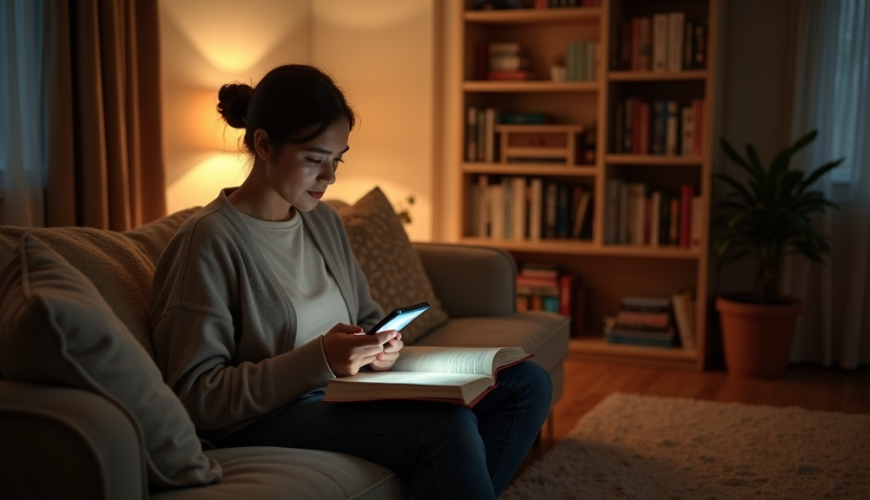
Over the past few years, digital screens have subtly transformed from a useful tool into the backdrop of nearly everything we do. The phone lies on the table like an extended hand, the computer is a gateway to work and entertainment, and the evening often concludes with a series on the tablet. It's no wonder that the question of how to reduce screen time is increasingly being asked, without feeling disconnected from the world. And perhaps even more important is the second question: why is it important to limit screen time when so many things are "just online" today?
The topic has a pleasant attribute: it doesn't require a radical digital detox or life without technology. For most people, it helps to return screens to their rightful place—as a service, not as the default mode. And this is where practical tips on how to spend less time on screens come in, which can be implemented gradually and without grand gestures.
Try our natural products






Why It's Important to Limit Screen Time – and What It Does to the Body and Mind
Time spent on screens is not automatically "bad" in itself. It depends on what happens on them, at what time of day, and how much space it takes away from sleep, movement, relationships, or plain boredom, which is surprisingly important for creativity. The problem arises when screen time starts to creep up: a few minutes in the morning with the news, a quick scroll during breakfast, work emails, social media "on break," evening video, and finally a swift phone check in bed. The result is often more hours than one would guess.
The Impact of Screen Time on Physical Health
The most visible impact is on movement. When free time is filled with screens, the body notices: less walking, fewer natural posture changes, more sitting. Long sitting is associated with a higher risk of various health issues, and although not everything can be blamed on the phone, long hours without movement are simply challenging for the body.
Problems with the neck and back are also common, as screens encourage forward leaning. The so-called "text neck" is not a trendy invention—the cervical spine takes a hit from prolonged downward gazing. It can add tension in the shoulders, headaches, or stiffness. And then there are the eyes: dry eyes, burning, blurred vision, fatigue. This isn't moralizing; it's simple biology—when focusing on a display, we blink less, and eyes are overstrained.
A special chapter is sleep. Screens in the evening often shorten sleep time (because of "just one more video") and can also worsen falling asleep. Blue light and mental stimulation from content push the body into an alert mode, and when repeated, one can easily fall into a cycle: poor sleep → more fatigue → more passive scrolling → more poor sleep. Sleep, in turn, is one of the most important "biohacks" that cost nothing.
For credible context, one might refer to information on sleep and light from the [Sleep Foundation] or general recommendations on healthy movement and sedentary behavior from [https://www.who.int/].
The Impact of Screen Time on Mental Health and Well-being
The psychological aspect is subtler but more frequent. Screens offer quick rewards: new messages, notifications, short videos, endless feed. The brain gets accustomed to this "micro-entertainment," making it harder to switch to focus mode where rewards don't come immediately. It's no coincidence that many people describe being distracted, having a reduced ability to read longer texts, or feeling like their head "can't switch off."
Added to this is social media comparison, which can worsen mood and self-esteem, especially during challenging times. And while digital contact can be supportive, it often happens that a screen fills the time that would otherwise belong to true relaxation or personal meetings. The result can be a paradoxical mix: a lot of stimuli but little genuine satisfaction.
Sometimes a simple sentence can serve as a compass: "Technology is a great servant but a bad master." It's not about getting rid of it, just about resetting boundaries.
How to Reduce Screen Time Without Drama: Small Changes That Add Up
When limiting screens is mentioned, many imagine strict rules, a phone ban after six, or a weekend without the internet. Yet a more effective approach often considers reality. Work is often online, transportation is planned through apps, and family communicates in groups. The goal is not "less technology" but more conscious use.
It's good to start with a map: when does a screen truly serve, and when does it merely fill silence? For most people, a few typical "black holes" will emerge—morning after waking, short breaks during the day, waiting, evening in bed. It's there where the biggest difference can be made with the least effort.
A Morning Start Without a Phone as a Quiet Reset
The first 20–30 minutes after waking up often set the tone for the whole day. Starting the day with notifications immediately switches the brain to reaction mode. Starting with water, a short stretch, breakfast, or an open window tunes the body and mind more calmly. It's not about the ideal, just a shift: instead of automatic scrolling, initially giving the phone a smaller role.
A small help: not charging the phone overnight next to the bed but a few steps away. Those few steps often make the difference between "automatically reaching" and "having to decide."
Notifications: The Simplest Lever for Less Screen Time
Notifications are invitations to interruption. And interruption is precisely what extends screen time. When the phone beeps, one checks one thing—and ten minutes later returns with the feeling that time has disappeared.
Basic hygiene is to keep only what's really important turned on (e.g., calls, messages from family, possibly a work channel at a certain time). The rest can wait. For many apps, it makes sense to switch notifications to summaries or turn them off completely and check them consciously, maybe twice a day.
Remove "Automatic" Apps From the Screen
Many people are surprised by how much a simple change of environment works. Social media and entertainment apps only need to be moved from the home screen to a folder or to another page. Even more effective is logging out, so logging in takes a small effort. It's not a punishment but inserting a short pause between impulse and action.
Another subtle trick: switching the phone to grayscale mode. Colorful icons and animations are designed to attract attention. When the colors disappear, part of the charm is lost, and "just because" one reaches for the phone less often.
The One Screen Rule and One Time for News
Multitasking looks efficient, but it often just increases fatigue. Eating while watching a video, replying to messages while watching a series, browsing emails during a conversation—all these extend screen time and worsen the ability to be calm. A simple rule helps: one activity at a time. When it's time to eat, it's eating. When it's time for news, it's time for news.
With news, it proves useful to set "windows"—for example, in the morning, after lunch, and in the evening. Most people quickly find that the world won't collapse if they don't respond in five minutes. And the mind relaxes because it doesn't have to be constantly on alert.
A Real Example: What 30 Minutes a Day Can Do
Imagine a common situation: a person works on a computer, is tired in the evening, and takes a phone "to switch off." The scrolling is meant to be short but often stretches out. A couple from the city resolved this subtly: after dinner, they implemented a rule that the phone stays on the shelf in the hallway, and in the living room, there's only music or a book. Not every evening, just three days a week. The result? Not only did screen time decrease, but small things returned: longer conversations, a quick walk around the house, better sleep. When summed up after a month, it was several hours a week that previously disappeared "without a trace." And that's often the biggest motivator—seeing that time wasn't lost, it just shifted to something that truly recharges.
Practical Tips for Less Screen Time That Can Be Implemented Immediately
There's no need to do everything. Just choose two or three changes that best fit your lifestyle and give them a week. If they prove successful, add more. Below is a single list—brief but usable.
Specific Steps to Reduce Screen Time
- Set a "screen-free" zone: the bedroom or dining table, where the phone simply doesn't belong.
- Implement an evening limit: for instance, the last 45–60 minutes before sleep without social media and videos; instead, a shower, reading, or calm music.
- Use timers on your phone: limits for selected apps (social media, videos), not as a ban but as a reminder.
- Replace "waiting scroll": while waiting in public transport or in line, try a podcast, a few pages of a book, or simply observing your surroundings. Boredom is sometimes healing.
- Give your body counter-movement: after every 30–45 minutes on a screen, get up, stretch your chest and neck, walk around the apartment.
- Turn off autoplay on videos: "next episode" and "next video" are designed to keep you from stopping.
- Have physical alternatives at home: a book on the table, a paper pad, a card game, a puzzle. When the alternative is at hand, it's easier to reach for it.
When discussing healthier habits, it often helps to think about the environment too. A household can be set up to support relaxation: warm light in the evening, a comfortable place for reading, a water bottle on the table instead of a phone in hand. And since Ferwer operates in the world of sustainable and healthy choices, it makes sense to remind that limiting screen time isn't just "digital discipline," but a return to small everyday rituals—movement, sleep, calm, and interpersonal closeness.
Perhaps it's ultimately simpler than it sounds: it's not about being constantly productive or a "perfect offline person". It's about ensuring screens don't engulf moments meant for regeneration. And when you manage to reduce even just half an hour a day, both body and mind usually notice faster than one would expect—in easier falling asleep, less eye strain, calmer attention, and also in the fact that space for things that never quite fit into a display reappears in the day.