

Cold soups from around the world will refresh you better than ice cream
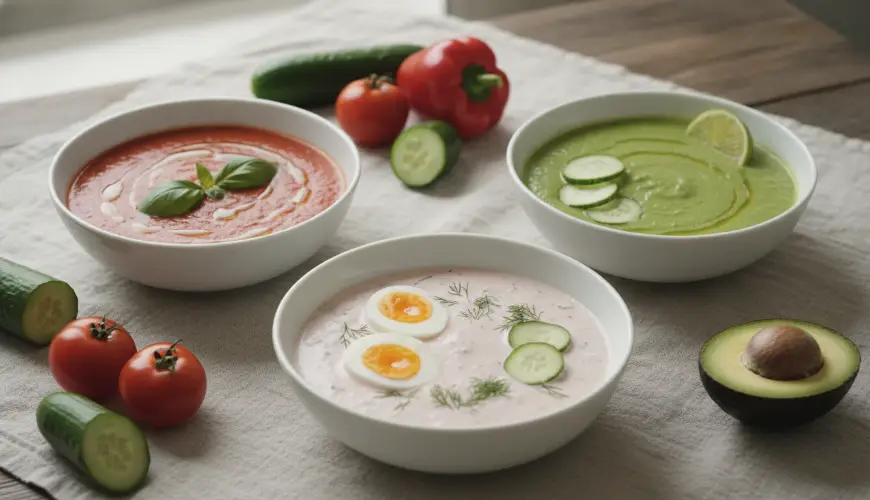
When the thermometer climbs to thirty degrees and the thought of hot soup provokes horror rather than appetite, one of humanity's oldest culinary inventions comes into its own – cold soup. It may sound like a paradox, but chilled soups are among the most refined dishes in world cuisine. This is no modern fad or trendy Instagram kitchen phenomenon. Cold soups have roots going back thousands of years, and their recipes were developed in precisely the places where summer can be merciless – in Spain, Turkey, Japan, or Bulgaria, for instance.
Interestingly, chilled soups are not only refreshing but also nutritionally rich. Because most ingredients are either not cooked at all or only minimally processed, vitamins and enzymes are preserved in their natural form. This makes them an ideal choice for those who want to eat lightly in summer without missing out on nutrients. And as a bonus? Preparation is in most cases quick, undemanding, and doesn't even require turning on the stove.
Try our natural products






Gazpacho and Company: Classics That Have Stood the Test of Time
The world's most famous cold soup is undoubtedly the Spanish gazpacho. It originates from Andalusia, the southernmost part of Spain, where summer heat is no exception and temperatures regularly exceed forty degrees. The recipe is fundamentally simple: ripe tomatoes, cucumber, red pepper, garlic, olive oil, vinegar, and a little bread for thickening. Everything is blended smooth, chilled in the refrigerator, and served with small cubes of vegetables or croutons. The result is surprisingly filling, yet light and refreshing.
What makes gazpacho exceptional is its flexibility. There are dozens of regional variants – salmorejo from Córdoba is thicker and creamier, served with hard-boiled egg and slices of jamón ham. Ajo blanco, the so-called white gazpacho, is made from almonds, garlic, and grapes and has a distinctly different, gently sweet flavour. Each of these variants tells the story of the place where it was created and the ingredients that were at hand.
A similar logic – using local ingredients and outsmarting the heat through chilling – is followed by the Bulgarian tarator. This soup is built on yoghurt, cucumber, garlic, dill, and walnuts. Bulgarian yoghurt is key here: its naturally sour, thick consistency gives the soup its characteristic base. Tarator is eaten in Bulgaria practically every day in summer, and in many families it is literally a compulsory part of the summer menu. A similar variant can be found in Turkish cuisine under the name cacık, where the yoghurt is diluted with water and flavoured with mint.
Moving from the Mediterranean to Central Europe, we encounter the traditional chłodnik – a Polish cold soup made from beetroot and kefir or buttermilk. Its distinctive pink colour is unmistakable, and the taste is pleasantly sour with a gentle earthiness from the beetroot. Chłodnik is typically garnished with a hard-boiled egg, fresh dill, and radishes. It is a soup that looks like a work of art on the plate, yet can be prepared in less than twenty minutes.
Inspiration from Asia and the Americas: Fresh Perspectives on a Cold Bowl
Asian cuisine approaches cold soups somewhat differently. The Japanese hiyajiru – literally "cold soup" – is a light broth made from miso paste, tofu, cucumber, and sesame, served poured over hot rice. The temperature contrast is intentional and forms part of the culinary experience. Hiyajiru originates from the Miyazaki region on the island of Kyushu and is a typical summer dish of Japanese farmers, who needed quick, nutritious, and cooling food in the middle of a working day. As the Japan Times describes, food in Japanese culture is closely tied to the season, and hiyajiru is one of the most authentic expressions of summer cuisine.
From Spain, let us jump to Mexico, where aguachile is prepared – a spicy cold soup made from shrimp marinated in lime juice, chilli, cucumber, and red onion. Technically it is a dish on the border between soup and ceviche, but in Mexican cuisine it is commonly classified as a soup. The acid from the lime "cooks" the shrimp without heat in a process called protein denaturation, so the result is fresh, mildly spicy, and full of contrast. Aguachile is a demonstration of how sophisticated food can be prepared from seafood without a single minute of cooking.
Then there is the French vichyssoise – a creamy soup made from potatoes and leeks, served chilled and garnished with chives. Interestingly, vichyssoise was most likely created in New York, where it was devised in 1917 by French chef Louis Diat at the Ritz-Carlton hotel. He drew inspiration from a soup his mother had made for him in childhood, and added the idea of serving it cold. Today, vichyssoise is a symbol of elegant summer cuisine and proof that even a "heavy" potato soup can be surprisingly light and delicate when served chilled.
Our seventh stop on this culinary journey is the Spanish-American gazpacho verde, or green gazpacho, which has been experiencing a major boom in recent years. Instead of tomatoes, it uses avocado, cucumber, spinach, lime, and jalapeño pepper. The resulting soup is a rich green, creamy, and full of healthy fats from the avocado. It is a modern variant that respects traditional principles while adapting them to contemporary tastes and available ingredients.
How to Prepare Cold Soups at Home and What to Keep in Mind
Preparing cold soups is genuinely simple in most cases, but a few principles are worth mentioning. The quality of ingredients plays a key role – because many ingredients are not cooked, their flavour is entirely dominant in the finished dish. An unripe or watery tomato simply cannot save a gazpacho. The same applies to the yoghurt in tarator or the avocado in green gazpacho.
Another important factor is time. Most cold soups taste best after at least an hour in the refrigerator, during which the flavours meld and the soup chills properly. Gazpacho prepared in the evening and served the following day at lunch is usually significantly better than one that is blended and immediately served. As the Spanish saying goes: "El gazpacho tiene que dormir" – gazpacho must sleep.
Serving is just as important as preparation. Cold soups are served in pre-chilled bowls or glasses, ideally with small garnishes – a drizzle of olive oil, a leaf of fresh herbs, or a pinch of quality salt. It is precisely these final touches that elevate home preparation to a gastronomic experience.
Those who want to approach cooking cold soups more systematically can find inspiration in publications such as BBC Good Food, where hundreds of tested recipes with ratings from real cooks are available. Their gazpacho recipe has long been among the most popular summer recipes on the entire portal.
A practical example? Imagine you are hosting a summer garden party. Instead of the classic barbecue and warm side dishes, you place four different cold soups in glass carafes on the table – red gazpacho, white ajo blanco, pink chłodnik, and a green avocado variant. Guests help themselves, combine, and taste. Preparation took an afternoon, the refrigerator did the rest of the work, and the result is visually stunning, delicious, and inexpensive. Such an approach to summer entertaining is also sustainable – it requires no energy-intensive cooking and works with fresh, seasonal vegetables.
Cold soups are in fact a perfect example of how different cultures around the world responded to the same problem – summer heat and the need for light, nutritious food – each in its own way. The Spanish reached for tomatoes and olive oil, the Bulgarians for yoghurt and dill, the Japanese for miso paste and tofu, the Mexicans for citrus and chilli. And yet all these soups share a common foundation: respect for ingredients, simplicity of preparation, and the ability to bring relief in the greatest heat. That is a culinary wisdom that needs no translation.