
Aquafaba or chickpea liquid will replace eggs in baking
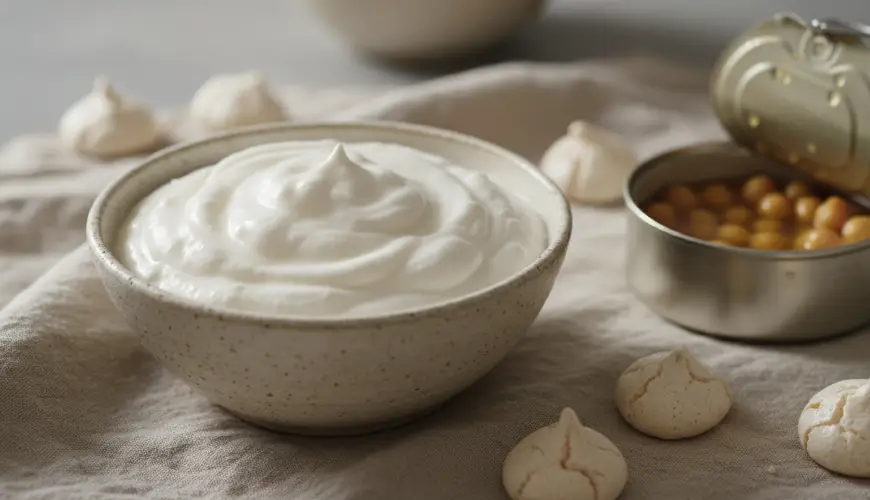
Most people who open a can of chickpeas do the same thing – they pour the liquid down the drain and forget about it. Yet this unassuming, slightly cloudy water contains properties that have sparked a small revolution in plant-based cooking among chefs and pastry cooks around the world. Aquafaba, as this liquid is technically called, is today one of the most interesting ingredients discussed in connection with vegan and egg-free cuisine – and it certainly deserves more attention than just being treated as can waste.
The name itself comes from Latin: aqua means water and faba means bean. The combination literally means "bean water", even though in practice the liquid from chickpeas is most commonly used, as it has the most neutral flavour and the best functional properties of all legume liquids. Aquafaba can of course be obtained from other legumes – from beans, lentils or white cannellini beans – but none of them come close enough to chickpeas in terms of baking and whipping results.
Try our natural products

Why does aquafaba work as an egg substitute?
The fascinating behaviour of aquafaba is driven by chemistry that is entirely natural. When chickpeas are cooked (or industrially processed in a can), a mixture of proteins, starches and saponins – natural surfactants capable of stabilising foams and emulsions – passes into the water. It is precisely this combination that causes chickpea liquid, once whipped, to behave surprisingly similarly to egg whites. The proteins in aquafaba create a stable network structure during mechanical aeration, which traps air bubbles and maintains volume – exactly as eggs do in classic pastry making.
Scientific research on this topic is relatively young. Aquafaba as an egg substitute was "discovered" in 2014 by French musician and cook Joël Roessel, who was experimenting with plant-based cuisine and found that chickpea liquid could be whipped into a stiff foam. A year later, American software engineer Goose Wohlt developed this discovery further and published a recipe for vegan meringues that immediately went viral. Since then, aquafaba has gained its own community of enthusiasts, scientific studies and entire cookbooks.
From a nutritional science perspective, it is interesting to note that although aquafaba comes from a legume rich in protein, the liquid itself contains relatively little – approximately 3–5 grams per 100 millilitres. It is therefore not a valuable source of protein as such, but its technological function in the kitchen is undeniable. The World Health Organization and professional nutritional institutions have repeatedly emphasised that legumes as a whole are among the healthiest sources of plant protein and fibre, so working with chickpeas in the kitchen makes sense from an overall lifestyle perspective as well.
The practical uses of aquafaba extend far beyond meringues and kisses. It is whipped into mousses, used as a binder in vegan burgers, replaces eggs in pancakes, quiches or muffins, and can even be used to make vegan mayonnaise and aioli. The approximate rule most commonly cited by pastry cooks and chefs states that two tablespoons of aquafaba correspond to approximately one egg white and three tablespoons to a whole egg. This simple substitution opens the door to plant-based baking even for those who previously believed that a quality pastry simply cannot be made without eggs.
How to prepare perfect vegan pastries from aquafaba
Theory is one thing, practice is another. Those trying aquafaba for the first time are often surprised by how long it takes for the liquid to actually whip into a firm foam. While egg whites become stiff in two to three minutes, aquafaba needs an average of eight to fifteen minutes of whipping with an electric mixer. The result is worth the patience, however – a glossy, fluffy foam that is visually almost indistinguishable from classic meringue.
Take Markéta, a thirty-year-old woman from Prague who decided two years ago to reduce animal products in her diet. For Christmas, she wanted to make traditional walnut slices but did not want to use eggs. She came across a recipe using aquafaba, sceptically opened a can of chickpeas and poured the liquid into a bowl instead of down the drain. "I didn't believe anything edible would come of it," she recalls. The result surprised her so much that she now uses aquafaba regularly and buys cans of chickpeas specifically to have a supply of the liquid – the chickpeas themselves then go into soup or salad.
For aquafaba to work as well as possible, there are several practical rules to follow. First and foremost, the consistency of the liquid matters – if it is too thin, it can be briefly boiled and reduced, which increases the concentration of proteins and starches. The liquid should have approximately the consistency of egg white – slightly viscous, not watery. It is also important that the bowl and whisk attachments are completely clean and free of any traces of fat – any fat will disrupt foam formation, just as with classic egg whites. Adding a small amount of cream of tartar (tartaric acid) significantly increases the stability of the foam and helps maintain volume during further processing.
When it comes to actual recipes, vegan meringues and kisses remain the most popular aquafaba treats. The process is simple: the whipped aquafaba foam is gradually sweetened with icing sugar until a thick, glossy mass forms that holds its shape. This is then shaped onto a baking sheet and dried in the oven at a low temperature – ideally around 90–100 degrees Celsius – for one to two hours. The resulting meringues are delicate, lightly caramelised and differ from the classic version only in that they contain not a trace of animal products.
Chocolate mousse made from aquafaba is another recipe that has won the hearts of vegan pastry cooks around the world. The whipped foam is gently folded into melted dark chocolate, the resulting mixture is left to set in the refrigerator, and the outcome is a dessert with a silky texture and intense chocolate flavour. As British chef and cookbook author Yotam Ottolenghi once wrote: "The best recipes are those that surprise with their simplicity while delivering results you wouldn't expect from such ingredients." Aquafaba perfectly fits this definition.
Beyond sweet cooking, vegan mayonnaise is also worth mentioning – it owes its creamy consistency to aquafaba. Unlike classic mayonnaise, where the emulsion is provided by egg yolk, here the role of emulsifier is taken over by saponins and proteins from the legume water. The resulting mayonnaise is lighter, lower in calories and completely free of cholesterol – and yet very close in taste to the original, especially when seasoned with mustard, lemon juice and a pinch of turmeric for colour.
The ecological dimension of using aquafaba is no less important. At a time when more and more people are interested in reducing food waste and taking a sustainable approach to cooking, aquafaba represents an elegant solution: instead of discarding liquid that would otherwise end up as waste, you transform it into a functional ingredient. According to data from the Food and Agriculture Organization of the United Nations (FAO), approximately one third of all food in the world ends up as waste – and precisely such small decisions in the home kitchen can contribute to solving this problem.
Chickpeas themselves are, moreover, one of the most ecologically efficient crops of all. Growing legumes enriches the soil with nitrogen, requires significantly less water than animal production and has a low carbon footprint. Making use of the water in which they were cooked or canned therefore makes perfect sense from both a sustainability and an economical cooking perspective.
For those who want to always have aquafaba on hand, the simplest approach is to regularly buy canned chickpeas – the liquid just needs to be strained and stored in a sealed container in the refrigerator for three to four days, or frozen in ice cube trays for later use. Those who prefer cooking from dried chickpeas can also prepare aquafaba from homemade cooking liquid – in that case, however, it is important to reduce the liquid sufficiently after cooking, as it tends to be thinner than that from a can.
Is aquafaba truly capable of replacing eggs in all situations? The honest answer is: not always and not completely. In recipes where eggs primarily serve as a binder and add rich flavour – such as a classic omelette or scrambled eggs – aquafaba naturally falls short. But in the realm of baking, whipping and creating light desserts, its performance is surprisingly close to the original. And for plant-based or egg-free cooking, it represents one of the most accessible and affordable ways to achieve results that would otherwise not be possible without eggs.
The liquid from chickpeas thus ceases to be mere can waste and becomes a fully-fledged kitchen ingredient – accessible, sustainable and surprisingly versatile. You just need to remember, next time, not to reach for the drain.