
# How to Prepare an Older Sibling for a Baby
When a pink or blue line appears on a pregnancy test in a family, a wave of euphoria, planning, and dreaming about the future begins. But in the midst of it all, there's someone else – a little person who until now has been the center of the universe and whose world is about to undergo a tectonic shift. Preparing an older sibling for the arrival of a baby is one of those things that reads nicely in parenting guides, but in practice, the situation tends to be considerably less Instagram-worthy. This is a guide without illusions – because honesty is the best thing you can offer your child (and yourself).
Most parents envision an idyllic moment when the older sibling gently strokes the belly and says: "I'm so excited about the baby." And sometimes that actually happens. Other times, though, you're more likely to hear: "Can we return it?" or even better – complete silence accompanied by a look that could melt steel. Both are perfectly normal. Child psychologist and author of Siblings Without Rivalry Adele Faber once noted that the best preparation for a sibling isn't painting a rosy picture of the future, but creating space for all emotions – including the unpleasant ones. And this is precisely where most well-intentioned advice fails, because it focuses on how to get the child excited rather than helping them process what they actually feel.
Let's start with the most important thing – timing. Children don't have the same relationship with time as adults. For a two-year-old, "in five months" is just as abstract a concept as "in a million years." That's why there's no point in announcing the pregnancy too early and then spending months answering the question "When is the baby coming?" which will be repeated approximately one hundred and thirty times a day. For toddlers and preschoolers, it's proven effective to wait roughly until the second trimester, when the belly is visible and the child has something to anchor their imagination to. For older children, say from age six and up, it's better to share the news earlier, because school-age kids are masters at catching whispered conversations and unfinished sentences, and the feeling that something is being hidden from them can hurt more than the news itself.
When the right moment arrives, it pays to be specific and honest. Sentences like "You'll have a playmate" sound lovely but are essentially lies – a newborn won't play, won't communicate, and will spend most of their time crying, sleeping, or eating. It's much fairer to say something like: "The baby will be very small at first and will need a lot of care. It will cry because that's the only way it knows how to say what it needs. And we will still love you exactly the same." It sounds simple, maybe even banal, but children need to hear that last sentence – repeatedly and in various forms. Not once during a ceremonial announcement, but again and again, because doubts come in waves.
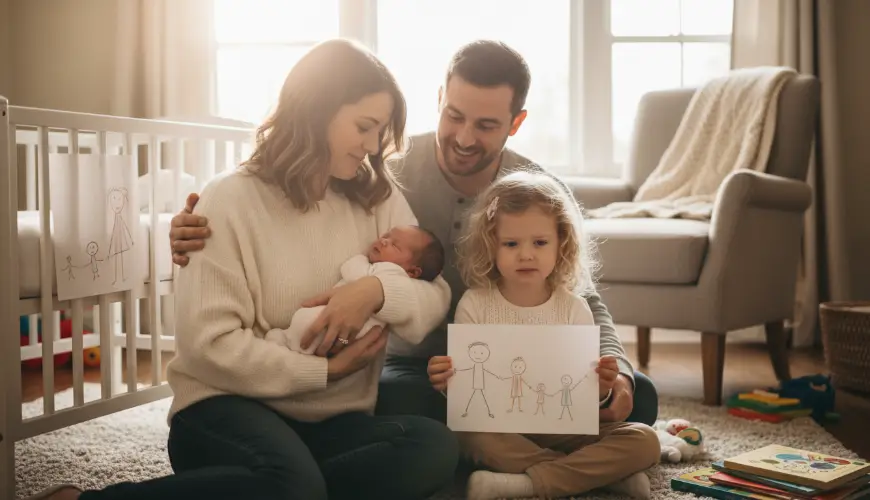
An interesting strategy is described by child psychologist Dr. Laura Markham on her website Aha! Parenting, where she recommends involving the older sibling in preparations in a way that matches their age and interests. It's not about having the child pick the color of the nursery (although why not), but rather about giving them a sense that they have a role in the whole process. A three-year-old girl can "help" sort clothes for the baby. A five-year-old boy can draw a picture to hang above the crib. A seven-year-old can choose a stuffed animal that the baby will receive "from her." These small rituals aren't just cute – they have deep psychological significance because they give the child a sense of control in a situation that is inherently uncontrollable.
And now let's look at something that's discussed less often – jealousy. Because it will come. Maybe not right away, maybe not in the expected form, but it will come almost certainly. Imagine for a moment that your partner came home and said: "Honey, I have great news – another woman is moving in with us, we're going to love her, and you'll share everything you have with her." Absurd? Of course. But for a small child, the arrival of a sibling is an emotionally very similar experience. This comparison, first used by Adele Faber herself, is a bit provocative, but it brilliantly illustrates why childhood jealousy is a completely legitimate reaction, not a sign of bad parenting.
Try our natural products





How to Handle the First Days and Weeks After Birth
The older sibling's first meeting with the baby is a moment worth preparing for, but at the same time there's no point in directing it down to the last detail. Some maternity hospitals allow sibling visits, others don't – in any case, it's good for the first contact to take place in a calm environment, ideally without an audience of ten relatives tensely watching and commenting on the reaction. A practical tip that circulates among experienced parents and is also supported by professional literature: when the older child comes to visit, have the baby placed in the crib, not in your arms. That way, mom can first hug her firstborn and only then "discover" the newborn together. It's a small thing, but for a child who may not have seen their mom for several days, it means the world.
Then come the days at home and with them, reality. The newborn demands attention every two hours, mom is exhausted, dad is trying to keep up with everything, and the older sibling suddenly discovers that this famous new addition doesn't actually bring much fun. This is when a period begins that could be called the disillusionment phase – and it's absolutely crucial to get through it without panic. Behavioral regression in older siblings is common and well-documented. A child who was long out of diapers suddenly wants diapers back. A four-year-old who could eat with utensils starts eating with his hands. A six-year-old who slept through the night starts waking up crying. These are all ways a child tests whether they are still loved and whether there's enough room left for them.
Parents' reactions in these moments shape the entire sibling dynamic for years to come. Reproaches like "But you're a big kid now" are understandable in moments of total exhaustion, but they have exactly the opposite effect of what's intended – they reinforce the child's belief that being big means being pushed aside. It's much more effective to name the emotion: "I can see you're feeling sad. You miss it when I'm always with the baby, don't you? Come on, let's spend some time together, just the two of us." This technique, which psychologists refer to as emotional validation, is according to the American Academy of Pediatrics one of the most effective tools for managing sibling rivalry.
A real-life example: Karolína, mother of three-year-old Matěj and newborn Eliška, described in a parenting forum a situation where Matěj, after arriving home from the hospital, took a stuffed bear and threw it into the crib saying, "That's for the baby, I don't need stuffed animals anymore." It sounded touching, but a week later Matěj began systematically hiding all his toys under the bed so the "baby couldn't take them." Instead of punishing him, Karolína introduced a simple system – Matěj got one shelf where he could put things that were "only his" and no one was allowed to touch them. This simple act of respecting boundaries dramatically reduced tension in the household. A child needs to know that the arrival of a sibling doesn't mean losing everything they had.
A Long-Term Perspective on the Sibling Relationship
It's tempting to measure the success of sibling preparation by the first few weeks. But a real sibling relationship is built over months and years, not days. And it's paradoxically built more in moments when parents aren't present than in those staged moments of "hand the baby the pacifier." Research published in the journal Child Development repeatedly shows that the quality of the sibling relationship correlates much more strongly with the overall emotional climate in the family than with specific preparatory techniques. In other words – if the parents feel good, if they communicate openly, and if there's room in the household for all emotions, siblings will find their way to each other.
That doesn't mean preparation is pointless. It has enormous value – but not as a one-time project with a clear beginning and end, rather as an ongoing process of listening and adapting. Some children need more physical contact with their parents, others need more verbal reassurance. Some process change through play, others through drawing, and still others through bedtime conversations. A universal guide doesn't exist, and anyone who claims otherwise is probably selling a book.
What works almost universally, though, is dedicated time just for the older sibling. It doesn't have to be anything grand – fifteen minutes of reading before bed, a walk to the playground together while the other parent watches the baby, or simply sitting over hot cocoa and talking about what happened at preschool. These moments are like an oxygen mask on an airplane for the older child – and just like on an airplane, the rule applies that you need to put yours on first before helping others. Parents who feel guilty about every minute spent out of the newborn's reach paradoxically weaken the entire family structure.
It's also worth mentioning the role of the extended family and wider circle. Grandparents, aunts, uncles, and family friends have a natural tendency to come visit and rush to the newborn's crib while the older child stands off to the side. A simple agreement – "when you arrive, greet Matěj first and ask him what's new" – can have a surprisingly big impact. It's not about ignoring the baby, but about making sure the older sibling doesn't feel like they've become invisible.
As a final thought, let's allow ourselves one that goes against the grain of most parenting guides: it's perfectly okay if the older sibling doesn't love the baby at first. Love between siblings isn't automatic and isn't conditional on sharing DNA. It's a relationship that is built, and like any relationship, it goes through phases of excitement, disappointment, conflict, and – with a bit of luck and a lot of patience – deep bonding. The parental role in this process isn't to be a director, but rather a gardener who prepares the soil, waters it, and then patiently waits.
The arrival of a second child is one of the biggest transformations a family goes through. It's not always beautiful, it's not always easy, and it's certainly not always according to plan. But with honesty, patience, and a willingness to accept even the unpleasant emotions, it can turn into something that one day – perhaps twenty years from now at the Christmas table – you'll see as one of the best gifts you ever gave your children. Not perfect, but real.