

# Resistant Starch and Its Impact on Gut Health
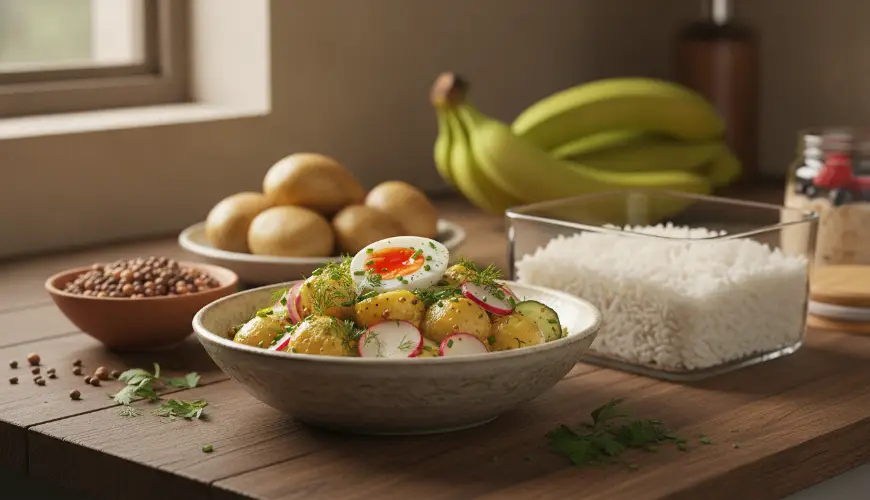
Imagine having warm potatoes with a vegetable salad for lunch. They're tasty, they fill you up, and you think you've made a healthy decision. And you're right – but what if we told you that those same potatoes, served cold the next day, would do even more for your gut? It sounds like food magic, but behind this effect lies a completely real and fascinating substance: resistant starch.
Resistant starch is no trendy invention of alternative nutrition. It's a well-documented phenomenon that scientists have been studying for decades, and its benefits for digestive health are supported by solid research. Yet most people have never heard of it – or perceive it as something complex and out of reach. In reality, it's literally within arm's reach, specifically in a pot of cooked and cooled potatoes or rice.
Try our natural products




What resistant starch actually is and why the body loves it
Starch is essentially a long chain of glucose molecules that forms the primary energy source in carbohydrate-rich foods. Most starches are quickly broken down into simple sugars in the small intestine and absorbed into the bloodstream. This is a standard process familiar to anyone who has ever taken an interest in the glycemic index of foods. Resistant starch works differently – as its name suggests, it resists digestion in the small intestine and travels further, all the way to the large intestine, where its real work begins.
There, trillions of microorganisms forming the gut microbiome are waiting for it. For them, resistant starch is literally a feast. They ferment it, and as by-products of this process, short-chain fatty acids are produced – particularly butyrate, acetate, and propionate. And butyrate is the substance that has been attracting significant scientific attention in recent years – it is the primary energy source for the cells lining the large intestine and plays a key role in maintaining a healthy gut barrier. Research suggests that sufficient butyrate production may contribute to the prevention of inflammatory bowel diseases and to reducing the risk of colorectal cancer.
In this sense, resistant starch acts as a prebiotic – that is, as food for beneficial bacteria, rather than as a probiotic that would itself supply these bacteria. This distinction is important. While probiotics (live cultures found, for example, in yoghurts or fermented foods) add new microorganisms to the gut, prebiotics nourish those that are already there. And well-nourished gut bacteria are the foundation of a functioning immune system, good mood, and overall metabolism.
Interestingly, different types of resistant starch occur naturally in different foods – in unripe bananas, in legumes, in whole grains. But one of the most interesting types, designated as RS3 or retrograde resistant starch, is formed precisely during the cooking and subsequent cooling of starchy foods. And that is the moment when potatoes and rice enter the picture.
Cold potatoes and rice: a kitchen trick with a scientific basis
When potatoes or rice are cooked, heat disrupts the structure of the starch granules, which swell and soften – which is why cooked potatoes are soft and digestible. But once they are left to cool, some of the starch undergoes a process called retrogradation: the starch molecules rearrange themselves into a firmer, crystalline structure that is more resistant to digestive enzymes. This transformed form is precisely the third type of resistant starch.
This effect is not negligible. Studies published in scientific journals show that the resistant starch content in cooked and cooled potatoes can be significantly higher than in freshly cooked potatoes. A similar effect has been observed with cooked rice – research published in 2015 in the journal Food Chemistry demonstrated that rice cooked with coconut oil and subsequently cooled contained up to ten times more resistant starch than freshly cooked rice. While specific results vary depending on the type of rice and preparation method, the principle remains consistent.
The good news is that retrogradation is largely preserved even after reheating. So if you reheat cold potatoes or rice – for example in a soup, in a pan, or in a microwave – some of the resistant starch will remain. You don't necessarily have to eat cold potato salad to benefit from this effect, although potato salad is actually one of the nutritionally more interesting side dishes in terms of resistant starch content.
Let's take a concrete example from everyday life: Jana, a working mother of two, cooks a larger batch of rice and potatoes every Sunday. She puts the leftovers in the fridge and throughout the week adds them to salads and soups, or reheats them as a side dish. Without realising it, she consumes foods with a higher resistant starch content throughout the week – and at the same time naturally lowers the glycemic index of her meals, because resistant starch slows the absorption of sugars into the bloodstream.
How resistant starch affects blood sugar levels and weight
This is where we come to another fascinating aspect of the story. Resistant starch has a demonstrably lower glycemic index than its digestible counterparts. This means that foods rich in resistant starch cause a slower and more gradual rise in blood sugar levels after a meal. For people with insulin resistance, prediabetes, or type 2 diabetes, this finding can be extraordinarily important.
Research referenced by, for example, the Harvard T.H. Chan School of Public Health, shows that regular consumption of fibre and resistant starch is associated with improved insulin sensitivity and stabilisation of blood glucose levels. Resistant starch behaves somewhat like soluble fibre – it slows the passage of food through the digestive tract, thereby prolonging the feeling of satiety. People who eat foods with a higher resistant starch content tend to eat less at their next meal because they feel full for longer.
As Michael Pollan, an American journalist and writer focusing on food, once noted: "We eat too much, too quickly, and too processed. The best diet is one that requires no diet at all." Resistant starch is precisely this kind of natural tool – it requires no special dietary supplement, no expensive "superfood", just a slightly different approach to what we already have in the kitchen.
As for the effect on body weight, a direct causal relationship is still the subject of research. However, the combination of a lower glycemic index, prolonged satiety, and a positive effect on the gut microbiome creates conditions that may contribute to maintaining a healthy weight in the long term. It's not a miracle solution, but it is a solid building block of a balanced diet.
How to naturally incorporate resistant starch into your diet
Incorporating resistant starch into everyday eating is surprisingly simple and requires no dramatic changes to your diet. It's enough to slightly rethink how we handle foods we already consume regularly.
A basic overview of foods with a naturally higher resistant starch content:
- Cooked and cooled potatoes – ideally as the basis of a potato salad or a cold side dish
- Cooked and cooled rice – great in salads or as the base of Asian dishes prepared the day before
- Cooked legumes – lentils, chickpeas, beans, and peas are among the richest natural sources
- Unripe bananas – naturally contain high amounts of resistant starch, which converts to regular sugar as they ripen
- Oat flakes – especially those soaked overnight in cold water (so-called overnight oats)
- Whole grain cereals – barley, rye, and whole wheat naturally have a higher proportion of resistant starches
The key is not any extreme diet, but rather a conscious use of what happens to foods during their preparation and storage. Cooking larger quantities of rice or potatoes for several days ahead is also practical from a time-saving perspective – and as we can see, it also brings a not insignificant nutritional bonus.
It is also good to proceed gradually. The gut microbiome needs time to adapt to a higher intake of fermentable fibres. A sudden increase in resistant starch intake can, in some people, temporarily cause bloating or flatulence – this is a normal reaction that typically subsides as the gut bacteria adapt to their new "menu". Starting with smaller portions and gradually increasing them is therefore a sensible approach.
This entire area of research reminds us that healthy eating does not have to be complicated or expensive. Sometimes it's enough to let the potatoes cool overnight and the next day prepare a salad from them with a mustard dressing, some vegetables, and an egg. Such a meal is not only tasty and filling, but also exceptionally friendly to the billions of microorganisms that work in our defence every day – and about whom most of us only think when our stomach hurts. Perhaps it's time to start paying attention to them sooner.